
Antimatter: The Mirror World of Physics
From the discovery of the positron to the mysteries of the universe

Antimatter: The Mirror World of Physics
From the discovery of the positron to the mysteries of the universe
In 1932, something extraordinary happened in physics. While studying cosmic rays with a cloud chamber, the American physicist Carl Anderson noticed unusual tracks that did not match any known particle at the time. These tracks revealed a particle with the same mass as the electron, but carrying a positive charge instead of a negative one. Anderson had just discovered the positron—the first known particle of antimatter.
This moment marked a turning point in science. Until then, antimatter existed only as a prediction in the equations of quantum theory, particularly in the work of physicist Paul Dirac, who had suggested in 1928 that every particle must have a mirror opposite: an antiparticle. The positron was the first experimental proof that Dirac’s strange idea was real.
What is Antimatter?
At its core, antimatter is simply the mirror image of matter. Every fundamental particle we know—electrons, protons, neutrons, neutrinos—has a corresponding antiparticle:
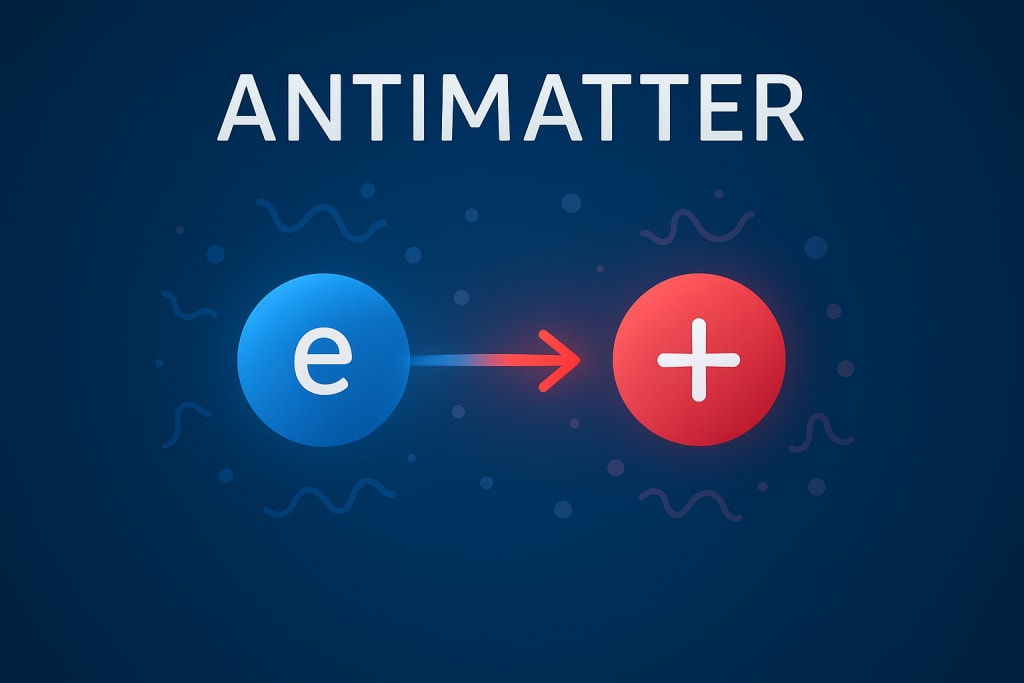
Electron (e⁻) ↔ Positron (e⁺)
Proton (p) ↔ Antiproton (p̅)
Neutron (n) ↔ Antineutron (n̅)
Neutrinos (ν) ↔ Antineutrinos (ν̅)
The only difference lies in certain properties, most famously electric charge. A positron, for example, has the same mass as an electron but the opposite charge.
When a particle meets its antiparticle, they annihilate each other, releasing pure energy in the form of high-energy photons. This process makes antimatter not only fascinating, but also extremely powerful.
Antimatter in the Standard Model
According to the Standard Model of particle physics, the universe is built from two families of building blocks: quarks and leptons, plus force-carrying particles called bosons.
Leptons include the familiar electron, along with heavier cousins (the muon and the tau) and three types of neutrinos. Each one has an antiparticle.
Quarks, which combine to form protons and neutrons, also have their own antiparticles (called antiquarks).
Even some bosons have antiparticles: the W⁺ and W⁻ bosons are each other’s opposites, while photons and gluons are their own antiparticles.
This elegant symmetry suggests that when the universe began with the Big Bang, it should have produced equal amounts of matter and antimatter. And yet, when we look around, everything we see—stars, planets, people—is made of matter. So where did all the antimatter go?
The Mystery of the Missing Antimatter
This is one of the deepest puzzles in modern physics. If matter and antimatter were created in equal amounts, they should have completely annihilated each other, leaving behind only radiation. Clearly, that didn’t happen, because we are here.
Physicists call this problem matter-antimatter asymmetry. Something in the early universe tipped the balance slightly in favor of matter. Even if only one extra particle of matter survived for every billion particle-antiparticle pairs, that tiny excess would be enough to build the entire visible universe today.
The exact reason remains unknown. Experiments at places like CERN in Switzerland and Fermilab in the United States are trying to uncover subtle differences in the behavior of particles and antiparticles—differences that might explain why matter triumphed.
Creating Antimatter on Earth
Antimatter is not just a cosmic mystery; it is also something scientists can create—though in very small amounts. Using particle accelerators, researchers can produce antiparticles like positrons and antiprotons. These are then trapped using powerful magnetic fields, since antimatter cannot touch normal matter without annihilation.
At CERN’s Antiproton Decelerator, scientists have even managed to create and trap atoms of antihydrogen (an antiproton orbited by a positron). These atoms survive for fractions of a second, long enough to be studied.
But here’s the catch: producing antimatter is incredibly expensive and inefficient. By some estimates, it would cost about 62.5 trillion US dollars to make just one gram of antihydrogen. To put that in perspective, all the antimatter ever produced in laboratories so far amounts to only a few nanograms—far less than a single gram.
Uses of Antimatter
Despite the challenges, antimatter has real-world applications:
Medical Imaging (PET Scans)
Positrons are already used in hospitals. In a Positron Emission Tomography (PET) scan, radioactive substances emit positrons that annihilate with electrons, producing detectable gamma rays. Doctors use this to create detailed images of organs and tissues.
Space Propulsion (Future Possibility)
Because matter-antimatter annihilation releases so much energy, scientists have imagined using it as the ultimate rocket fuel. A few grams of antimatter could, in theory, propel spacecraft to near-light speeds.
For now, this is science fiction, since producing even milligrams is beyond our current technology.
Fundamental Research
By comparing matter and antimatter, physicists hope to uncover why the universe favors one over the other. This could lead to discoveries that transform our understanding of physics.
Antimatter in Popular Culture
Thanks to its exotic nature, antimatter has captured the imagination of writers and filmmakers. It appears in novels like Dan Brown’s "Angels and Demons", where it is used as a powerful energy source. In science fiction, it often powers futuristic spaceships or devastating weapons.
While these portrayals exaggerate current possibilities, they are not entirely disconnected from reality. Antimatter truly is the most energy-dense substance possible. The challenge lies not in theory, but in producing and storing it safely.
The Future of Antimatter Research
Looking ahead, antimatter research faces both enormous hurdles and exciting opportunities. Advances in accelerator technology, magnetic traps, and detection methods will allow scientists to study larger quantities of antiparticles.
One of the key questions is whether antimatter falls up or down in a gravitational field. In other words, does antimatter respond to gravity in the same way as normal matter? Experiments like ALPHA-g at CERN are attempting to answer this. Early results suggest antimatter falls down just like matter, but scientists continue to test the idea with greater precision.
If we can one day learn to produce antimatter more efficiently, it could revolutionize both energy and space travel. But even if practical uses remain far away, the study of antimatter is already reshaping our understanding of the universe and our place within it.
Conclusion
From the discovery of the positron in 1932 to the creation of antihydrogen atoms at CERN, antimatter has gone from a strange prediction to a central focus of modern physics. It is a mirror world hidden within our equations, reminding us that nature is built on symmetry—and that sometimes, symmetry hides deep mysteries.
Why the universe chose matter over antimatter remains unanswered. Yet this very imbalance is why we exist at all. Without it, there would be no stars, no planets, and no life to ask these questions.
Antimatter, then, is not just a curiosity of physics. It is a key to understanding the origins of everything we know.
About the Creator
Mohamed hgazy
Fiction and science writer focused on physics and astronomy. Exploring the human experience through imagination, curiosity, and the language of the cosmos.
Keep reading
More stories from Mohamed hgazy and writers in Futurism and other communities.
The Cloud Chamber at CERN
The Cloud Chamber at CERN When we think of the great milestones in modern science, the mind often jumps to spacecrafts, satellites, and groundbreaking discoveries like DNA or the Higgs boson. Yet, hidden behind the spotlight lies a remarkable tool that quietly changed the way humanity studies the invisible building blocks of matter: the cloud and bubble chambers. Among them, one machine stood out in scale and impact — the Big European Bubble Chamber (BEBC) at CERN.
By Mohamed hgazy7 months ago in Futurism
Contract Catering Market: How AI Is Transforming Institutional Food Services
AI Overview of the Contract Catering Market Contract catering refers to outsourced food services provided under long-term agreements to institutions such as offices, hospitals, schools, airlines, and industrial sites. Unlike traditional restaurants, contract catering companies operate within client premises, offering tailored food solutions that align with organizational needs.
By James Smith7 days ago in Futurism
Vinyl Record Market Trends: Music Collectibles, Analog Revival & Forecast to 2034
Vinyl is no longer a relic of the past — it's one of the most exciting growth stories in the global music industry. Fueled by nostalgia, the enduring appeal of analog sound, and a passionate collector community, the global vinyl record market is on a firm upward trajectory. According to IMARC Group's latest research, the global vinyl record market size reached USD 2.1 Billion in 2025. Looking ahead, IMARC Group expects the market to reach USD 3.6 Billion by 2034, exhibiting a CAGR of 6.50% during 2026-2034. Asia Pacific currently dominates the global market, driven by growing middle-class spending, flourishing indie music scenes, and strong collector culture across the region.
By Suhaira Yusuf4 days ago in Futurism
Guard Your Battery
Why are some people so attractive just by standing there? It’s not because they are "likable," but because they don’t need everyone to like them. I realized later that truly charismatic people allow themselves to be criticized, but they never criticize themselves. They never try to please the world; instead, the world stops to watch them.
By Emily Chan - Life and love sharing6 days ago in Poets



Comments
There are no comments for this story
Be the first to respond and start the conversation.