
And I watched the sun set, and smiled.
The world is not broken. The world has just changed.
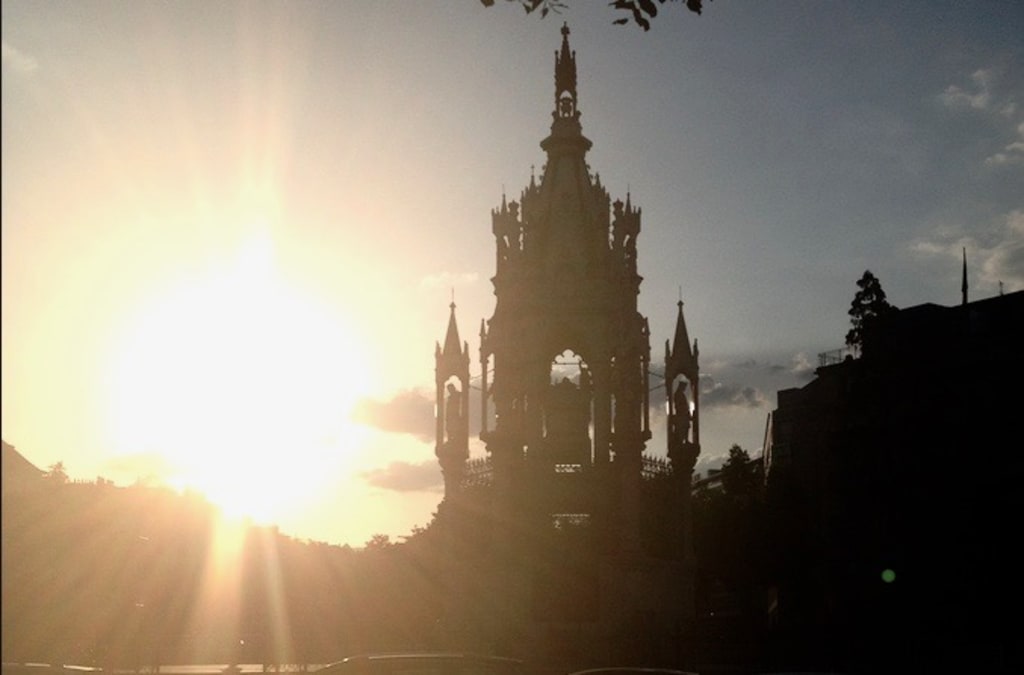
There are few things more beautiful than the slow unfurling of nature across urban areas as it gently reclaims what we borrowed. These stones were only ever on loan; these iron railings, these glassy facades, these pillars of steel; they were never ours, not really. And here she comes, with weary inevitability, to take it all back.
It should be sad, but I cannot find it in myself to see the melancholy in it all. When you’ve lived for this long you start to think differently; at this age every second counts, so why waste a single one on yearning for what was?
Besides, this cautiously encroaching wilderness is beautiful. Trees twist through open windows; briars raise broken glass from the ground as they tangle skyward, the shards like secondary thorns, catching the morning light. And there is a herd of deer in the square. I’ve never quite lost the childlike wonder I feel at the sight of deer, though they are of course a far more common sight now than when I was small and the creatures were almost mythical in their rarity. Now they graze peacefully on the scraggly grass, forcing its way up with dogged determination through the cracks in the concrete and tarmac of the city. Where once polished shoes and harried heels beat an endless rhythm of purpose into these floors, now soft hoofbeats echo into the silence that rings against the high-rise walls and windows. I stop to listen, and smile.
I’m loathe to disturb the peace of the herd, but my gammy knee begins to ache as I crouch behind a car skeleton, watching them. The pressure builds until, cursing old age, I stand straight and the herd scatters in started indignation. It always makes me chuckle that anything could be afraid of an old woman like me; these days I can’t move at anything faster than a slow amble. Which suits me fine. It’s not as though there are any predators to run from in this country; the only creature that could hurt me is another human and we’re pretty scarce beasties in this strange new world.
What people are left live mainly in the countryside these days, building little solar powered communities and living mainly on subsistence farming. Cities will be unsafe soon as the buildings weaken and rust and crumble back to dust. Plus, many find the endless silent concrete jungles eerie. But, although it is highly unwise for an old woman to be alone amid the crumbling facades, I’ve found myself drawn to the place where I grew up.
When I left my community, some months ago, they whispered that I’d gone to the city to die; run (hobbled) away like an old cat to pass away quietly in some back alley. Perhaps I have. I don’t see that there’s anything wrong with that.
I step through a shattered glass door and begin to climb a stairwell. The building is high; my body aches with years; I have to stop every few minutes to catch my breath. But something drives me up those stairs; a yen to see the horizon, the sun, the skyline of my youth.
About halfway up I stop on a whim and move into the corridors; this was a residential building, and I imagine children in their bright little clothes running in and out of their flats. I pass one room, the door hanging open wearily, and see a rocking chair in the middle of the floor. The doorframe is rotting, but something has caught my eye: someone hid something, lifetimes ago, behind the cheap wood there.
I smile and take it out.
It’s money. A large roll of soft paper notes, tied up in a clear plastic sandwich bag. It must be old then, from before they replaced paper with plastic. How strange.
I feel a brief flare of excitement, imagining that it must have come from some dubious criminal underworld deal, picturing mob bosses shadily sliding a roll of notes across a table in some bar somewhere, like they used to show in old movies.
I miss movies, I think idly, ambling slowly back to the stairwell. I miss many things of course, and it does not do to dwell on the ghosts of what was. But still.
The sun seems to be in a late afternoon position; I have been climbing for hours- though when I say climbing, I mean clambering laboriously up a few steps and then stopping to wheeze and contemplate life on every landing. There’s no one to judge. And I have all the time in (what’s left of) the world.
It is sunset by the time I reach the top of the building. Typical me, I’d lost count of the floors, but I’d imagine it was about thirty. Not quite a skyscraper then, but still an achievement, I thought as I heaved open the fire-door to the roof.
My head swims and my back feels like it is trying to grow an extra spine or some-such other unnatural, painful thing; I hobble to the edge of the roof and sit clumsily, thinking ruefully of my childhood ballet days, when it was inconceivable that movement could ever be so difficult.
My god was it worth the struggle though. From here I can see out across the city; there are higher skyscrapers near me but not many. A few blocks away, one is listing dangerously to the left. When that goes, I’d imagine the others will fall too from the shock, like glittering dominos. What a sight to see that would be.
Further away, the buildings are black against an orange sky, streaked with clouds stained green and purple and pink with the fire of the setting sun. I feel a sharp, mournful tug deep inside my stomach; this was my view as a child most evenings. Not specifically: I had looked for my old block but found it too weak and crumbling to consider entering. But this was close.
The sun’s explosion, the stark skyline, the hum of traffic-borne impatience, now silenced and replaced with only the singing of the wind as it wends and whispers through glass-steel shells.
My father’s hand on my shoulder, his soft voice telling me: What a world we’ve built for ourselves, huh? What a world.
I inspect the money bag. The notes are well loved and crumpled, and I take out a fistful and stare at them with my head cocked. People fought for this paper, I think to myself. People bled for this. People died for these little crumpled things. Money has no meaning in the world these days: what we have, we trade or credit on the Little Internet (rebuilt from the original with care and pride some years ago).
Once, these things I hold- the idea of money, the plague of coin- brought some men to their knees and others to the stars. It toppled kings and built civilizations. These small, helpless pieces of hope, pieces of despair; reduced to paper… and then to dust, I think, letting go and watching them flutter cautiously away in the wind.
I count out the entire bag, while I wait for the sun to set.
Ten… eleven… twelve…
One-hundred-and-one… one-hundred-and-two…
The numbers tick away in the back of my mind and the fluttering, rustling river of money spirals down and away into the concrete maze below, shimmering and golden like a shoal of fish in the setting sun.
Two hundred. Two hundred fifty-pound-notes. That’s ten-thousand-pounds worth of money. A small fortune once- now reduced to a pretty stream of paper on the breeze.
The summer sun warms my face as it melts into the horizon, and I sit back and breathe out and choose to wonder at the beauty of it all, instead of mourning the past.
This world is not broken.
This world has just aged.
And all things must crumble.
And all things must change.
I smile and wonder what it will be like to die.
About the Creator
Jackson Howling
Supposed to be studying for an engineering degree. But words are fun too. They keep escaping. So I thought I'd put them here. Favourite words: silver, Juarez, psithurism, twit.
Keep reading
More stories from Jackson Howling and writers in Futurism and other communities.
Red Sands
Red sands, thin sky, dusty hands, tired eyes. The travellers move through the strange landscape; they are weary and home is too far away to bear thinking about without a shadow falling across the soul, so instead they choose to lose themselves in the stark and barren beauty of their surroundings.
By Jackson Howling5 years ago in Futurism
About Binding Prometheus
I want to start actively advocating on behalf of my own work, and the most valuable part of my canon is, without a doubt, Binding Prometheus, the play I have been working on since 2019 and only finished in 2023 as part of my MA. The play itself is an amalgamation of a million different inspirations. On one end, it evokes the Ancient Greek myth-play, deriving its own title from the earliest extant work of Western drama we have, Aeschylus’s Prometheus Bound. On the other end, it borrows significantly from the sci-fi bulwarks from over the years, namely Mary Shelley’s Frankenstein and Karel Capek’s Rossum’s Universal Robots. The play could be an episode of Black Mirror, I fear. I don’t know. I’ve only ever seen one episode of Black Mirror.
By Steven Christopher McKnight16 days ago in Futurism
8 Mobile App Development Companies Working Across Multiple Industries
As mobile technology becomes central to business operations, organizations across industries are relying on mobile applications to improve efficiency, customer engagement, and digital reach. From healthcare and finance to retail, logistics, and education, mobile apps now support a wide range of use cases, each with unique technical and regulatory requirements.
By Apptunix usaabout 21 hours ago in Futurism


Comments
There are no comments for this story
Be the first to respond and start the conversation.