
Amazing 2,700-Year-Old Winged Deity from Assyria Discovered in Iraq
The Legendary Lamassu: Magnificent Signs for Mesopotamian Defence

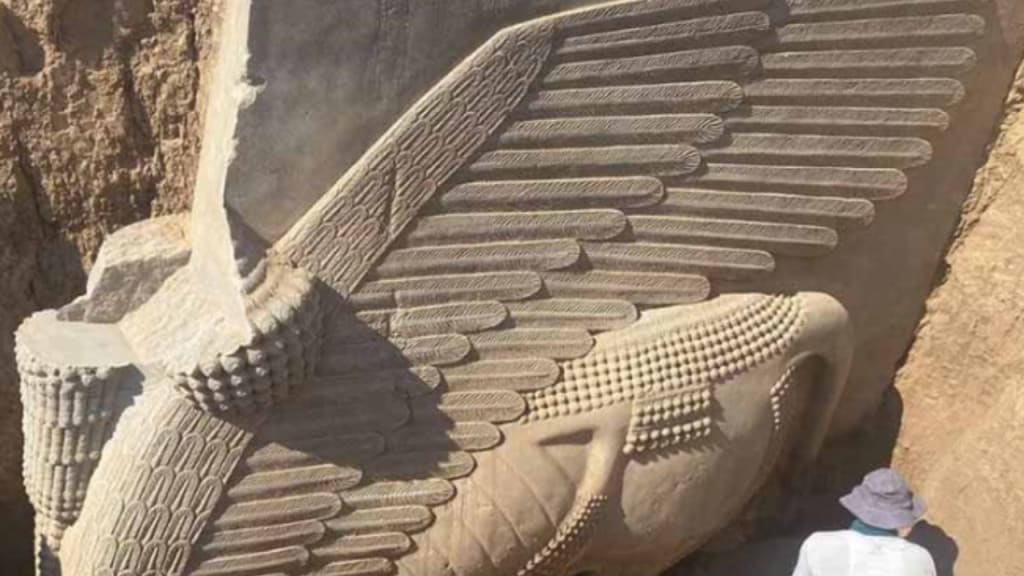
Archaeologists have re-excavated a magnificent lamassu at the ancient city of Khursbad, Iraq, in a historic discovery. The enormous sculpture, which represents an Assyrian guardian deity, is typically shown with a body that resembles a lion or bull, wings that resemble birds, and a head that is like a human.
For the first time in thirty years, the world has seen this elaborate work of Assyrian workmanship, which was commissioned by Assyrian King Sargon II in 721 BC to guard the capital city of Khursbad. At Khursbad's sixth gate, an Iraqi archaeological team first the lamassu in 1992. But in 1995, not long after it was found, its head was stolen. It was later found and is now safe in the Iraqi Museum. After the Gulf War, the statue's main body was buried again to preserve what remained of it. This precautionary measure most likely prevented the lamassu from being destroyed, especially since ISIS later destroyed a large portion of Khursbad in 2015.
Re-excavation of this ancient artifact began with a combined Iraqi/French effort led by Professor Dr. Ahmed Fakak Al-Badrani, according to a news release from The General Authority for Antiquities and Heritage. The discovery delighted the team. The General Body for Archaeology and Heritage's Chairman, Dr. Layth Majid Hussein, states that evaluations are presently being conducted to decide on the lamassu's future conservation initiatives.
The Sculpture with Wings, Monumental
The magnificent sculpture made of alabaster, which measures about 12 and a half feet in length and weighs an amazing 19 tonnes, has garnered attention from all over the world. "I've never unearthed anything this big in my life before," said Pascal Butterlin, a French archaeologist and professor of Middle Eastern archaeology at the University of Paris I Pantheon-Sorbonne, expressing his amazement. Usually, pieces this size are only found in Egypt or Cambodia.
Famous characters from ancient Assyrian mythology, the Lamassus were frequently represented by enormous statues that stood watch at the gates of important cities and palaces. These guardian angels are usually depicted with a human head, avian wings, and a bull or lion's body. They served as ornamental and symbolic elements and were thought to fend off evil and shield the palace or city from outside attacks. In addition to their spiritual significance, the artistic achievement of the Assyrians is demonstrated by the lamassus, which frequently displayed elaborate detailing and a distinct dual perspective that made them appear motionless from a side view yet immovable when viewed from the front.
The imagery and symbolism of earlier cultures had a great influence on ancient Jews, who also valued the Lamassu. Regarding Lamassu, the prophet Ezekiel said that it was a marvelous creature made up of parts of a bull, an eagle, a lion, and a human. All four of these mythological elements were also connected in the early Christian era to the four Gospels.
Moreover, it is quite probable that the Lamassu played a role in the adoption of the lion as a protective emblem as well as a representation of a courageous and powerful tribe chief.
Strong Monuments
Lamassu can still be seen standing tall and proud today. They came from a single block that was cut. The earliest monumental sculptures are composed of alabaster and stand between 10 and 14 feet (3.05 and 4.27 meters) tall. The shape of their bodies is the most obvious distinction between the elder Lamassu and those from a later era. The original Lamassu were carved with a lion's body, while the ones from King Sargon II's palace have a bull's body. More intriguingly, Sargon's Lamassu is grinning.
Dur Sharrukin, Sargon's capital, was established in 713 BC. He made the decision to install guardian-like genies on either side of each of the seven gates. In addition to being striking ornamentation and protectors, they performed an architectural role by supporting a portion of the weight of the arch above them.
Lamassu piqued the interest of Sargon II. Numerous monuments and sculptures depicting the legendary monsters were made during his rule. Lamassu's body had a high relief and more pronounced modeling during this time. The head resembled a bull with its ears, a guy with a beard on his face, and a thin mustache on his mouth.
Some of the monuments that were brought to the Louvre in France were discovered by archaeologists during excavations headed by Paul Botta at the start of 1843. Perhaps this was the first time the mythological animals were seen by Europeans.
At the moment, Lamassu's works are included in the collections of the Oriental Institute in Chicago, the Metropolitan Museum of Art in New York, and the British Museum in London. In 1942 and 1943, the British troops even made Lamassu their national symbol while they were operating in Iraq and Iran. The Lamassu symbol is currently used on the logo of US soldiers in Iraq.
About the Creator
Keep reading
More stories from Francis Dami and writers in Futurism and other communities.
Do we know the shape of the Moon?
Could life exist then? not quite, as Venus has a dry, windy atmosphere without enough water for life to exist, and rings encircling other planets are more frequent than we had believed. The most famous and impressive rings are those of Saturn; they are made up in part of sparkling, reflective water ice, and there is nothing else like it in the rest of our Solar System.
By Francis Dami2 years ago in Futurism
About Binding Prometheus
I want to start actively advocating on behalf of my own work, and the most valuable part of my canon is, without a doubt, Binding Prometheus, the play I have been working on since 2019 and only finished in 2023 as part of my MA. The play itself is an amalgamation of a million different inspirations. On one end, it evokes the Ancient Greek myth-play, deriving its own title from the earliest extant work of Western drama we have, Aeschylus’s Prometheus Bound. On the other end, it borrows significantly from the sci-fi bulwarks from over the years, namely Mary Shelley’s Frankenstein and Karel Capek’s Rossum’s Universal Robots. The play could be an episode of Black Mirror, I fear. I don’t know. I’ve only ever seen one episode of Black Mirror.
By Steven Christopher McKnight17 days ago in Futurism
High Voltage Cable Market: Grid Modernization, Renewable Integration & Transmission Efficiency Trends
According to IMARC Group's latest research publication, global co-packaged optics market size reached USD 84.43 Million in 2024. Looking forward, IMARC Group expects the market to reach USD 3,095.40 Million by 2033, exhibiting a growth rate (CAGR) of 48.69% during 2025-2033.
By sujeet. imarcgroup2 days ago in Futurism



Comments (1)
Nice story