
AI: The Game-Changer of the Future
How AI will affect multiple sectors in the near future

In today's rapidly evolving world, one thing is certain: artificial intelligence (AI) is poised to revolutionize multiple sectors like never before. From healthcare to transportation, finance to manufacturing, AI is set to be a game-changer, transforming industries and reshaping our lives. With its ability to analyze vast amounts of data, learn from patterns, and make autonomous decisions, AI holds the potential to unlock unprecedented levels of efficiency, productivity, and innovation. Let's delve into the myriad ways in which AI is set to transform various sectors in the near future.
In the healthcare sector, AI is already making waves. Picture this: a patient walks into a hospital with a mysterious set of symptoms, leaving doctors scratching their heads. AI steps in, armed with its powerful algorithms and machine learning capabilities, and quickly analyzes the patient's medical history, cross-referencing it with vast databases of similar cases. Suddenly, a diagnosis emerges, pinpointing a rare condition that had eluded human doctors. AI's ability to process immense amounts of data and spot patterns hidden to the human eye is truly remarkable, revolutionizing the accuracy and speed of diagnoses.
But the transformative power of AI doesn't stop there. In the realm of drug discovery, AI is poised to save countless lives. Traditionally, the process of developing new drugs has been painstakingly slow, with researchers sifting through mountains of data and conducting endless experiments. AI, however, can swiftly sift through vast volumes of research papers, clinical trial data, and molecular structures, identifying potential drug candidates in a fraction of the time. By accelerating the drug discovery process, AI has the potential to bring life-saving treatments to market faster than ever before.
Moving on to the transportation sector, AI is set to redefine the way we commute and travel. Self-driving cars, once a far-fetched dream, are now becoming a reality thanks to AI. These intelligent vehicles, equipped with sensors, cameras, and advanced algorithms, can navigate complex roadways, interpret traffic patterns, and make split-second decisions to ensure passenger safety. Imagine the convenience of commuting without the stress of driving, freeing up valuable time for work, leisure, or simply relaxation. The potential impact on road safety is immense, as AI's vigilant sensors are less prone to human error, leading to a significant reduction in accidents.
Meanwhile, AI is also set to revolutionize the financial sector, changing the way we manage our money. Chatbots powered by AI are already transforming customer service, providing instant, personalized support to users. These bots can handle a wide range of inquiries, from account balances to investment recommendations, with a level of efficiency and accuracy that rivals human agents. Moreover, AI algorithms can analyze vast financial data sets in real-time, identifying market trends, detecting anomalies, and making data-driven investment decisions. This level of sophisticated analysis has the potential to optimize portfolios and maximize returns for investors.
In the realm of manufacturing, AI is poised to enhance productivity and efficiency on a monumental scale. Smart factories, equipped with AI-powered robots and machines, can autonomously perform complex tasks with precision and speed. These machines can analyze production data in real-time, identifying inefficiencies, predicting maintenance needs, and optimizing production schedules. By leveraging AI, manufacturers can streamline their operations, reduce costs, and deliver products with unparalleled accuracy and consistency.
However, it's important to acknowledge the challenges that come hand in hand with AI's game-changing potential. Ethical considerations, privacy concerns, and the impact on the workforce are all valid concerns that need to be addressed. AI must be developed and deployed responsibly, with clear guidelines and regulations in place to ensure the protection of user data and prevent biases or discrimination. Additionally, the transition to an AI-driven world may disrupt certain job markets, necessitating the retraining and upskilling of workers to adapt to the changing landscape.
In conclusion, AI's game-changing potential across multiple sectors is undeniable. From healthcare to transportation, finance to manufacturing, AI has the power to transform industries and reshape our lives. With its ability to analyze vast amounts of data, learn from patterns, and make autonomous decisions, AI is set to unlock unprecedented levels of efficiency, productivity, and innovation. However, it's crucial that we navigate this transformative journey with care, addressing ethical concerns and ensuring a smooth transition for the workforce. The future holds immense promise, and with AI at the forefront, we can look forward to a world brimming with endless possibilities.
About the Creator
Keep reading
More stories from Maaff Mktg and writers in Futurism and other communities.
The Need for Monitoring and Regulation of AI
Artificial intelligence (AI) has become an integral part of our lives, permeating various industries and revolutionizing the way we live, work, and interact. Its potential is immense, and it promises a future filled with efficiency, convenience, and innovation. However, with such power comes the need for responsibility and accountability. As AI continues to advance at an unprecedented pace, it becomes imperative to closely monitor and regulate its development and deployment. In this article, we will explore the reasons why AI must be subject to monitoring and regulation, highlighting the importance of striking a delicate balance between progress and protection.
By Maaff Mktg3 years ago in Futurism
About Binding Prometheus
I want to start actively advocating on behalf of my own work, and the most valuable part of my canon is, without a doubt, Binding Prometheus, the play I have been working on since 2019 and only finished in 2023 as part of my MA. The play itself is an amalgamation of a million different inspirations. On one end, it evokes the Ancient Greek myth-play, deriving its own title from the earliest extant work of Western drama we have, Aeschylus’s Prometheus Bound. On the other end, it borrows significantly from the sci-fi bulwarks from over the years, namely Mary Shelley’s Frankenstein and Karel Capek’s Rossum’s Universal Robots. The play could be an episode of Black Mirror, I fear. I don’t know. I’ve only ever seen one episode of Black Mirror.
By Steven Christopher McKnight28 days ago in Futurism
Europe Pen Needles Market Poised for Steady Expansion, Reaching US$1.10 Billion by 2031 Amid Diabetes Growth and Home-Care Shift
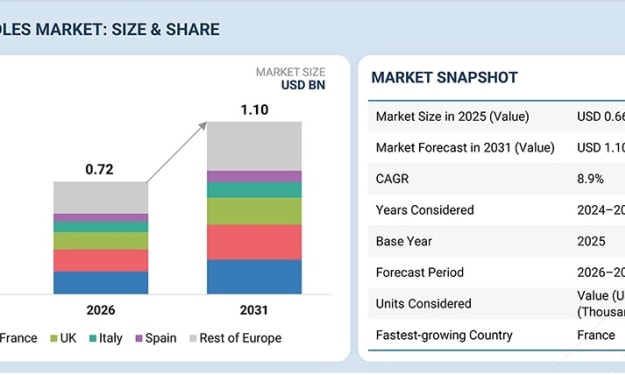
Europe’s pen needles market is entering a period of sustained, value-driven growth as chronic disease burden, demographic shifts, and home-based care adoption reshape injectable therapy delivery across the region. Valued at US$0.66 billion in 2025, the market increased to US$0.72 billion in 2026 and is projected to expand at a resilient CAGR of 8.9% from 2026 to 2031, reaching a forecasted US$1.10 billion by 2031.
By Juan Martinez2 days ago in Futurism


Comments