
AI Just Replaced Another 100,000 Workers — Is Your Job Next?”
AI jobs lost, automation threat, future of work
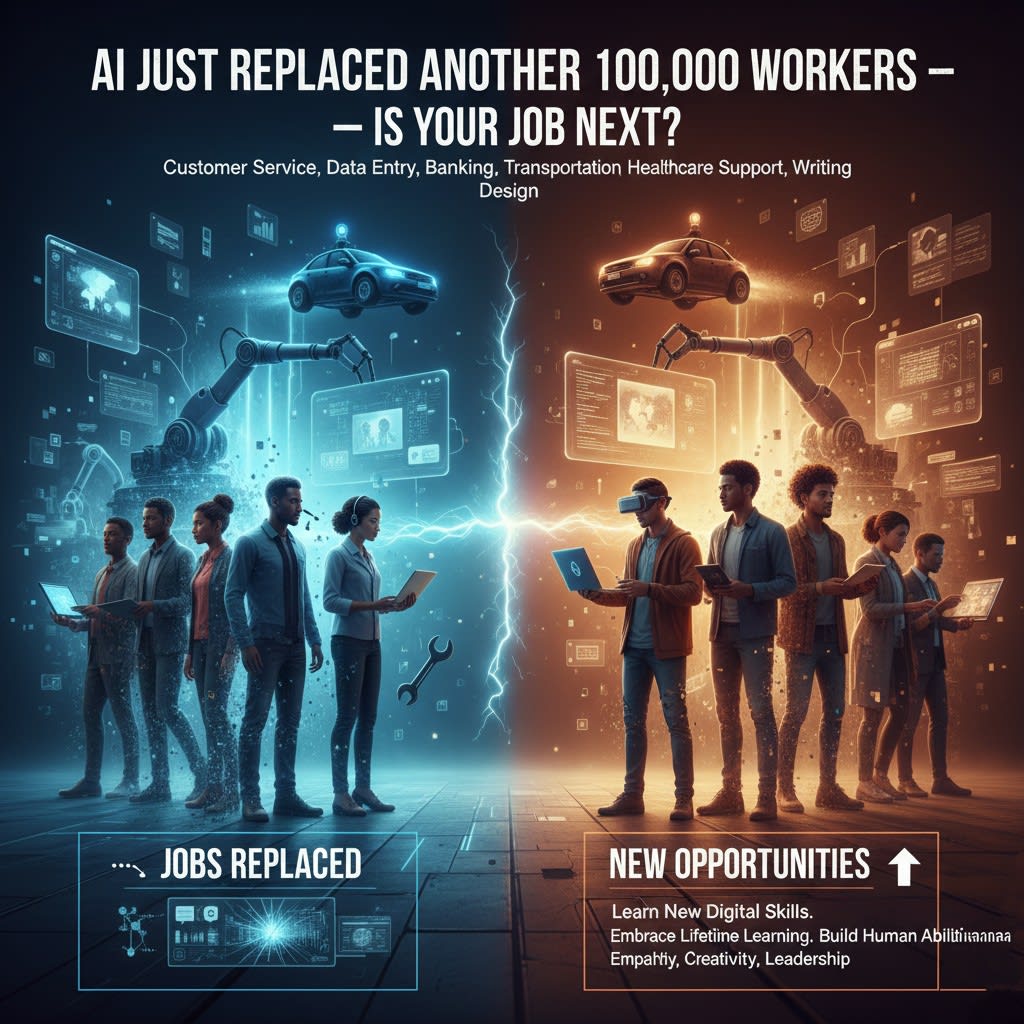
AI Just Replaced Another 100,000 Workers — Is Your Job Next?
Artificial Intelligence is no longer a futuristic idea — it is a present-day economic force reshaping industries, careers, and livelihoods across the globe. What began as a tool for automation in factories has now evolved into a sophisticated technology capable of performing tasks once thought to be purely human. And the most recent global employment reports reveal a startling fact: AI has replaced over 100,000 workers in the last year alone.
This isn’t happening in one country. It’s a global wave. From the United States to India, China to Germany, companies are rapidly adopting AI systems to cut costs, increase efficiency, and outperform competitors. Entire job categories are shrinking. And the workers most affected often come from fields that were once considered secure.
Customer service, data entry, banking, transportation, healthcare support, and even creative fields like writing and design are feeling the weight of AI disruption. Chatbots now handle customer complaints. AI software scans millions of documents in minutes. Autonomous vehicles are reducing the need for human drivers. And automated design tools are producing logos, videos, advertisements, and even songs.
But the most shocking development is how fast this transformation is accelerating.
Tech analysts say that what we are witnessing is the fastest job displacement event in human history. During past industrial revolutions, workers had decades to adapt. Today, the shift is happening in months. As companies adopt AI tools, human employees find themselves competing against systems that work faster, cheaper, and without rest.
In the United States, major corporations in tech, finance, and e-commerce have laid off workers, citing "AI restructuring" as the primary reason. In Asia, call centers that once employed millions are now adopting generative AI agents that can speak multiple languages and solve problems in seconds. In Europe, manufacturing giants are replacing assembly workers with intelligent machines capable of precision work.
But the most important question remains: Are all jobs at risk?
Experts say no. While AI is replacing many jobs, it is also creating new opportunities — but these opportunities require new skills. Roles like AI trainers, data analysts, automation supervisors, cybersecurity specialists, and prompt engineers are seeing massive demand. Workers who adapt quickly may thrive, but the transition will not be easy.
The global fear is understandable. A factory worker cannot instantly become an AI technician. A customer service agent cannot immediately transform into a machine learning specialist. Millions of workers lack access to training, resources, and opportunities.
Governments worldwide are being urged to prepare safety nets — retraining programs, job assistance, unemployment support, and strict regulations to prevent abuse. Some countries have already begun funding digital literacy programs. Others are considering taxes on AI-driven companies to support displaced workers.
Still, the future remains uncertain. Some futurists argue that AI will eventually take over almost all repetitive tasks, forcing humans to shift into more creative and strategic roles. Others warn of massive unemployment if urgent action is not taken.
One thing, however, is clear: no job category is completely immune. Even professionals in law, medicine, and education are seeing parts of their tasks automated. AI can now draft legal documents, diagnose illnesses, and even grade school assignments.
So what can workers do?
Experts recommend three key strategies:
1. Learn new digital skills — even basic digital literacy increases job security.
2. Embrace lifelong learning — the workplace of the future rewards adaptability.
3. Build uniquely human abilities — empathy, creativity, leadership, and emotional intelligence cannot be automated.
Artificial Intelligence is not slowing down. It is accelerating. And the decisions workers make today will determine whether they survive — or get swept away — by the wave of automation reshaping the global workforce.
About the Creator
Keep reading
More stories from Gideon Polycarp and writers in Futurism and other communities.
Food Prices Are Exploding Worldwide — Experts Warn the Worst Is Yet to Come”
Food Prices Are Exploding Worldwide — Experts Warn the Worst Is Yet to Come The world is entering a new era of economic uncertainty, and for millions of families, the first sign of crisis is appearing right on their dining tables. From Africa to Europe, Asia to the Americas, food prices are rising faster than wages, and economists warn that the global inflation wave may only be beginning.
By Gideon Polycarpabout a month ago in Earth
About Binding Prometheus
I want to start actively advocating on behalf of my own work, and the most valuable part of my canon is, without a doubt, Binding Prometheus, the play I have been working on since 2019 and only finished in 2023 as part of my MA. The play itself is an amalgamation of a million different inspirations. On one end, it evokes the Ancient Greek myth-play, deriving its own title from the earliest extant work of Western drama we have, Aeschylus’s Prometheus Bound. On the other end, it borrows significantly from the sci-fi bulwarks from over the years, namely Mary Shelley’s Frankenstein and Karel Capek’s Rossum’s Universal Robots. The play could be an episode of Black Mirror, I fear. I don’t know. I’ve only ever seen one episode of Black Mirror.
By Steven Christopher McKnight16 days ago in Futurism
Top-12 AI Agents Development Services in the 2026
AI agents are no longer experimental tools. In 2026, they sit at the core of how modern companies automate workflows, support customers, analyze data, and make decisions at scale. Autonomous customer support agents and multi-agent enterprise systems coordinate complex operations. Businesses actively seek partners capable of designing, building, deploying, and maintaining production-ready AI agents.
By CEO A&S Developers4 days ago in Futurism



Comments
There are no comments for this story
Be the first to respond and start the conversation.