
AI Isn’t Replacing Us — It’s Redefining What It Means to Be Human
Why the future of artificial intelligence depends on empathy, not efficiency

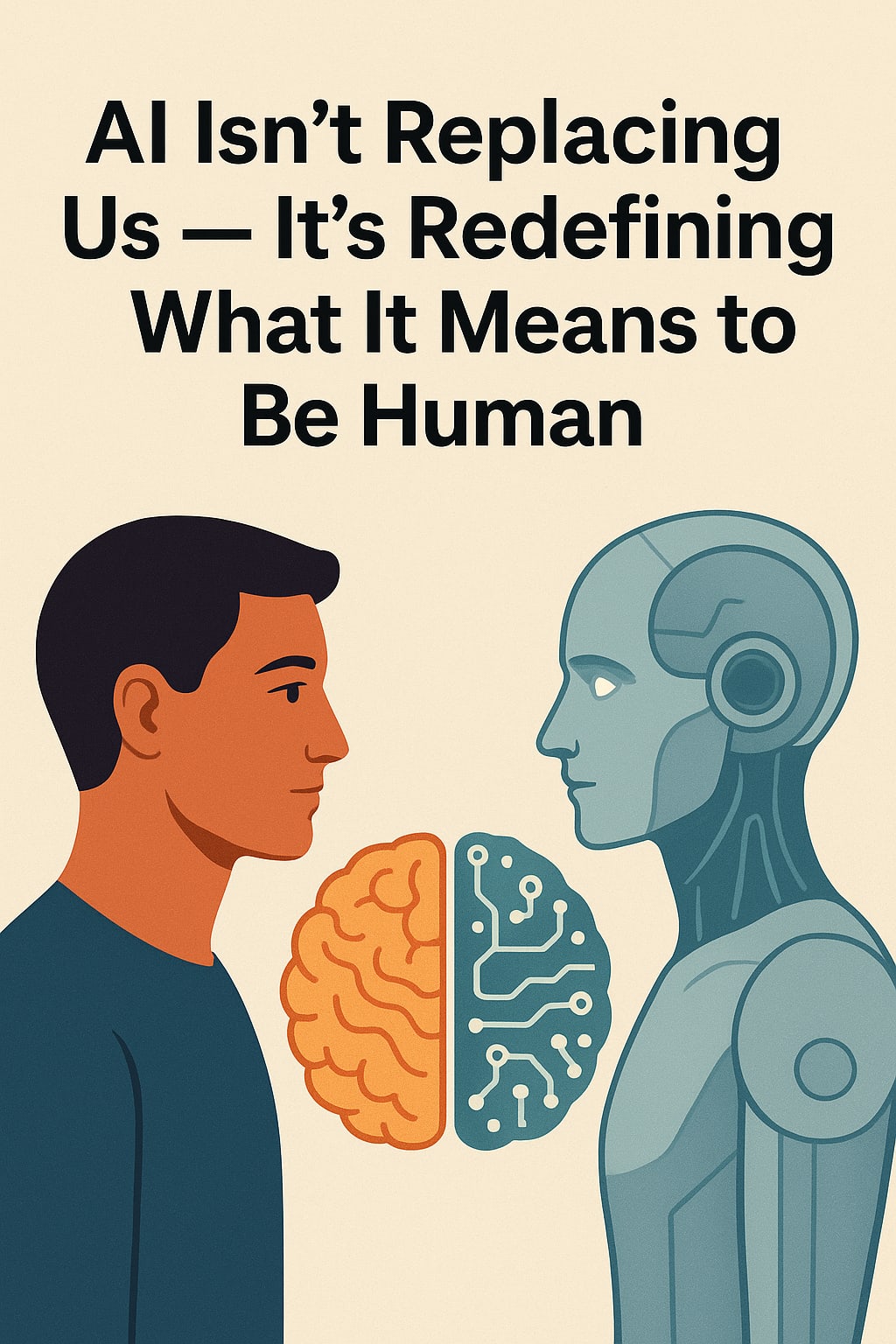
For years, headlines have echoed the same fear: “AI is coming for your job.” Every technological leap — from ChatGPT to image generators — seems to deepen the anxiety that machines are slowly making humans obsolete. But what if we’ve been asking the wrong question all along?
The real question isn’t whether AI will replace us, but how it will reshape us — how it will force humanity to rethink creativity, emotion, and meaning itself.
The myth of replacement
Artificial intelligence is astonishingly capable. It can write essays, compose symphonies, diagnose diseases, and even mimic human conversation. Yet for all its brilliance, AI remains just that — artificial. It doesn’t dream, it doesn’t suffer, and it doesn’t love. It calculates patterns and probabilities, not purpose.
When we talk about AI “taking over,” we often forget that machines only know what we teach them. Every dataset, every algorithm, every neural network is built upon human input — our words, our decisions, our biases, our art. The intelligence we fear isn’t replacing humanity; it’s reflecting it.
That reflection, however, can be uncomfortable. AI reveals our contradictions — our creativity and our cruelty, our curiosity and our carelessness. It forces us to confront the fact that intelligence without empathy can be dangerous, and efficiency without ethics can be destructive.
Redefining creativity
A common argument is that AI can never be truly creative — that it simply remixes what already exists. But isn’t that what humans do too? Every writer, artist, or musician draws from the world around them, transforming existing ideas into something new. The difference is intention.
AI doesn’t mean what it creates. When a language model writes a poem or generates a painting, it doesn’t feel pride, sadness, or inspiration. We do. That emotional resonance is still uniquely human.
In this way, AI doesn’t destroy creativity; it redefines collaboration. It acts as a mirror, a muse, and sometimes a challenger. It invites us to explore what happens when human intuition meets machine precision. The artists and thinkers who thrive in the AI age will be those who use technology not to imitate life, but to amplify it.
The rise of emotional intelligence
Ironically, the more intelligent AI becomes, the more valuable emotional intelligence will be. As machines take over repetitive and data-driven tasks, our distinct human advantage shifts toward empathy, storytelling, ethics, and imagination.
Think about it: AI can generate an answer in seconds, but it can’t genuinely care about how that answer affects someone. It can simulate conversation, but it can’t feel compassion. The human ability to connect, comfort, and inspire will become the new currency of progress.
This shift also challenges the way we define “work.” Productivity won’t just be measured in output — it will be measured in insight, interpretation, and emotional impact. The future belongs not to those who out-code machines, but to those who can work alongside them with conscience.
The next evolution: Augmented humanity
The AI revolution is not about building a world where humans vanish; it’s about building a world where humans expand. Every major technological breakthrough in history — electricity, the internet, smartphones — has extended our capabilities. AI is simply the next extension: of thought, of creativity, of potential.
But to make that future sustainable, we need to design AI systems that reflect our best values, not our worst instincts. That means prioritizing fairness over speed, empathy over profit, and truth over convenience.
The goal shouldn’t be creating machines that think like humans — it should be creating societies that think deeply about what it means to be human in an AI-driven world.
In the end, AI is a mirror
Artificial intelligence doesn’t erase humanity. It exposes it.
It shows us where we are wise and where we are reckless, where we seek meaning and where we settle for noise.
The more we teach machines to “think,” the more we must remember how to feel.
Because the real future of intelligence — artificial or otherwise — won’t be measured in processing power or predictive accuracy.
It will be measured in compassion, creativity, and conscience.
And that’s something no algorithm can replicate.
About the Creator
minaal
Just a writer sharing my thoughts, poems, and moments of calm.
I believe words can heal, connect, and remind us that we’re not alone.
About Binding Prometheus
I want to start actively advocating on behalf of my own work, and the most valuable part of my canon is, without a doubt, Binding Prometheus, the play I have been working on since 2019 and only finished in 2023 as part of my MA. The play itself is an amalgamation of a million different inspirations. On one end, it evokes the Ancient Greek myth-play, deriving its own title from the earliest extant work of Western drama we have, Aeschylus’s Prometheus Bound. On the other end, it borrows significantly from the sci-fi bulwarks from over the years, namely Mary Shelley’s Frankenstein and Karel Capek’s Rossum’s Universal Robots. The play could be an episode of Black Mirror, I fear. I don’t know. I’ve only ever seen one episode of Black Mirror.
By Steven Christopher McKnight16 days ago in Futurism
Top 10 Healthcare Software Development Companies in the USA
“The healthcare industry today is undergoing an incredible digital evolution, thanks to an increasing need for intelligent healthcare delivery, optimized operations, and evidence-based decision making. Ranging from electronic health records, telehealth platforms, to AI-assisted diagnosis and remote monitoring solutions, today’s healthcare entities leverage technology to enhance care to an incredible extent. Consequently, it has become an imperative choice to select the most apt Healthcare Software Development Companies to keep pace in 2026.”
By Olivia Carter2 days ago in Futurism



Comments
There are no comments for this story
Be the first to respond and start the conversation.