
AI in Supply Chain
Artificial Intelligence applications in Supply Chain / Procurement

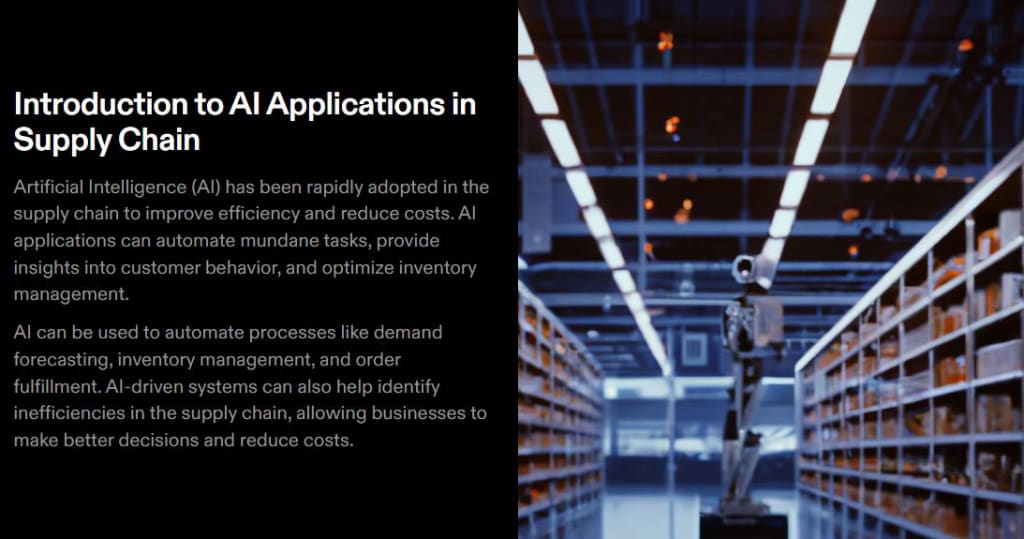
There are many potential use cases for artificial intelligence in supply chain management. Some examples include:
Demand forecasting: AI can analyze historical sales data and use machine learning algorithms to make more accurate predictions about future demand for products.
Inventory management: AI can help optimize inventory levels by analyzing data on sales, production, and logistics to determine the most efficient stocking levels.
Supply chain optimization: AI can be used to analyze data on suppliers, transportation routes, and other logistics to identify opportunities for cost savings and efficiency improvements.
Supply chain risk management: AI can be used to identify potential risks such as natural disasters or supplier disruptions, and help develop plans to mitigate these risks.
Predictive maintenance: AI can analyze data from sensors on equipment to predict when maintenance will be needed and schedule it accordingly, reducing downtime and increasing efficiency.
Quality control: AI can be used to inspect products for defects at various stages of the production process, reducing the risk of defective products reaching customers.
Chatbots and virtual assistants: AI-powered chatbots and virtual assistants can help customers track their orders and answer questions, reducing the workload for customer service staff.
Autonomous vehicles and drones: AI can be used to control autonomous vehicles and drones for tasks such as transportation and delivery, reducing the need for human drivers and pilots.
Predictive analytics: AI can be used to analyze data from various sources, such as social media and weather forecasts, to anticipate changes in demand and adjust supply chain operations accordingly.
Robotics: AI-powered robots can be used in warehouses and distribution centers to automate tasks such as picking and packing, increasing efficiency and reducing labor costs.
Real-time tracking: AI can be used to track and monitor the location and status of goods in real-time, allowing companies to quickly respond to delays or other issues.
Cognitive computing: AI-powered cognitive computing can be used to process large amounts of unstructured data, such as customer reviews, to identify trends and improve supply chain operations.
Smart contracts: AI-powered smart contracts can be used to automate and streamline supply chain contract management, reducing the risk of errors and increasing efficiency.
Fraud detection: AI can be used to analyze financial data to identify fraud, waste and abuse, and prevent potential losses to the supply chain.
Procurement is another area where artificial intelligence can be applied to improve efficiency and reduce costs. Here are some examples of AI use cases in procurement:
Spend analysis: AI can be used to analyze spend data to identify patterns, trends and opportunities for cost savings.
Supplier discovery and evaluation: AI can be used to search through large volumes of data to find new suppliers and evaluate their performance and suitability.
Contract management: AI can automate the process of contract management, such as creating, executing, and monitoring contracts.
Pricing optimization: AI can be used to analyze market data to determine optimal pricing strategies for procurement.
Sourcing optimization: AI can be used to identify the most cost-effective sourcing options based on factors such as lead time, delivery cost, and supplier performance.
Risk management: AI can be used to identify and assess risks associated with suppliers, such as financial instability or political instability in their country of operation.
Predictive maintenance: AI can predict the timing of the next purchase and generate a purchase order based on the usage and consumption rate, which helps to keep the inventory level in control.
NLP: Natural Language Processing can be used to extract data from unstructured documents such as contracts, purchase orders, and invoices, making it easier to identify key information and automate processes.
About the Creator
Sendil Arasu Vijaya Kumar
I attained bachelor degree in mechanical engineering and master degree in marketing management, having 21 Years of professional work experience. International exposure in Supply Chain Procurement domain. Author of "The Procurement Acumen"
Keep reading
More stories from Sendil Arasu Vijaya Kumar and writers in Futurism and other communities.
Blockchain in Supply Chain
Blockchain technology has the potential to revolutionize supply chain management by providing an immutable and transparent ledger of transactions. This can improve supply chain efficiency and traceability, enabling real-time tracking of goods as they move through the supply chain. Some potential use cases for blockchain in supply chain include:
By Sendil Arasu Vijaya Kumar3 years ago in Education
About Binding Prometheus
I want to start actively advocating on behalf of my own work, and the most valuable part of my canon is, without a doubt, Binding Prometheus, the play I have been working on since 2019 and only finished in 2023 as part of my MA. The play itself is an amalgamation of a million different inspirations. On one end, it evokes the Ancient Greek myth-play, deriving its own title from the earliest extant work of Western drama we have, Aeschylus’s Prometheus Bound. On the other end, it borrows significantly from the sci-fi bulwarks from over the years, namely Mary Shelley’s Frankenstein and Karel Capek’s Rossum’s Universal Robots. The play could be an episode of Black Mirror, I fear. I don’t know. I’ve only ever seen one episode of Black Mirror.
By Steven Christopher McKnight19 days ago in Futurism
Home Shopping Market: Convenience-Led Retail & Growth Outlook
According to IMARC Group's latest research publication, The global home shopping market size was valued at USD 4,598.70 Billion in 2024. Looking forward, IMARC Group estimates the market to reach USD 12,791.25 Billion by 2033, exhibiting a CAGR of 11.44% during 2025-2033.
By James Whitman6 days ago in Futurism
The Devil's Cut
“Comrade, finally you’re awake.” The voice was smooth, sensual. A flickering incandescent bar was all that lit the white, sterile room. All Vladimir remembered was everything going black. He tried to move his arms and found them strapped to the gurney.
By Matthew J. Fromm6 days ago in Fiction



Comments
There are no comments for this story
Be the first to respond and start the conversation.