
AI Governance Platforms: Ensuring Ethical AI Deployment in Modern Enterprises
Why Your Company Needs Guardrails Before the Algorithms Take Over

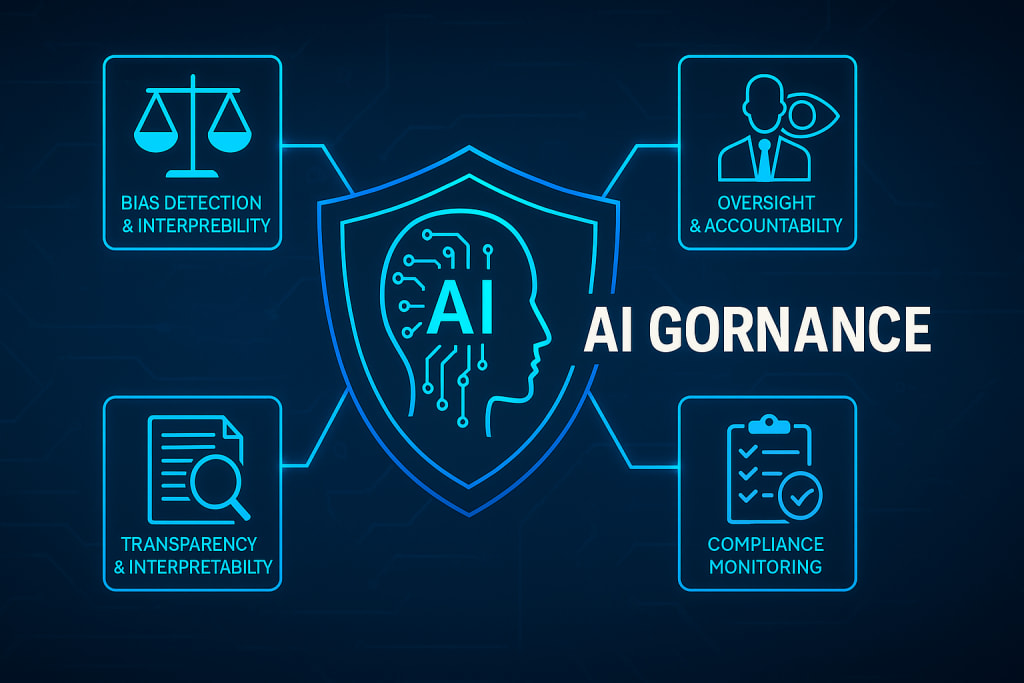
Why Your Company Needs Guardrails Before the Algorithms Take Over
In a world increasingly powered by artificial intelligence, one question looms large: Can we trust the AI we build? From customer service bots to algorithmic hiring tools, artificial intelligence is no longer just a buzzword — it’s embedded in the very fabric of modern business. Yet, with power comes risk. Bias, opacity, ethical lapses, and unregulated autonomy are just a few of the growing pains facing enterprise AI today.
That’s where AI governance platforms come in.
These emerging tools promise to do for AI what cybersecurity frameworks did for data — introduce accountability, transparency, and oversight into a space once dominated by unchecked innovation. In 2025, they aren’t just optional — they’re becoming essential.
🤖 What Is an AI Governance Platform?
An AI governance platform is a structured framework or toolset that helps organizations manage how their artificial intelligence systems are developed, deployed, monitored, and refined — with ethics and compliance in mind. Think of it as a digital constitution for your AI systems. These platforms monitor:
Model bias and fairness
Data lineage and usage compliance
Algorithmic transparency and explainability
Decision accountability and audit trails
Human oversight vs machine autonomy
In short, they make sure your AI behaves responsibly — and that your company can prove it.
📉 The Risks of Ignoring AI Governance
Companies are now facing increasing pressure from regulators, consumers, and investors to ensure their AI doesn’t violate privacy, promote discrimination, or make opaque decisions.
Consider the following scenarios:
A recruiting algorithm trained on historical data rejects female candidates for engineering roles.
A credit scoring model offers lower limits to minority applicants based on zip codes.
A healthcare diagnostic AI makes decisions that clinicians can't explain — or challenge.
These aren’t hypotheticals. They’ve already happened. The reputational damage? Severe. The legal consequences? Mounting. The solution? Governance before deployment.
🧠 Features of Modern AI Governance Platforms
Today’s leading AI governance tools integrate seamlessly with existing machine learning workflows and offer:
Bias Detection & Mitigation
Analyze models for discriminatory patterns based on gender, race, or other protected classes.
Explainability & Transparency Dashboards
Provide human-readable insights into how AI makes decisions — crucial for trust and legal compliance.
Automated Documentation
Generate version histories, data usage logs, and training source references.
Compliance Mapping
Ensure AI systems meet global frameworks like the EU AI Act, GDPR, and U.S. AI Bill of Rights.
Alerts & Escalations
Notify stakeholders if models drift, break ethical rules, or misbehave in the wild.
🔍 Leading Platforms to Watch in 2025
Some of the most notable platforms setting the standard in AI governance today include:
Credo AI – Enterprise-grade governance with strong policy mapping.
Truera – Focused on explainability, bias, and monitoring.
Fiddler AI – Transparency and model performance auditing.
DataRobot MLOps – Combines operational AI monitoring with compliance workflows.
Many of these integrate with popular ML stacks like TensorFlow, PyTorch, and AWS SageMaker.
🏛️ The Regulatory Landscape Is Catching Up
Governments are no longer sitting on the sidelines.
The EU AI Act, set to take full effect in 2025, categorizes AI by risk level and mandates governance structures for high-risk use cases — like finance, healthcare, and surveillance. The U.S. is following suit with proposed AI liability laws and algorithmic accountability mandates.
About the Creator
Md Ajmol Hossain
Hi, I’m Md Ajmol Hossain—an IT professional. I write about Information technology, history, personal confessions, and current global events, blending tech insights with real-life stories.
Keep reading
More stories from Md Ajmol Hossain and writers in Futurism and other communities.
Alcatraz Awakens: The Ghost Prison Returns to Life After 60 Years
Alcatraz Awakens: The Ghost Prison Returns to Life After 60 Years In the shadowy waters of San Francisco Bay, a forgotten fortress stirs. The infamous Alcatraz Federal Penitentiary, once the most feared prison in America, is about to reopen its iron gates—and this time, it’s under orders from former President Donald J. Trump.
By Md Ajmol Hossain8 months ago in Futurism
About Binding Prometheus
I want to start actively advocating on behalf of my own work, and the most valuable part of my canon is, without a doubt, Binding Prometheus, the play I have been working on since 2019 and only finished in 2023 as part of my MA. The play itself is an amalgamation of a million different inspirations. On one end, it evokes the Ancient Greek myth-play, deriving its own title from the earliest extant work of Western drama we have, Aeschylus’s Prometheus Bound. On the other end, it borrows significantly from the sci-fi bulwarks from over the years, namely Mary Shelley’s Frankenstein and Karel Capek’s Rossum’s Universal Robots. The play could be an episode of Black Mirror, I fear. I don’t know. I’ve only ever seen one episode of Black Mirror.
By Steven Christopher McKnight13 days ago in Futurism
Carbon Accounting Software Market: Green IT Adoption & Industry Expansion
According to IMARC Group's latest research publication, The global carbon accounting software market size was valued at USD 22.2 Million in 2025. Looking forward, IMARC Group estimates the market to reach USD 98.1 Million by 2034, exhibiting a CAGR of 18.0% from 2026-2034.
By James Whitman5 days ago in Futurism




Comments
There are no comments for this story
Be the first to respond and start the conversation.