
AI Engines Are Starting to Challenge Google’s Search Dominance
AI Search Engines, Google Search, ChatGPT, Perplexity AI, OpenAI
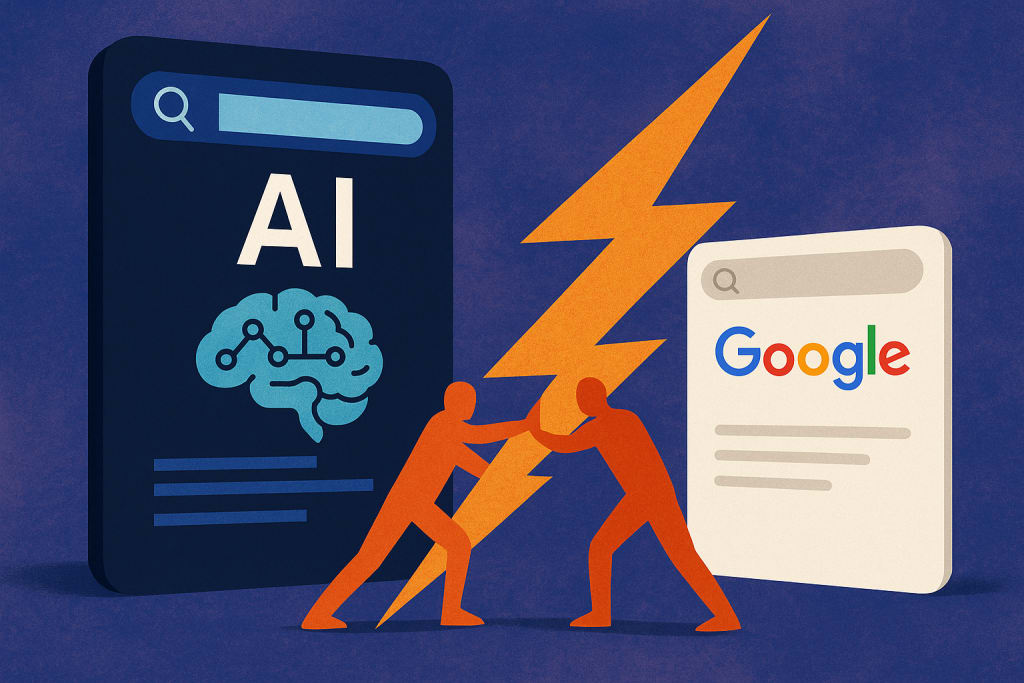
For over two decades, Google has been the undisputed king of the internet search space. “Google it” became synonymous with searching for anything online. From academic queries to news and shopping, Google's search engine has been the default gateway to the web. But 2025 is witnessing a significant shift—a seismic disruption driven by artificial intelligence.
AI-powered engines such as OpenAI’s ChatGPT, Perplexity AI, and others are offering users not just search results, but intelligent, conversational answers. This evolution is redefining what it means to “search,” and it’s beginning to chip away at Google’s long-standing dominance.
The Rise of AI-Powered Answers
Traditional search engines like Google rely on indexing billions of web pages and surfacing the most relevant links based on keywords, authority scores, and machine learning. However, this model has limitations—users often have to sift through multiple links to get direct answers. Enter generative AI.
OpenAI’s ChatGPT and Microsoft’s integration of it into Bing introduced a new paradigm: instead of serving links, users get curated, contextual answers, sometimes supported by citations. This drastically improves the search experience, particularly for complex or multifaceted queries.
For example, a user asking “What’s the best diet for muscle gain with a gluten allergy?” would typically receive a series of links from Google. With AI engines, the user gets a synthesized, paragraph-long response customized to their specific need—instantly.
Perplexity AI: The Quiet Disruptor
Among the most notable disruptors is Perplexity AI, which blends conversational responses with real-time web citations. It presents an appealing hybrid: the context of AI with the factual reliability of traditional search. Users can even “drill down” into topics with follow-up questions in a way that Google’s one-shot queries can’t easily handle.
Perplexity’s design also eliminates much of the clickbait problem—responses aren’t driven by SEO-optimized headlines, but by actual relevance and trustworthiness. This model could become the go-to for students, researchers, and professionals alike.
Google’s Response: Search Generative Experience (SGE)
Google is not sitting idle. Its Search Generative Experience (SGE) integrates generative AI into the search workflow. Users now receive AI-generated snippets alongside traditional results in certain contexts. These snippets aim to keep Google ahead of the curve, but early feedback has been mixed.
The challenge for Google is balancing its ad-driven model with the reduced need for click-throughs that AI answers bring. The longer-term implications could be a reshuffling of revenue structures and even Google's own business model.
The Trust Factor
One of the biggest concerns with AI-driven search engines is trust. Generative models can hallucinate, producing incorrect or misleading information with high confidence. Google still holds the advantage in terms of authority and accuracy—users know they’re likely to find vetted, reliable content.
However, AI engines are improving rapidly. Tools like ChatGPT now cite sources, allow plug-in integration, and even offer browsing capabilities. As they grow more trustworthy, the reliance on traditional search engines could further wane.
Impact on the SEO Industry
If AI search engines become the new norm, the entire SEO industry will have to pivot. Instead of optimizing for keywords and backlinks, websites may need to structure their data to be “readable” by AI engines. Structured data, transparency, and content quality—not keyword density—will become the key ranking signals.
In this landscape, content that directly answers user intent will thrive. Niche blogs, expert opinions, and curated datasets will become more valuable than ever, especially when AI models look for domain-specific training data.
Monetization & Ad Revenue Challenges
A massive chunk of Google’s revenue—over 80%—comes from advertising. If users stop clicking links and start relying on AI summaries, the ad business could be in jeopardy. While Google is experimenting with ads embedded within AI-generated content, it hasn’t cracked the code yet.
Conversely, companies like Perplexity, OpenAI, and even Apple (rumored to be developing its own AI search interface) are focused on user experience over monetization—for now. The economics of AI search still need to catch up with their capabilities.
What the Future Holds
Will Google collapse? Unlikely. Its infrastructure, brand trust, and ecosystem are immense. But its monopoly over search is no longer guaranteed. As more users opt for tools that save time and deliver context-rich answers, Google's grip will loosen.
In a future dominated by intelligent search assistants, we may not even “search” in the traditional sense. We’ll have conversations with engines that understand context, remember past queries, and anticipate our needs. And in this future, companies like OpenAI and Perplexity AI won’t just coexist with Google—they’ll compete head-on.
Final Thoughts
The AI search revolution is in full swing, and it’s changing how we interact with information. Google’s dominance may be eroding, not because it failed, but because the game has changed. As users, we stand to benefit from faster, smarter, more human-centric search experiences—ones that truly understand us.
About the Creator
The Interactive Shift: Exploring the Future of Storytelling in Digital Age
For centuries, storytelling was a one-way street. We sat around campfires, listened to bards, turned the pages of novels, and watched silver screens. In these scenarios, the creator was the architect, and we—the audience—were the passive observers. We cried for characters we couldn't warn and cheered for heroes we couldn't help. But we are currently standing at a massive crossroads in cultural history.
By Muhammad Owais SEOabout 21 hours ago in Futurism
Australia Power Market: Renewable Energy Expansion, Grid Modernization & Electricity Demand Growth
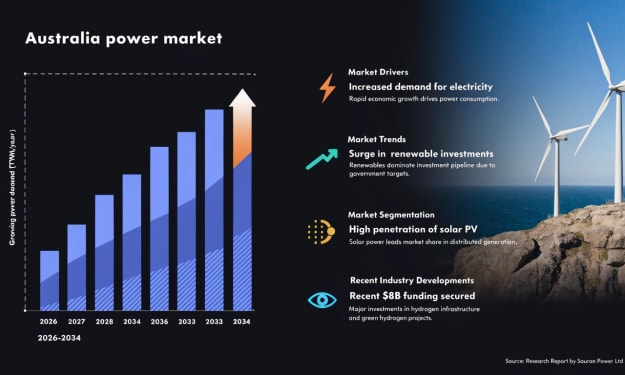
According to IMARC Group, the Australia power market reached 285.7 TWh in 2025 and is projected to reach 377.0 TWh by 2034, growing at a compound annual growth rate (CAGR) of 3.04% during 2026–2034. The market’s growth is being shaped by accelerating renewable energy adoption, increasing electricity demand and large-scale investments in grid modernization. Government incentives supporting clean energy transition, combined with rising corporate sustainability commitments, are encouraging the expansion of solar, wind and battery storage infrastructure. At the same time, the gradual phase-out of coal-fired power plants is transforming the structure of Australia’s electricity generation mix. With emerging technologies such as hydrogen energy systems and virtual power plants gaining traction, Australia’s power sector is evolving into a more diversified, digitally integrated and sustainable energy ecosystem.
By Kevin Cooper4 days ago in Futurism



Comments
There are no comments for this story
Be the first to respond and start the conversation.