
AI Coding Assistants Revolutionizing Software Development in 2026
Exploring how autonomous agents and predictive logic are reshaping the workflow of modern developers and engineering teams.

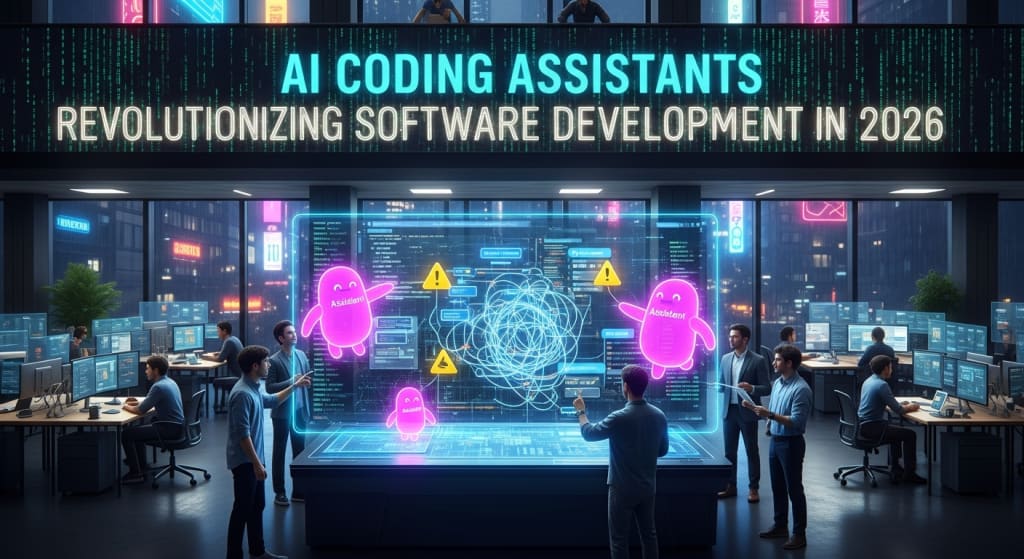
We are now moving through the year 2026. The landscape of software engineering has shifted significantly. It moved from manual syntax entry to high-level system orchestration. System orchestration means managing complex automated tasks and components. The rise of AI coding assistants has changed everything. These tools moved beyond simple autocomplete features. They now operate within the realm of autonomous "agentic" workflows. Agentic workflows allow AI to act as an independent worker. It can plan and execute multi-step technical tasks alone. Today, developers spend less time worrying about semicolons. They focus more on architecture, security, and user experience.
These tools are no longer just simple plugins. They are integrated partners in the development process. These partners understand the entire lifecycle of a project. They leverage large language models for this purpose. These models are specifically tuned for logic and reasoning. These assistants help teams bridge a major gap. They connect complex requirements to functional, scalable code.
The Change from Autocomplete to Autonomous Agents
AI tools were mostly reactive in the early 2020s. They only gave suggestions when you pressed a key. By 2026, the model has changed to one that encourages proactive help. Proactive assistance means the AI acts before you ask. Modern AI agents can now scan an entire repository. They identify technical debt and suggest refactoring patterns. Technical debt refers to messy code that causes future problems. Agents do this before a developer opens a specific file.
The primary problem these tools solve is cognitive load. Cognitive load is the mental effort required to finish tasks. Managing massive, aging codebases creates high cognitive load. Developers used to spend hours tracing a single bug. They searched through many nested dependencies. Now, developers use AI-driven observability to pinpoint causes. They can find the root cause in mere seconds. This allows for a consistent "flow state" for engineers. Flow state was previously interrupted by constant documentation searches. It was also interrupted by repetitive boilerplate generation. Boilerplate is standard code used in many places.
A Framework for 2026 AI Integration
Engineering teams are now adopting a new framework. It is called the "pilot-navigator" framework for integration. In this model, the AI acts as the pilot. The pilot handles the execution of standard patterns. It also manages unit tests and technical documentation. The human developer acts as the navigator. The navigator provides the strategic direction for the project. They ensure the output aligns with business goals.
Key components of this framework include:
- Contextual Awareness: Assistants now ingest project-specific style guides.
- They also read internal documentation to ensure consistency.
- Real-time Security Scanning: Vulnerabilities are caught during the writing phase.
- This replaces the old method of catching bugs at the gate.
- A deployment gate is a final check before publishing code.
- Traditional gates often cause long delays for dev teams.
- Automated Documentation: AI generated summaries now accompany every pull request.
- These summaries explain the "why" behind the "what."
Strategic Implementation and Local Ecosystems
The technology behind AI coding is global. However, implementation of high-end software requires a specialized touch. Companies often seek mobile app development Minnesota. These companies are looking for specific types of partners. They want partners who combine AI tools with local expertise. This blend ensures the code is generated very efficiently. It also ensures the final product resonates with users. Users in the Midwest have specific tech expectations. There are also regional regulatory rules that must be met.
Local development hubs can now compete with global giants. They maintain lower overhead by using AI assistants. They also achieve much faster ship times for products. Teams in regions like the Twin Cities use these tools. They build sophisticated enterprise applications with them. These projects previously required twice the headcount. They also required double the original budget to complete.
The 2026 Developer Blueprint
Developers should follow a structured approach this year. This helps them maximize the value of AI assistants. This approach is known as the 2026 Developer Blueprint.
- Requirement Mapping: Use AI to break down business requirements.
- Turn high-level goals into technical sub-tasks automatically.
- Skeleton Generation: Allow the assistant to generate the boilerplate.
- Let it create the initial structure of the module.
- Logic Refinement: Review the logic created by the AI.
- Focus specifically on edge cases that require human intuition.
- Edge cases are rare problems that happen at extremes.
- Validation: Deploy automated test suites generated by the AI.
- This ensures that you have 100% code coverage.
This blueprint reduces the "time-to-first-commit" significantly. The reduction is nearly 60% compared to 2023 standards. This allows for very rapid prototyping and iteration cycles.
Risks, Tradeoffs, and Human Oversight
The 2026 landscape is not without its challenges. Efficiency gains come with new and unique risks. Over-reliance on AI can lead to "code blindness." Code blindness happens when developers approve unknown logic. They might not fully comprehend the blocks of code. This creates a risk of long-term maintenance issues. The AI might make subtle logical errors in code. These errors might even pass the automated tests. To prevent this, teams must perform manual logic audits. They must verify the AI's reasoning on critical paths.
Data privacy also remains a significant concern today. Organizations must ensure their assistants run in "private mode." Private mode prevents proprietary code from leaking out. It stops code from being used to train public models. Premium, secure enterprise AI seats are also expensive. This cost can be a barrier for smaller startups. However, the ROI in saved man-hours is usually high. It typically offsets the subscription fees very quickly. Most companies see this benefit within the first quarter.
Conclusion and Key Takeaways
The role of the developer is evolving in 2026. Developers are becoming high-level digital architects. AI coding assistants have eliminated the drudgery of boilerplate. They have also removed the pain of manual debugging. However, they have increased the demand for critical thinking. System design skills are now more important than ever.
Key Takeaways:
- Autonomy is standard: AI now handles entire tasks.
- It no longer just suggests single lines of code.
- Security is shifted left: Vulnerability detection happens in real-time.
- Scanning occurs directly within the developer's IDE.
- Human oversight is non-negotiable: AI is a force multiplier.
- It is not a complete replacement for senior expertise.
- Localization matters: Use AI alongside local specialists.
- This ensures high-tech solutions meet specific regional needs.
We look toward the remainder of 2026 now. The focus will stay on refining human-machine collaboration. We will continue to balance creativity with machine efficiency.
About the Creator
Keep reading
More stories from Devin Rosario and writers in Futurism and other communities.
Top AI Coding Assistants for Efficiency in 2026
The landscape of software development has shifted. We moved from simple autocomplete tools to autonomous coding agents. These agents understand entire project architectures. In 2026, efficiency is not about typing speed. It is about how a developer orchestrates AI tools. They handle repetitive tasks. This lets the developer focus on high-level system design. This guide explores the premier AI assistants. These tools are currently dominating the industry. They are transforming the developer workflow.
By Devin Rosario2 months ago in Futurism
Health Insurance Market Trends: Preventive Care Incentives, Wellness Programs & Industry Forecast to 2034
Rising healthcare costs, a growing geriatric population, and the increasing prevalence of chronic diseases are driving global health insurance demand, supported by digital transformation, value-based care models, and supportive government policies. According to IMARC Group’s latest data, the global health insurance market size was valued at USD 2,064.8 Billion in 2025. Looking forward, IMARC Group estimates the market to reach USD 3,510.3 Billion by 2034, exhibiting a CAGR of 5.80% from 2026-2034.
By Andrew Sullivan7 days ago in Futurism
Why Folding Bikes Are Redefining Urban Mobility?
With experimentation in new cross-urban public transport systems, folding bicycles are one of the most practical developments in personal transport for urban users․ These bicycles can be folded into a small size that is useful for commuters whose streets or public transportation may be congested․
By deepanshu Thakur7 days ago in Futurism
When the Shelter Closes
Across the street from my house, a man slept under a tree, his dog by his side. My first, naive thought: he must be traveling through. But he kept coming back, often sleeping there during the day. Then it hit me—that person might not have a home.
By Bride of Sound4 days ago in Humans


Comments
There are no comments for this story
Be the first to respond and start the conversation.