
Top AI Coding Assistants for Efficiency in 2026
Modern devs use specialized AI to automate boilerplate, debug logic, and maintain high-speed production cycles.

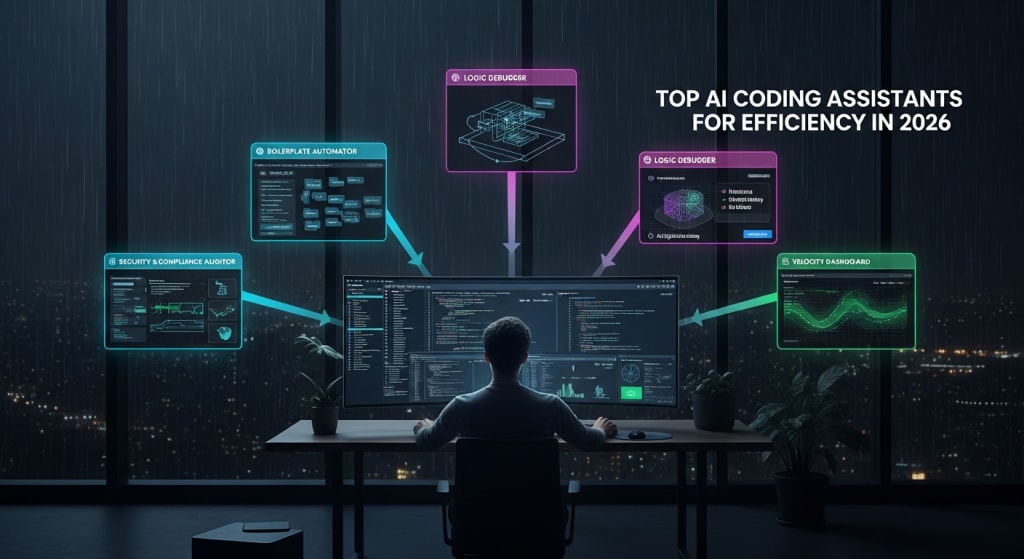
The landscape of software development has shifted. We moved from simple autocomplete tools to autonomous coding agents. These agents understand entire project architectures. In 2026, efficiency is not about typing speed. It is about how a developer orchestrates AI tools. They handle repetitive tasks. This lets the developer focus on high-level system design. This guide explores the premier AI assistants. These tools are currently dominating the industry. They are transforming the developer workflow.
The Challenge of Modern Code Velocity
Engineering teams in 2026 face a paradox. They have more powerful tools than ever. Yet, the complexity of modern systems has increased. This has increased the cognitive load on individual contributors. Traditional IDEs often fall short. They struggle with cross-service dependencies. They also struggle with legacy migrations. Developers frequently lose hours to context switching. They jump between documentation and terminal threads.
To solve this, current AI assistants have evolved. They moved beyond the "next-token prediction" model. They now use Retrieval-Augmented Generation. This is often called RAG. RAG allows the AI to scan your specific codebase. It ensures every suggestion is contextually aware. It follows your internal libraries and style guides. This reduces the rate of hallucinations. Earlier models in 2023 and 2024 had many errors. New models are much more reliable.
The 2026 Efficiency Framework
Developers now use a tiered framework. They choose tools based on the "Content Job" required. You might be troubleshooting a memory leak. You might be scaffolding a new microservice. Your tool should match the specific task.
1. Context-Aware Autocomplete
This is for real-time logic completion. It helps with rapid boilerplate generation. It predicts your next lines of code instantly.
2. Autonomous Agents
These are for complex, multi-file refactoring. They handle large dependency updates. They work across many files at once.
3. Terminal-Native Assistants
These are for infrastructure-as-code tasks. They excel at CLI-heavy operations. They automate server and cloud configurations.
Top AI Assistants for 2026
1. Cursor: The Native AI Code Editor
Cursor has solidified its position as the leader. It is an AI-first IDE. It is not just a simple plugin. It is a fork of VS Code. It was built to integrate LLMs into the core. The "Composer" feature is its best part. It lets developers describe features across multiple files. The AI handles simultaneous edits for you. This task previously took hours of manual work. Now it happens in seconds.
2. GitHub Copilot Extensions
In 2026, Copilot has evolved into a platform. It uses third-party extensions. It interacts with documentation from AWS and Azure. It also uses Stripe data inside the IDE. This minimizes the need to leave the editor. You do not have to check API specifications elsewhere. This significantly improves your flow state.
3. DeepSeek Coder V3
This is for teams prioritizing raw performance. It is best for technical precision. DeepSeek Coder V3 is a favorite for experts. It has specialized training on 2025 repositories. It handles cutting-edge frameworks with fewer errors. It is effective for low-level systems programming. It also works well for high-performance computing.
Implementation Blueprint for Minnesota Tech Teams
Many companies focus on mobile app development in Minnesota. Local engineering hubs in Minneapolis are adopting these tools. St. Paul startups are also using them to stay competitive. They want to compete with coastal firms. Integrating AI requires a systematic approach. You cannot just buy a subscription. You must follow a clear onboarding plan.
- Step 1: The Context Audit (Week 1) Identify which parts of your code are "AI-ready." This involves cleaning up your technical debt. Ensure your internal documentation is up to date. This helps the RAG systems provide accurate suggestions. Without good docs, the AI will fail.
- Step 2: Pilot Testing (Weeks 2–4) Assign a small group of senior developers. Let them test different assistants. A team of 14 developers may see gains. They might see a 22-35% improvement in turnaround. This applies specifically to PR generation.
- Step 3: Scaling & Governance (Month 2+) Establish clear rules on data privacy. Set rules for code attribution. Ensure your team understands the human role. The human is still responsible for final audits. The human must verify all logic.
Risks and Tradeoffs
The gains are significant but have limits. Over-reliance can lead to "code bloat." Developers might accept every suggestion without thinking. Junior developers may find their learning slowed. They might rely on AI for every error. They must still understand the underlying principles. Do not let the tool replace the brain.
Summary of Key Takeaways
- Context is King: The best assistants understand your project architecture.
- Focus on Logic: Use AI for the "how" of syntax.
- Focus on "Why": Focus your human energy on system design.
- Continuous Evaluation: Review your tool stack every six months.
- Stay Updated: New model iterations arrive very quickly.
The future of software engineering is collaborative. It is not just between humans. It is between developers and digital partners. Adopt the right framework today. Ensure your team remains efficient through 2026.
About the Creator
Keep reading
More stories from Devin Rosario and writers in Futurism and other communities.
Top 5 AI Innovations Shaping Marketing Trends in 2026
As of early 2026, the marketing landscape has shifted. It moved from a "predictive" model to an "agentic" one. This change impacts the Twin Cities and the entire nation. Static chatbots and basic automation are now behind us. Local innovators from Bloomington to Duluth are navigating a new reality. Algorithms no longer just suggest content. They actively negotiate it. In 2025, self-reported attribution from AI sources grew by 9.25%. This trend accelerated into a full-scale revolution in 2026. (Source: Cognism, 2025).
By Devin Rosario3 months ago in Futurism
Lignans Market Outlook: Functional Food Demand and Nutraceutical Growth Opportunities
According to IMARC Group's latest research publication, The global lignans market size reached USD 463.2 Million in 2024. Looking forward, IMARC Group expects the market to reach USD 794.6 Million by 2033, exhibiting a growth rate (CAGR) of 5.69% during 2025-2033.
By James Whitman7 days ago in Futurism




Comments
There are no comments for this story
Be the first to respond and start the conversation.