
AI-based Trend in Content Creation
Revolutionizing Creativity: How Artificial Intelligence is Transforming the Future of Video, Art, and Storytelling


In a quiet room lit by the soft glow of multiple screens, a young content creator named Mira sat staring at her monitor. Just five years ago, she would have needed a full team — a videographer, a sound designer, an editor, and a marketing strategist — to produce her content. But now, in 2025, she was working alone, with only one partner: an artificial intelligence system named “AURA.” Together, they were redefining what it meant to be creative in the digital age.
The Rise of AI in the Creative World
The evolution of content creation has always been tied to technology. From the invention of the printing press to the rise of digital cameras and editing software, each innovation democratized creativity. But none have been as disruptive or transformative as artificial intelligence. AI has crossed the boundary from being a mere tool to becoming a true collaborator.
In 2023, AI image generators like Midjourney and DALL·E captured public fascination. Soon after, large language models capable of writing scripts, stories, and even entire books began to emerge. By 2024, AI video generation entered the mainstream, enabling anyone with an idea to turn text prompts into cinematic experiences. And in 2025, the fusion of these technologies — video, text, voice, and emotion recognition — gave rise to what many call the “Age of Intelligent Creation.”
From Tools to Partners
Mira wasn’t just using AURA to save time. She treated it as a partner, capable of understanding her style and goals. She could say, “AURA, create a two-minute inspirational short about overcoming failure,” and within minutes, AURA would generate a storyboard, choose background music, and even simulate facial expressions for animated characters.
But what fascinated Mira most wasn’t the speed — it was the depth. The AI could interpret emotion, context, and narrative flow. It learned from Mira’s previous projects, adapting to her tone and artistic preferences. Every collaboration refined the AI further, turning it into a mirror of her own creativity.
Across the globe, similar stories unfolded. Writers used AI to overcome writer’s block. Musicians composed songs with AI harmonies. Digital artists co-created surreal masterpieces with machine learning algorithms. The line between human and machine imagination began to blur.
The Democratization of Creativity
For centuries, creativity was often tied to privilege — those with resources could produce, and those without could only consume. But AI changed that. Now, a teenager in a remote village with nothing but a smartphone could generate professional-quality videos, animations, and songs.
Platforms like “DreamCreate” and “NeuraVision” allowed users to collaborate with AI models directly in their browsers. A single sentence could become a 3D short film. A photo could evolve into a virtual world. The cost barrier of creativity was crumbling, replaced by a world where ideas alone held power.
Educational systems began to shift, too. Schools introduced “AI Art Labs” and “Creative Machine Partnerships” as part of their curriculum. Students learned not just how to use AI, but how to think creatively with it — how to prompt effectively, critique algorithmic results, and maintain ethical storytelling.
The Ethical Crossroads
However, with great innovation came new dilemmas. The use of AI-generated content raised questions about authenticity, originality, and intellectual property. Who owns a piece of art created by both a human and a machine? How do we distinguish between genuine human expression and algorithmic mimicry?
Some artists feared being replaced. Others saw AI as a creative amplifier — a way to explore ideas faster, deeper, and more experimentally than ever before. Organizations began developing ethical frameworks, ensuring transparency in AI-aided creations. New labels appeared online: “AI-assisted,” “co-created,” and “machine-generated.”
Governments also stepped in, introducing laws to protect both creators and consumers from misinformation and deepfakes — especially as AI video generators became powerful enough to create lifelike simulations of real people.
The Human Element That Machines Can’t Replace
Despite all these advancements, one truth remained unshakable: AI could imitate human creativity, but it couldn’t replace the soul behind it. Machines could compose melodies, but they didn’t know heartbreak. They could write poetry, but they had never felt love or loss.
Mira often reminded herself of this when she worked. She used AI not as a crutch, but as a canvas — a tool that expanded her imagination. AURA might generate hundreds of visual ideas, but it was Mira’s emotional choices — the lighting she preferred, the pacing she loved, the moments of silence she inserted — that made her work feel human.
A New Era of Collaboration
By late 2025, AI had become an inseparable part of the global creative economy. Major studios used AI to pre-visualize entire films before production. Independent creators earned full-time incomes from AI-generated shorts. Musicians collaborated with AI to produce immersive soundscapes tailored for virtual reality concerts.
Mira’s work, for instance, reached millions online. Her audience knew that she used AURA, but they didn’t care — because the emotional core of her stories still resonated deeply. Her AI wasn’t replacing her creativity; it was amplifying it.
AI had not taken creativity away from humans — it had given it back. It had removed the technical and financial walls that once held ideas captive. Now, anyone could dream, design, and deliver.
The Future Ahead
Looking forward, experts predict even more profound shifts. AI systems are evolving toward emotional intelligence — understanding tone, context, and human sensitivity. Imagine an AI that could analyze global moods and create art reflecting collective emotions. Or systems that help people process trauma through personalized visual storytelling.
But the most exciting part isn’t what AI will create — it’s what humans will do with it. The real revolution isn’t in the technology itself, but in the partnership it forms with human imagination. Together, they are redefining art, culture, and communication for generations to come.
Mira looked at the final video AURA had helped her craft — a story about hope in an uncertain world. She smiled and whispered, “Let’s publish it.”
And as the video went live, somewhere across the world, millions of others — artists, students, dreamers — were doing the same, united by one simple truth: creativity had entered its most limitless era yet.
About the Creator
[email protected]
Living life, one smile at a time 😎
Coffee lover ☕ Dreamer 🌟"
Just vibin’ and creating memories ✌
Curious mind, happy heart 💛
Chasing sunsets and good vibes 🌅
.
Keep reading
More stories from [email protected] and writers in Futurism and other communities.
Political instability & protests in various countries
In the autumn of 2025, the world found itself vibrating with a familiar yet amplified tension — the sound of dissent. From the bustling streets of Paris to the dusty avenues of Nairobi, from the plazas of Buenos Aires to the high-tech boulevards of Seoul, humanity was once again taking to the streets. The reasons were many — corruption, inequality, injustice, economic hardship — but the spirit behind them was singular: the call for change.
By [email protected]5 months ago in Futurism
Australia Private Equity Market: Capital Inflows, Deal Activity & Strategic Exits
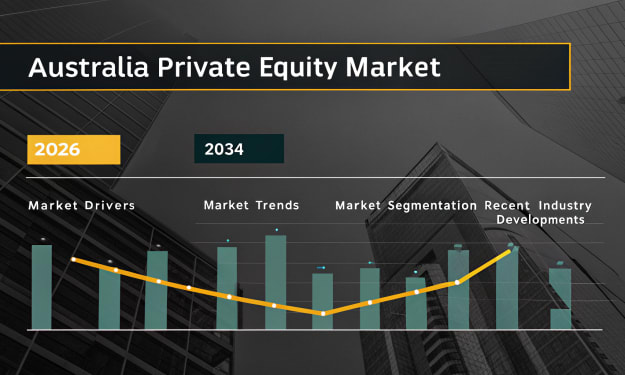
According to IMARC Group, the Australia private equity market reached USD 23.9 Billion in 2025 and is projected to grow to USD 48.5 Billion by 2034, exhibiting a compound annual growth rate (CAGR) of 8.21% during 2026–2034. The market’s expansion reflects increasing capital inflows, rising institutional participation, and strong deal-making activity across key sectors in Australia. Demand for buyout funds, venture capital investments, and infrastructure-focused portfolios is accelerating as investors seek higher returns and portfolio diversification. With strong opportunities in technology, healthcare, renewable energy, and real estate, Australia private equity market share continues to expand within both domestic and cross-border investment ecosystems.
By Kevin Coopera day ago in Futurism
Australia Robotics Market: Industrial Automation, AI Integration & Application Expansion
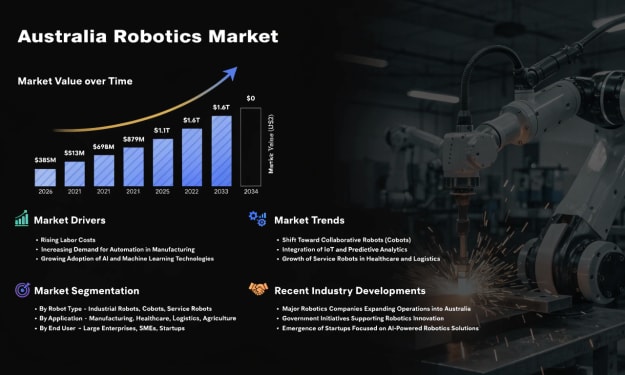
According to IMARC Group, the Australia robotics market reached USD 1.5 Billion in 2024 and is projected to expand to USD 6.7 Billion by 2033, exhibiting a robust compound annual growth rate (CAGR) of 16.20% during 2025–2033. This remarkable growth underscores Australia’s accelerating transition toward automation and intelligent systems across Australia. Robotics—spanning industrial arms, autonomous vehicles, service robots and AI-enabled collaborative systems—has evolved from niche industrial tools into critical infrastructure for manufacturing, mining, healthcare, agriculture and logistics. As businesses prioritize efficiency, productivity and safety, robotics adoption is becoming central to Australia’s digital and industrial transformation strategy.
By Shrestha Roy7 days ago in Futurism
A Historic Declaration
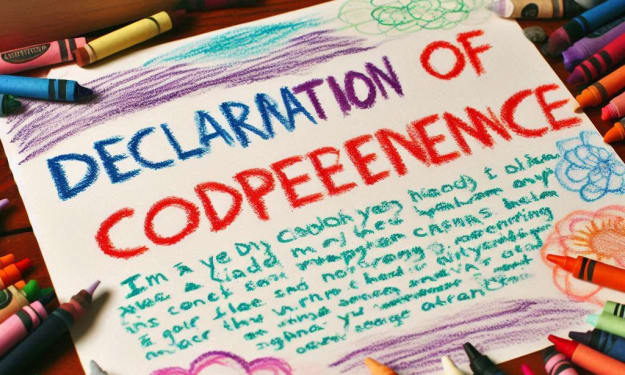
We the People of the Husbands of the United States of America, in Order to form a more perfect Union, and I mean you...with me...establish Justice, insure domestic Tranquility, provide for the common defence, promote the general Welfare, and secure the Blessings of Liberty to ourselves, after Puberty, do ordain and establish this Declaration of Co-Dependence.
By Gerard DiLeo5 days ago in Humans

Comments
There are no comments for this story
Be the first to respond and start the conversation.