
AI and the Human Condition: Rethinking What It Means to Be Human in the Age of Machines
A philosophical exploration of how artificial intelligence is reshaping our understanding of consciousness, empathy, and what makes us truly human.
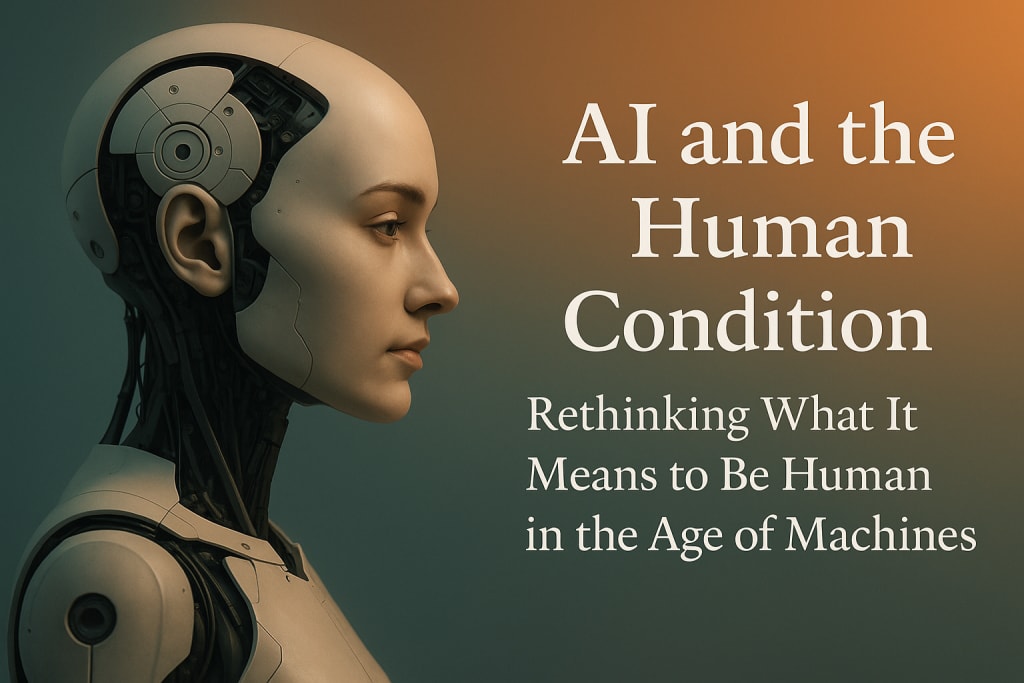
In an age where artificial intelligence writes poetry, diagnoses illnesses, and even simulates empathy, we are prompted to ask a timeless question in a new context: What does it mean to be human?
AI’s rapid integration into daily life has sparked a cultural and philosophical reckoning. No longer confined to science fiction, intelligent machines are reshaping our workplaces, relationships, and even the way we perceive ourselves. As AI becomes more humanlike, we are compelled to redefine our uniqueness—not just in terms of what we can do, but what we should be.
The Machine Mirror
One of the most revealing aspects of AI is how it reflects the human mind. Algorithms are built on datasets derived from human behavior—our choices, language, and values. In training machines to mimic us, we inadvertently hold up a mirror to ourselves. This reflection is sometimes flattering, showcasing our intelligence and creativity. But often, it is troubling, exposing our biases, contradictions, and inconsistencies.
AI has no soul, yet it can appear soulful. It does not feel joy, grief, or longing, but it can replicate language that gives the illusion of emotion. This illusion is powerful—and dangerous. If a machine can simulate love, does it truly feel it? And if not, how do we differentiate authentic connection from programmed mimicry?
This blurring of emotional authenticity is where the human condition enters a new frontier. Our definitions of consciousness, empathy, and morality are being tested not by other humans, but by the machines we’ve created.
The Crisis of Uniqueness
For centuries, humans believed their intelligence set them apart. We built civilizations, wrote literature, composed symphonies, and created art as proof of our cognitive superiority. But now, AI can generate music in the style of Bach, write sonnets that echo Shakespeare, and even paint portraits with unsettling originality.
This raises an existential tension: if machines can replicate the products of human creativity, does our creativity lose value? The answer lies not in what AI produces, but in what humans experience. A painting crafted by AI may be aesthetically pleasing, but it lacks the context of human struggle, emotion, and story. What AI lacks is not talent, but intention. It cannot mean what it creates—only simulate meaning.
Our uniqueness may no longer rest in our intellectual capabilities alone, but in our capacity to suffer, to hope, to care, and to choose meaning in the face of meaninglessness. In a world increasingly governed by automation, the most human trait may be our irrationality—our stubborn insistence on love, art, and purpose even when they're inefficient or unprofitable.
Emotional Machines, Emotional Humans
AI is being trained to respond with increasing sensitivity. Chatbots now express sympathy, virtual therapists offer comfort, and robots are used in elder care to provide companionship. But can machines truly be empathetic?
The answer lies in the difference between simulation and sensation. Empathy, in humans, is not just cognitive—it is somatic and emotional. We feel others' pain. AI, however, only processes patterns and responds according to learned behavior. While this can be useful, even life-saving, it should not be mistaken for genuine empathy.
Yet, paradoxically, the rise of emotionally responsive AI may help us become more human. In contrast to synthetic emotion, we are reminded of what real connection feels like. The question then becomes not whether AI can be human, but whether humans will remember how to be human in an increasingly synthetic world.
The Ethical Reckoning
At the heart of this transformation is an ethical imperative: How do we ensure that AI enhances rather than erodes the human experience?
AI amplifies the values embedded within it. If we program it with narrow definitions of success, it may prioritize efficiency over empathy. If we train it on biased data, it may perpetuate inequality. If we design it to replace rather than support, it may alienate rather than empower.
Thus, the true test of AI is not technological, but moral. How we build and deploy it reflects our collective values. As we teach machines to understand us, we must simultaneously ask ourselves: What are we teaching them about what it means to be human?
Redefining Humanity
This moment in history offers not just a technological shift, but a philosophical one. The rise of AI does not necessarily diminish humanity—it challenges us to redefine it.
To be human in the age of machines may mean embracing our vulnerability rather than hiding it. It may mean choosing depth over speed, presence over automation, and community over convenience. It may mean resisting the temptation to offload every difficult task to a machine, and instead using AI to enrich, not replace, our emotional and ethical lives.
Conclusion: Becoming More Human
AI will continue to evolve—faster and more intelligently than many of us are prepared for. But in its shadow lies an invitation: to reconnect with the very traits machines cannot replicate.
In rethinking what it means to be human, we are offered a mirror, a warning, and a possibility. The mirror shows us our strengths and flaws. The warning reminds us that unchecked technology can erode our essence. But the possibility—perhaps the most powerful of all—is that AI might lead us back to a deeper understanding of ourselves.
After all, it is not the machine that defines humanity—it is our response to it.
About the Creator
kritsanaphon
"A storyteller who dives deep into news, technology, and global cultures, sharing fresh perspectives you might never have seen before. Enjoy easy-to-read, insightful content with me in every article!"
Keep reading
More stories from kritsanaphon and writers in Futurism and other communities.
The Silent Revolution: How AI Is Reshaping the World Beyond the Screen
In the public imagination, artificial intelligence (AI) is often visualized as humanoid robots, supercomputers, or dystopian overlords. But in reality, the most transformative AI developments of our time are nearly invisible. They operate silently in the background of our digital lives, embedded in recommendation engines, financial algorithms, supply chains, and even healthcare diagnostics. And yet, their impact is far more sweeping than we typically acknowledge.
By kritsanaphon7 months ago in Futurism
About Binding Prometheus
I want to start actively advocating on behalf of my own work, and the most valuable part of my canon is, without a doubt, Binding Prometheus, the play I have been working on since 2019 and only finished in 2023 as part of my MA. The play itself is an amalgamation of a million different inspirations. On one end, it evokes the Ancient Greek myth-play, deriving its own title from the earliest extant work of Western drama we have, Aeschylus’s Prometheus Bound. On the other end, it borrows significantly from the sci-fi bulwarks from over the years, namely Mary Shelley’s Frankenstein and Karel Capek’s Rossum’s Universal Robots. The play could be an episode of Black Mirror, I fear. I don’t know. I’ve only ever seen one episode of Black Mirror.
By Steven Christopher McKnight19 days ago in Futurism
7 eCommerce App Development Companies Supporting Digital Retail Transformation in Dubai
Dubai’s retail landscape is rapidly evolving as businesses embrace digital-first and mobile-first strategies. From fashion and electronics to groceries and on-demand services, eCommerce applications now play a central role in how retailers engage customers, manage operations, and scale efficiently.
By Apptunix usa5 days ago in Futurism
Ludacris and Nelly draw backlash over bookings at MAGA-coded music festival
Ludacris and Nelly headlining a mostly right-wing event is good for them. It’s also great for the genre of hip hop. The two rap veterans have showcased their talents on other stages. Why can’t they perform for mostly MAGA folks and grab that bag?
By Skyler Saunders5 days ago in Beat


Comments (1)
AI's mimicking of us makes me wonder: are our unique traits really that special if machines can copy them? It blurs the line between us.