
Africa’s Giant Eye Turns 20
Celebrating two decades of discovery, innovation, and inspiration from the Southern African Large Telescope
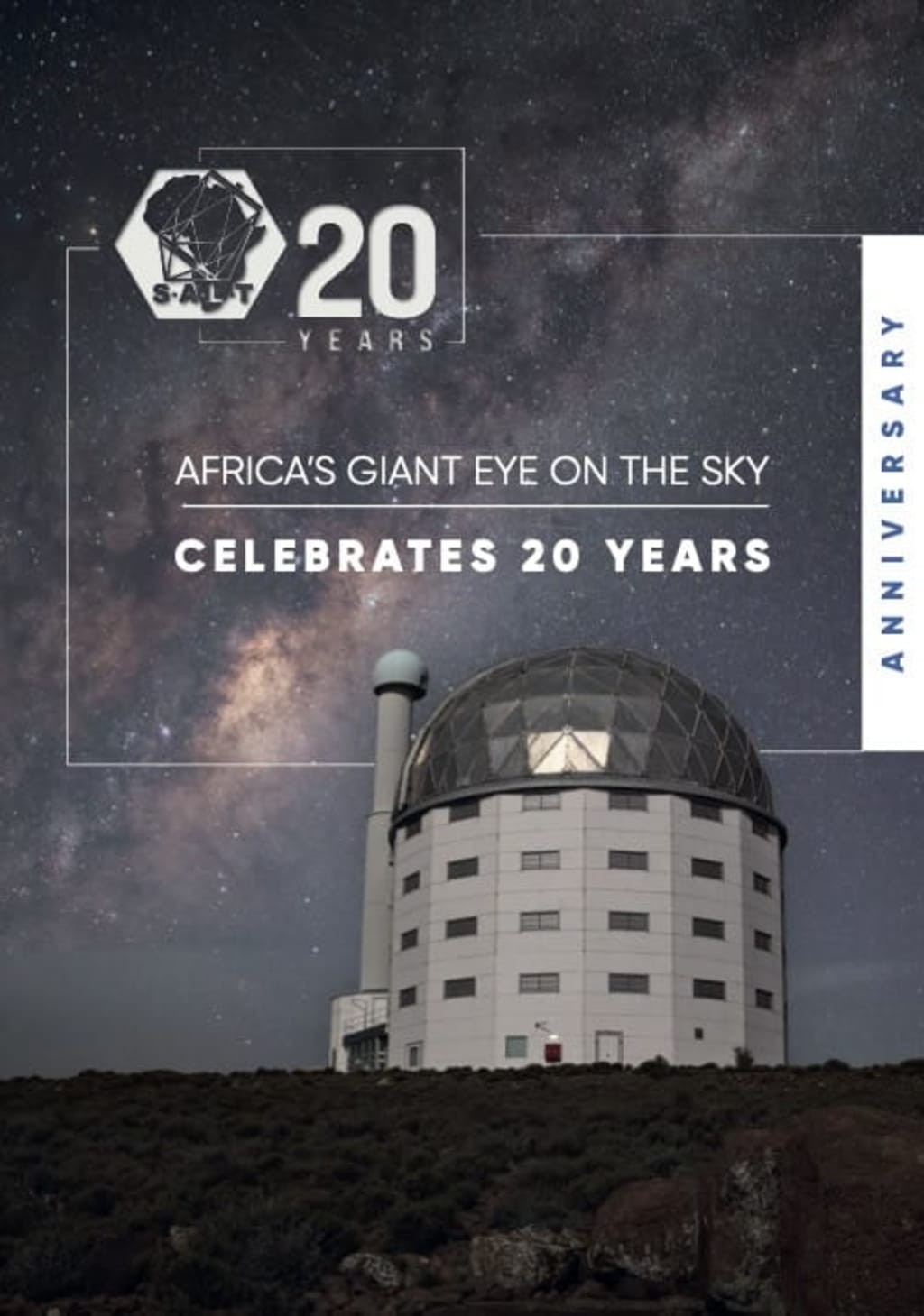
Imagine looking billions of light-years into the universe from a quiet desert town in South Africa. That is exactly what the Southern African Large Telescope, or SALT, has been doing for twenty years.
Twenty years ago, in the Karoo town of Sutherland, a group of dreamers set out to achieve what few thought possible. They wanted to build one of the most powerful telescopes on Earth. That dream became reality in 2005 with the opening of SALT, Africa’s largest optical telescope and one of the most advanced in the world.
Its 20-year anniversary is more than a scientific milestone. It is a story of courage, determination, and belief in what Africa can achieve. The Karoo region was chosen for its exceptionally clear skies, dry climate, and minimal light pollution, making it ideal for observing faint celestial objects.
When SALT was first proposed in the late 1990s, many doubted whether such an ambitious project could succeed. Scientists, engineers, and leaders pressed ahead, determined to show that world-class science could thrive on African soil. The telescope features a 10-meter segmented mirror, designed to capture light from objects billions of times fainter than what the human eye can see. Its innovative design allows for precise observation of distant galaxies, stars, and other celestial phenomena.
At the anniversary celebration, Professor Brian Chaboyer, Chair of the SALT Board, called the decision to build the telescope a leap of faith that changed the course of African astronomy. Every large telescope before SALT had been built outside South Africa until this one.
Dr. Nomalungelo Gina, Deputy Minister of Science, Technology and Innovation, said the telescope was built not only for science but also for society, to inspire, educate, and show that Africa can lead in global discovery. She emphasized that SALT serves as a bridge between research, technology, and education, creating opportunities for young scientists across the continent.
Since its inauguration by former President Thabo Mbeki, SALT has done more than capture light from distant galaxies. It has shaped lives. Over fifty doctoral theses have been completed using SALT data, and hundreds of students have trained at the observatory, gaining hands-on experience in astronomy, engineering, and data analysis. Many of these students now work in leading research and technology positions around the world, carrying the knowledge and inspiration gained at SALT into new discoveries.
For Professor Mosa Moshabela, Chair of the National Research Foundation, SALT’s greatest achievement is its people. Every discovery made involves a student, a technician, or a scientist whose growth tells a story of progress. He noted that SALT has also fostered international collaboration, linking South African researchers with institutions in Europe, the United States, and beyond.
Known as Africa’s Giant Eye on the Sky, the telescope continues to make groundbreaking discoveries, from mapping distant galaxies to studying the behaviour of stars and cosmic phenomena. It stands as proof of what vision, determination, and partnership can achieve.
Twenty years later, SALT continues to explore the universe and inspire new generations. It remains a symbol of African innovation and ambition, showing that with patience, dedication, and cooperation, even the most distant stars are within reach.
Today, SALT stands not only as a tool for exploring the cosmos but as a beacon of what is possible when vision, courage, and collaboration come together. It reminds us that scientific discovery is not just about observing distant stars, but about empowering people, fostering innovation, and inspiring generations to reach beyond what seems possible. As Africa’s Giant Eye continues to scan the heavens, it carries with it the dreams, dedication, and determination of everyone who made it a reality.
This article was drafted and edited with the assistance of AI technology.
About the Creator
Keep reading
More stories from writers in Futurism and other communities.
About Binding Prometheus
I want to start actively advocating on behalf of my own work, and the most valuable part of my canon is, without a doubt, Binding Prometheus, the play I have been working on since 2019 and only finished in 2023 as part of my MA. The play itself is an amalgamation of a million different inspirations. On one end, it evokes the Ancient Greek myth-play, deriving its own title from the earliest extant work of Western drama we have, Aeschylus’s Prometheus Bound. On the other end, it borrows significantly from the sci-fi bulwarks from over the years, namely Mary Shelley’s Frankenstein and Karel Capek’s Rossum’s Universal Robots. The play could be an episode of Black Mirror, I fear. I don’t know. I’ve only ever seen one episode of Black Mirror.
By Steven Christopher McKnight19 days ago in Futurism
Saudi Arabia Cloud Computing Market & Forecast 2025–2033
Introduction Saudi Arabia’s digital transformation is entering a decisive phase, with cloud computing at the core of the Kingdom’s technology roadmap. As enterprises, government agencies, and startups accelerate their shift toward digital platforms, cloud infrastructure is rapidly becoming the backbone of innovation, efficiency, and scalability across industries.
By jaiklin Fanandish5 days ago in Futurism


Comments
There are no comments for this story
Be the first to respond and start the conversation.