
A Tapestry of Tomorrow
Bridging Earth and Mars in the Age of Connection

---
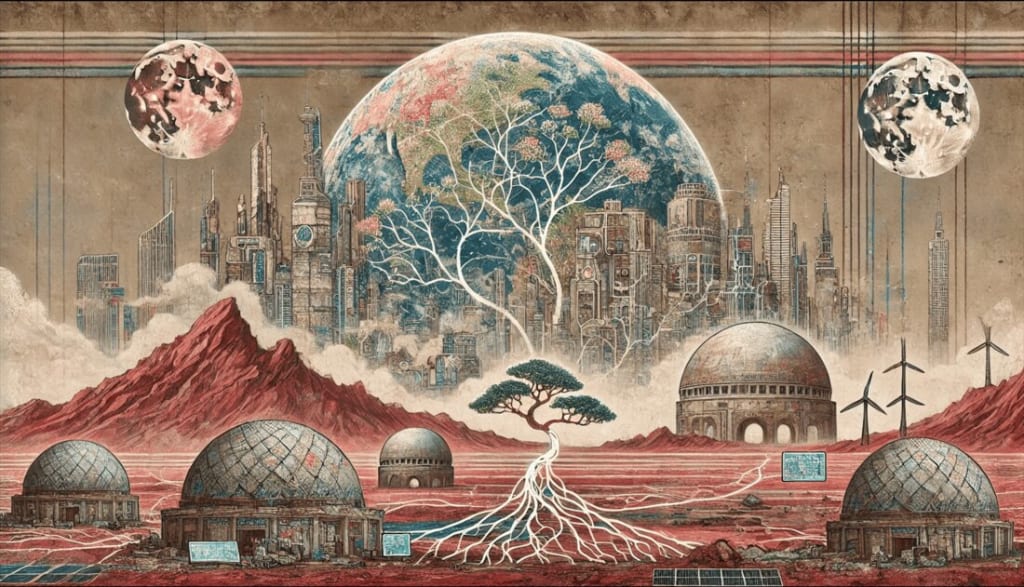
In 2050, the world hummed with an energy unlike anything the past could have imagined. Skyscrapers woven with living algae lit up the night sky with bioluminescent threads, absorbing carbon by day and exhaling oxygen by night. Humanity had not only survived the challenges of climate change, resource scarcity, and technological disruption—it had thrived. But the most unexpected evolution lay not in the gleaming cities or Martian colonies, but in the hearts and minds of people who had learned to live differently.
In this tapestry of the future, Rhea Patel was a weaver.
At 26, Rhea was already one of the leading architects of the WorldLink Network—a decentralized system that allowed individuals to connect their thoughts, emotions, and dreams directly through a neural interface. What had begun as a tool for education and therapy had become a new cultural frontier. People now shared not just photos or words but fragments of their lived experiences, building empathy and understanding at a scale unimaginable a generation ago.
This morning, as sunlight filtered through the pearlescent trees of Delhi’s Urban Oasis District, Rhea prepared for her most ambitious project yet: bridging the minds of two very different communities, one on Earth and the other on Mars.
The Martian Colony, established in the 2030s, had grown into a bustling outpost of 50,000 residents, many of whom had never set foot on Earth. Distance and time delays had made communication between planets formal and detached. But the WorldLink Network, with its quantum entanglement-driven connections, promised to change that. For the first time, humans on Earth and Mars would feel what it was like to walk in each other’s shoes—or, as Rhea put it, "to walk in each other's worlds."
The room hummed softly as Rhea synced her interface. The process required a careful calibration of sensory data streams: the crunch of Martian sand underfoot, the faint metallic tang of its thin air, the alien pull of its weaker gravity. On Earth, she prepared to send her memories of the vibrant chaos of Delhi—the aroma of freshly fried pakoras, the laughter of street vendors, and the warm, humid air that wrapped around you like a living thing.
Her partner in the experiment was Ezra Lee, a second-generation Martian and astrophysicist known for his work on terraforming. Ezra had only seen Earth in old holovids. To him, Earth was a mythical Eden, lush and overwhelming. Yet, Rhea sensed his longing for the vibrant culture and human density Earthlings often took for granted.
As their minds connected, the first sensations were cautious, like two hands reaching out in the dark. Ezra gasped as he felt the vivid textures of Earth’s streets—so crowded, so noisy, so alive. Meanwhile, Rhea’s breath caught at the quiet majesty of Mars. Its red deserts were vast and silent, the kind of silence that carried the weight of a thousand untold stories.
But the experiment wasn’t just about sensory immersion; it was about understanding. Through the link, Rhea felt Ezra’s yearning for home—not Earth, but the fragile, red-tinted community he had grown up in. She felt his fears, too: the isolation, the fear of a colony collapse, the pressure to succeed in an environment where every mistake could mean death. In return, Ezra glimpsed Rhea’s childhood memories: summers with her grandmother under banyan trees, her first attempts to code on a hand-me-down tablet, her relentless drive to create a world where no one felt alone.
When the connection broke after two hours, Rhea and Ezra were left trembling, tears streaking their faces. Neither could speak for several moments. The experiment had worked—but it had done more than either had anticipated. They had not merely shared experiences; they had shared each other’s humanity.
---
The days that followed were a whirlwind. News of the Earth-Mars link spread like wildfire, sparking debates about privacy, identity, and the limits of empathy. Critics warned of the dangers of cultural homogenization, of the potential loss of individuality in a hyperconnected world. But for Rhea and Ezra, the project wasn’t about erasing differences—it was about celebrating them.
In the weeks to come, the link expanded. Martian poets shared their odes to the "two suns" of Phobos and Deimos, while Earth musicians composed symphonies inspired by Mars’s haunting stillness. Students on Earth learned to solve problems in Martian gravity, while Martian children dreamed of Earth’s vibrant rainforests. The barriers of distance and difference began to dissolve, replaced by a shared curiosity and wonder.
But not everyone embraced the new connection.
Deep in the Pacific, a small group of tech-resistant "Disconnectors" held onto a different vision of the future. For them, the world’s growing dependence on technology threatened the purity of the human experience. Among them was an artist named Nia Torres, who painted vast murals depicting a world untouched by machines. When asked why she resisted the WorldLink, she replied, “Some beauty comes from not knowing. From the spaces between us.”
Rhea respected Nia’s perspective but disagreed. To her, the WorldLink wasn’t about erasing mystery—it was about creating bridges where walls once stood. Still, Nia’s words lingered in her mind as she prepared for the next phase of the project: connecting not just individuals, but entire ecosystems.
---
The year was 2051 when the first interspecies link was achieved. A team of biologists and engineers used the WorldLink to connect a human mind with that of a bottlenose dolphin. The experience was disorienting and overwhelming—a rush of sonar pulses, a sense of playfulness, and an alien yet strangely familiar intelligence. The experiment was hailed as a breakthrough in understanding non-human consciousness.
Rhea watched the world change around her. By 2055, humans were linking with everything: whales, trees, even the ancient fungal networks that stretched beneath forests. The world began to feel less like a collection of separate entities and more like a single, interconnected organism. Nations once divided by politics and resources collaborated on projects that spanned continents and planets. Climate recovery accelerated as humanity began to understand the Earth not as a resource to exploit but as a living system to nurture.
Yet, through it all, Rhea remained grounded. For all the wonders of technology, she knew the true miracle lay in people—their capacity to dream, to adapt, to find hope even in the face of uncertainty. The future, she realized, wasn’t something to fear or to wait for. It was something to weave, thread by thread, with the hands and hearts of everyone who dared to imagine it.
---
By 2060, when Rhea looked out at the world—Earth, Mars, and beyond—she saw a tapestry richer than anything she could have dreamed. A tapestry of connection, resilience, and endless possibility.
The future, she thought, was not a place. It was a promise.
About the Creator
Keep reading
More stories from Autumninspace and writers in Futurism and other communities.
About Binding Prometheus
I want to start actively advocating on behalf of my own work, and the most valuable part of my canon is, without a doubt, Binding Prometheus, the play I have been working on since 2019 and only finished in 2023 as part of my MA. The play itself is an amalgamation of a million different inspirations. On one end, it evokes the Ancient Greek myth-play, deriving its own title from the earliest extant work of Western drama we have, Aeschylus’s Prometheus Bound. On the other end, it borrows significantly from the sci-fi bulwarks from over the years, namely Mary Shelley’s Frankenstein and Karel Capek’s Rossum’s Universal Robots. The play could be an episode of Black Mirror, I fear. I don’t know. I’ve only ever seen one episode of Black Mirror.
By Steven Christopher McKnight16 days ago in Futurism
Saudi Arabia Fuel Station Market: Retail Network Expansion, Mobility Demand & Market Growth
According to IMARC Group's latest research publication, Saudi Arabia fuel station market size was valued at USD 871.8 Million in 2025. The market is projected to reach USD 1,122.7 Million by 2034, exhibiting a growth rate of 2.85% during 2026-2034.
By Suhaira Yusuf4 days ago in Futurism


Comments
There are no comments for this story
Be the first to respond and start the conversation.