

It is difficult for me to grasp the concept that everything I see before me did almost not exist.
I see my beautiful children, and best yet, my grandchildren.
The balloons are lovely. Red, green, gold. Colors of warmth in a cold world.
Look at my eldest granddaughter. A conglomeration from black and white, green eyes, curly, frizzy, dirty blonde hair. If it wasn’t for her stubborn mother, she would have been a fashion model.
And to think, and my heart bleeds when I say this, that their existence might probably would have been unthought of.
“Hi grandma. Why aren’t you having any fun? After all, it is your birthday.”
“At my age, you look at fun, and try not to break your hip having it. Come my child. You are my first grandchild, and I am going to tell you a story.
I was seventeen, living on the island, not here in the U.S., when I got the opportunity to work as a secretary’s assistant at a hospital. It was great. The pay was okay, by today’s standards. It kept my brother and sister’s tummies full. It also eased some burden off my parents.
What made the job awesome was that I could go anywhere in the hospital, wherever the secretaries would send me. Whether it was to deliver mail, get signatures, anything they needed.
One day I overheard a doctor and a nurse screaming at each other. I was in the closet restocking supplies. It wasn’t difficult to listen to their conversation. The walls had apertures up top, overlooking the other rooms. It was to keep the cement cool and hardened, as tropical weather could sometimes be unfair to structures. And the ventilation helped to keep the rooms fresh.
The nurse was crying because she did not like what she helped the doctor do.”
“What did they do?”
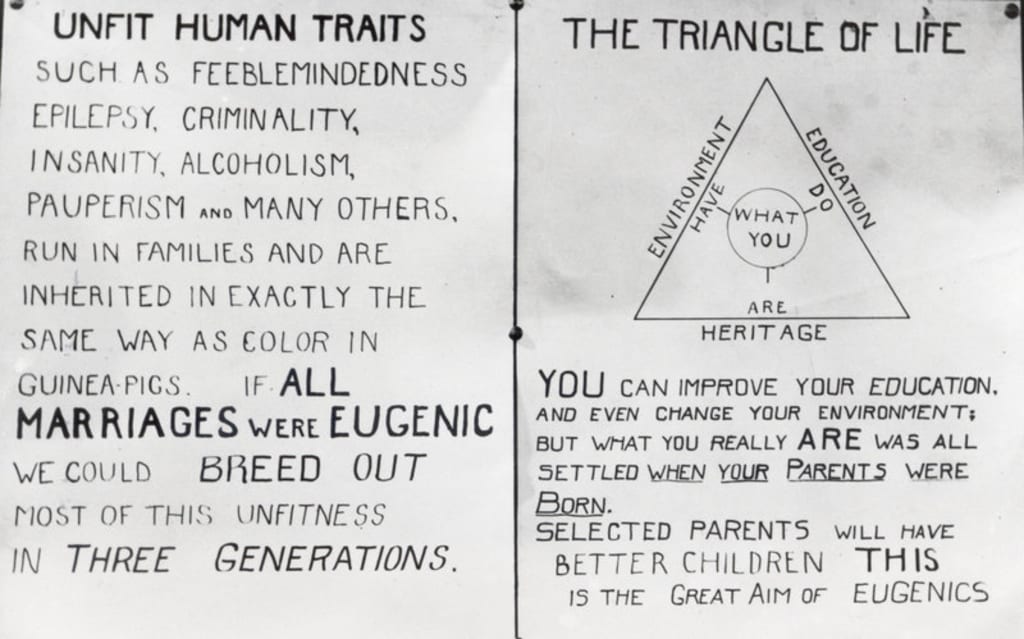
“There was a movement, called eugenics. It was a way of controlling the population. My island was, according to them, increasing in unemployment, poverty, lack of surplus, food, illiteracy, but illiteracy was always high. School was reserved for those who could afford it.
I can read, by the numbers on charts, that the list of mentally disabled persons was, too, rising.”
“This is a strange story grandma. Why are you telling me this?”
“Because I want you to know that history is never kind. Because I could have been one of the unlucky ones. Because life is not fair to everyone. And I’m pretty sure that this atrocity I’m telling you was not taught to you in school. I kind of had a clue because, growing up, this was not taught at school, or spoken in public, even when your mother went to school. So, is it considered common knowledge? I don’t know. But I will tell it to you anyway.”
“Please grandma. Go on.”
“I had to read more on what was happening with the people on the island. Every opportunity I had I spent gathering lots of information as I could possibly handle. I always had to do it out of sight when the secretaries either took their break or were done with their shift. They didn’t mind me staying afterwards. They took a liking to me.
What I read was quite disturbing. And I should say that if I were caught, I would be in so much trouble.
You see, genes are important. It’s what makes us: Gives us character: Defines our purpose in life, according to our wills. But there were those who wanted to control our genes. Politics is a mere subset of power, just like forced sterilization is a subset of eugenics.
There was a Sir Francis Galton who proposed unscrupulous ideas to improve the human race: The main focus, if I remember, was to acquire admirable qualities, and keep those qualities available and inherent to future generations.”
“But, what’s wrong with that grandma? I understand what that means. So, what’s the problem?”
“The problem, or problems, I should say, were that people of special, social, and political positions decided who should have children.”
“That’s terrible!”
“That’s right. People who were “fit” could reproduce. Those deemed “unfit” were to be sterilized.”
“What did they mean, “unfit”?
“’Unfit’ meant the mentally disabled, people of color, those with no social status, the poor and indigent… people who were considered social burdens.”
“But how did they sterilize them? By force? I doubt anyone would agree to such a thing?”
“That is what you should know as well. Throughout my time at the hospital, I saw many young women come in for simple procedures; however, later I found out that doctors and nurses deceived them into unwanted and unknowing sterilization procedures.
Many didn’t realize until it was too late. Some had their tubes tied, their uterus removed. Pregnant women, ready to give birth, were turned away from the hospital, unless they consented that, after giving birth, they would undergo sterilization.
It was 1957. And from what I read and understood, it was not a new concept. Women returned with eyes swelled to the back of their corneas, crying so hard, knowing that the dream of having a progeny would never reach their fingertips. Can you imagine such a desire, or fulfillment, that could never come true? That is real hell.”
“I’m sorry grandma.”
“Don’t’ be sorry. Learn, learn everything. Not just for our sake, but for those who don’t know how to learn. And speak for them. My parents sacrificed everything for me to learn, just as your parents are doing. You must remember these horrendous acts of human history. What would have happened if I went through that procedure?”
“I would not be here to celebrate your birthday!”
About the Creator
Education ERP Market to Surpass USD 66.3 Billion by 2033
Education ERP Market Overview The global Education ERP Market is experiencing steady expansion as educational institutions adopt digital systems to manage academic and administrative operations. The market is projected to reach USD 66.3 Billion by 2033, rising from USD 16.1 Billion in 2023, reflecting a CAGR of 15.2% during the forecast period from 2024 to 2033. The growth trajectory is associated with increasing digital transformation across schools, colleges, and universities. Institutions are investing in centralized platforms to handle admissions, finance, attendance, and academic records more efficiently.
By Roberto Crum6 days ago in Futurism
K-12 Education Technology (EdTech) Market to Reach USD 253.9 Billion By 2033
K-12 Education Technology (EdTech) Market Overview The global K-12 Education Technology (EdTech) market is experiencing steady expansion as schools and governments increasingly adopt digital tools to support modern learning environments. The market is projected to reach USD 253.9 Billion by 2033, rising from USD 78.2 Billion in 2023, reflecting a compound annual growth rate of 12.5% during the forecast period from 2024 to 2033. The expansion of internet connectivity, increasing device accessibility in classrooms, and strong government investments in digital education programs are contributing to this growth.
By Roberto Crum6 days ago in Futurism



Comments
There are no comments for this story
Be the first to respond and start the conversation.