

To those who were born not of the blood, nor of the will of the flesh, nor of the will of man, but of God.
—John 1:13
There once lived near a small village in Co. Cork Ireland a poor widowed cotter who had no children and grew sad in his loneliness for the company of a friend. He spoke very little, but worked hard for his bread, and never touched a pint of ale to his lips. A faithful son, every night he would pray to God and the Saints, but to be content in nature and by the work of his hands until the very day arrived that he should pass from this world.
One day as he was walking home from laying new sod on a neighbor’s roof, he heard a distant, yet beautiful voice from within the forest. Entranced by the bearer’s melody he was carried away into the depths of the wood towards a grove of towering trees, their boughs entwined into a sheltered haven around him. He did not halt there long for the song took him further into this sanctuary, where he came at last to a laurel tree, whose limbs had formed a shallow entanglement of golden tufts of straw and leaves, and within the caressing arms of the branches lay a crying infant. When the cotter looked into its eyes, the child stopped it’s wailing and smiled, suckling its thumb.
“This most certainly is a miracle!” he cried.
As a boy his mother would tell him that long ago there resided on earth creatures of yore that inhabited places such as these and during the twilight they would venture out from their hidden dwellings to sing and dance till the dews of dawn were upon their feet. They’d drift through the air, as the soles of their feet did not touch ground, traversing by night into sleeping villages to steal away dreaming children from their beds, bidding them to carouse with them in the moonlight.
Perhaps the Angels had heard his callings late into the night and granted him this child, or the Faeries had stolen him from his cradle and some poor codgers wife was weeping over her needlework besides a dying fire.
Falling to his knees he raised his arms in thanks to God for once again Blessing his life with Love. “As the verse says, Oh Lord: whosoever receiveth a child in Thy name, receiveth Thee… For thy mother and thy father hath forsaken thee, but I, oh child, will take thee!” He received the little one into his arms and went way never to return that place or to question the true fate which lay behind the child’s birthright. He raised him as his own, earning his happiness, for his son was never in want or need, but always content with what was given to him.
The rains shuddered off the eaves of the thatched roof, the snows fell, and the years flew away like the gentle hiss of an autumn breeze, and destiny wove its web around the lives of the people. Soon the land was taxed. Those who could not afford to pay lost their homes and the soil they inherited. When the crops ripened, no one was there to tend the harvest and the heart of the country withered like the petals of a once beautiful spring flower. But Faith kept the people in God’s Grace and though time had laid this terrible burden on them, their convictions brought goodly tidings.
The boy was christened Christopher for his compassionate heart and a rare gift of inspiring people’s lives with little cupfuls of happiness. He matured like a weed-ling, sooner than most boys normally do, in both physique and intellect. He was a grand story teller and would fill cottage rooms with old songs and ballads he had learned from aging men outside the local tavern. He showed great potential for carrying on his father’s trade and it was noted rather peculiar that he a poor cotter had discovered an orphaned child who undertook in his own profession, as young Christ had taken up the yoke of his foster father.
Now Christopher took great care for the little and goodly things and grew to appreciate nature and her gifts, all things living and alive. He had a fondness for words and speech, and grew very curious of the written language, but his father was illiterate and could not teach him the secret of letters. Those in the village who could read and write were few, but for the local abbot and a wise old woman who lived alone in the wood behind the church, no one was willing to tutor him.
The old woman was said to be a witch, for seldom did she walk into town and spoke to no one except the animals and plants and ancient spirits that resided in the forest. Nor did she attend the sermon on Sunday afternoons. Yet she possessed an unusual talent for writing and withheld this secret knowledge from anyone of an inquiring mind, even the local abbot; for to be a woman and to know such things was truly the workings of a daemon. So she kept to her own amongst a great tapestry of dreams and rarely went out into the world except during eventide and on holy days.
It happened that Christopher was returning from the river, where he went to think and fish, collect nuts and berries and talk to the animals that resided there, when in passing he noticed an old woman feeding her sheep. She was tending to her flock as usual when her back suddenly felt as if it had caught fire; the flames writhing up and down her spine. She was immobilized like the quickening sands in a muddy bog. The boy saw her struggling and hurried to aid her, but she waved him back saying, “These old bones have made it this far in life, what’s a few more steps for an old lady like me.”
He disregarded her refusal and taking her by the arm led her to her cottage. He held wide the door and she inched inside to a sit in a rickety old chair by a cold fireplace. It was a chilly spring morning and taking this into consideration he went outside, gathered kindling and a few logs and placing them so lit a small fire, while the old lady griped of her pains.
Finally she asked of him a favor. “There is a jar setting on the shelf above the window, please grab it for me.” None of the jars had labels, and even so he could not read them, but when explained that the contents held therein were chamomile and mint and other such soothing herbs, he found it without delay. She then asked him to boil some water. Taking a wooden tray and a cup he found in a cupboard, he hung a kettle over the wrekin* above a thin wisp of flame in the fire place. As soon as it was hot, the old woman spooned the herbs into the cup while he poured the water. She sighed with delight warming her palms around the steaming vessel.
“I hear that you are cotters son and would like to know the meaning of words, but cannot find a soul to teach you,” she said modestly sipping her tea.
He shook his head considerately.
*A word seldom found in most dictionaries to describe the hook used to hang a pot over the fireplace. In olden days it meant to go the long way around something, since it was suppose to have been a great hill found somewhere in England. The long way round he went, all around the Wrekin, instead of explaining clearly.
She attempted to sit back, but the chair pained her, so again she asked him, “And being a cotters son, you are also gifted in the use of your hands?”
He replied that he was and she wondered if he could keep a secret. He nodded the affirmative.
She told him of her youth and how she too yearned to understand the strange yet beautiful language of words. As a child they had seemed like magical charms thrown into a gossamer bag for the willing to sprinkle over their eyes or stirred into a bubbling cauldron and then bottled to sustain an eternal shelf life; a miraculous enchantment that would never lose its potency even as the broom of time swept away the dust from the doorstep of Forever bridging this world and the next—but women were forbidden against such practices.
In turn he relayed to her his own life, of how he resided so closely tied to the earth, always adrift in a field of wonderment, often questioning God and the Universe and his birthright. He had been told that his mother had died in childbirth, which was not far from the truth, yet he sought to learn more of this fact. To this point his father was of a mute tongue.
Having heard and understood his story she said, “If you with your miraculous power of hand and eye can build me a chair that will relieve my ache, in turn I will teach you this secret knowledge. Here is something for your trouble which I am indebted for.”
He could not take the coin offered, so instead replied, “Not a farthing would I take from you, only that I might practice my hand one day at the written word.”
And so saying he left her and went about busying himself in the woods nearby. Borrowing from his father an axe, he cut down a young tree, stripped it of its bark and went about the task of building a chair. He planed and cut, bent and jointed pieces of timber to form a base. Many times did he have to start again and rearrange his thinking.
Every day after long hours of fitting and driving wooden pegs, he’d wander off to the old woman’s cottage where she would reveal the magical power of words from out of an old leather bound book. When finally he finished the chair he sat in it and sighed, relieved that he had completed his task. The following day brought it to her.
It was not an ordinary chair, for it did not have four post legs and a straight back. The backside was curved slightly to accommodate the spine and never stood still but swayed to and fro, rocking gently on bow shaped feet. The lady had never seen anything the likes of it in all her life. How long he had whittled away to make it smooth and sturdy, for in those days tools of the trade were costly or impossible to come by.
She leaned back, as the soles fell softly to the floor she lifted herself up on the balls of her feet, rocking as one does in a boat upon a lake, the beating of the oars creating small subtle waves while a gentle breeze glides gently across the waters. The old woman smiled. A beam of light glanced through an opening in the canopy of trees and shone on her countenance. A teardrop like a stray piece of shattered crystal descended from her cheek.
“My son you are a worker of miracles, for now my pain has been eased.”
From that day forth he learned the music of speech, the natural flow and rhythm of words off the tongue and off the heart. He gained much wisdom, as much as the lady could grant him, but yearned to know more, as those who seek knowledge, finding its faults and sorrows yet inadequate, do. Not only did he become literate, but he learned about other things as well. He glowed with the light of Gods universe upon his head, for now it was in the palm of his hand.
He went around the village asking his neighbors if they had any work for him to do. They said there’s plenty to be had, but not a farthing to spare.
“All I ask friend in return for a small favor is that you grant me a piece of your wisdom.” And Christopher prospered greatly on these small deeds of compassion, fueled by the lust for knowledge, building many things of convenience for pregnant, old, and disabled villagers. His brain whirled with a thousand increments of poetic verse. A million phrases filled the recesses of space in his mind as he absorbed all the understandings of the wise.
After a time his father was seized with a form of Melancholy. He would neither eat nor sleep, and drank very little wine handed to him. The boy asked a local apothecary for a remedy and was given him a draught of concocted herbs in return for helping to gather them, while a traveling merchant gave him a bottle of port in exchange for new rigging on his wagon.
And thus he continued, until one day the clouds covered the hill lands and the rains continued, washing away the harvest crop and the people’s hope. His father’s condition grew considerably worse. He was a superstitious man plagued by ill omens; the howling of hounds late into the night, the caw of a raven outside his door. He was diagnosed to suffer from an imbalance of the humours* but none knew of an antidote, neither the local herbalist or chirurgeon+, nor even the wise old woman in the wood.
*Adopted from the ancient Greeks and Romans, in medieval medicine humours represented manifestations or metabolic agents within the body of the four elements, which consisted of four distinct bodily fluids (black bile--earth, yellow bile--fire, phlegm--water, and blood--air) which would wax and wane depending on a person’s diet or activity. When a person was healthy they were stable, but when unbalanced it was said to affect a patients mental or physical condition—bloodletting was said to act as a remedy for this.
+Literally translates from an old English term for surgeon; a physician that cuts into the body to perform an operation or surgery.
One day she asked what was troubling him and he answered, “My father is sick and there is no remedy to cure his ills. He hears the dogs cry in the middle of the night, and I fear that he has given up hope. Surely he will die. Perhaps you know of spell to comfort his weariness mayhap a potion to drop in his ear?”
She told him as a little girl her grandmother would speak of strange enchantments. “There is an ancient spell that says if you take something of great value, bury it in a sacred place and make a wish; surely it will be granted by the spirits that reside there.”
But he knew of no such place, excepting a churchyard and went to the abbot to ask him what he should do. The priest gave a solemn reply that only a father would know what’s best for his child and that is the Father in Heaven. So he went to the cotter, but did not speak of what the old woman had said. His father spoke instead.
“My son I fear that I am dying and it is now time I told you of your birthright.” At first the boy did not understand, and as his father continued he only grew frightened of learning the truth in his words. The cotter told him that many years ago after the death of his wife a beautiful voice had guided him to a grove, where he had found in the comfort of the arms of a laurel tree an infant child. He knew not from where the boy had come, but believed that the angels had answered his prayers by sending him a son—as Abraham had received an heir—but alas Christopher was not of his own line.
This greatly saddened and disturbed the boy, though he still felt love for the father whom had found and raised him and did not want him to die. So he asked of him something of great importance; that he needed coin to buy some medicine. The cotter was rapidly losing his senses, but took from a shelf near his bed a ring that was once worn by his lovely bride and gave it to Christopher. The boy kissed his father’s forehead and ran into the woods. It was on the Eve of May, when he wandered into the forest, lamenting and praying to God. But he soon became lost in trying to find the sacred grove and lay down by the roots of an old tree and wept, fraught with grief for his misfortune.
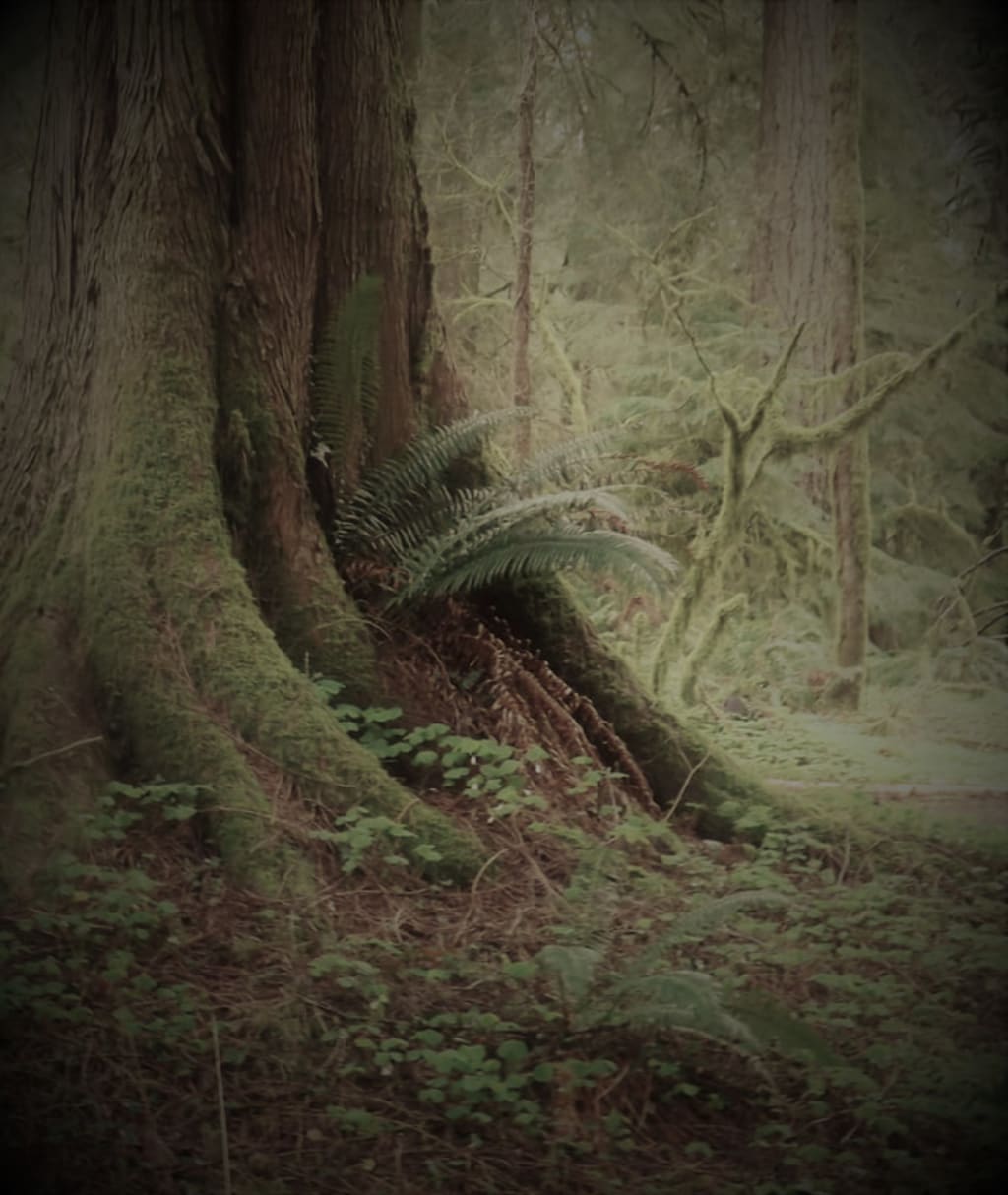
Suddenly out of the wood arose a voice, singing an old song which felt familiar to his heart. He hummed along, ambling through the thicket of scrub and underbrush. Through a break in the trees he perceived a lovely clearing, of lush green forest lawn. The trees were like great castle walls enveloping the hollow like a grand cathedral. Illusions of shadows and light cast off their trunks like bright emerald stained glass. Through these openings fractures of sun light escaped inside dancing off the walls and floor. He rested on a lichen covered log to gaze upon this fulfilling sight. A beam of light brushed upon an ancient tree whose bark was twisted and distorted like an old hags face. He proceeded towards the laurel and within a fold of limbs there rested a nest of bird’s eggs.
Within the center of the grove appeared an apparition of light, translucent and white, with hands outstretched towards the heavens. The face was revealed like a ripple in a pond, a flowing of golden hair swept the air behind the ghostly image. It wore a gown of a fine substance, which appeared not as clothing, but part of the creature’s body, as are the wings to a butterfly or the fins to a fish. She danced upon invisible stones in the air, gliding listlessly above the ground. Neither feet nor the hem of her gown touched the tops of the grass.
He quickly hunched down and took cover within a rushes bush. She passed over the hallow ground of this earthly church and found not her footing, but faltered before the laurel, hovering still. As he sat huddled within his leafy shelter, she took an egg that had not hatched and holding it close to her face blew over the surface of it. Moments later the delicate little shell divided into twenty-odd fragments. A swallow emerged from out of it. Shaking sorrel colored wings, as a new-born butterfly from a cocoon, and with a chirp of gratitude the creature flew away into the trees.
The lady returned to the nest, and swept the emptied shells into her hand. She crushed them to fine powder and blew the glistening particles into the air. It swirled like magic in the sunlight. He had no desire to stay in that cramped fettered place any longer. An impulse strove him to seek out who and what this creature was. While she stood peering longingly at the ceiling of the dome-shaped haven, he quietly emerged from out of the bush. The lady sensed his presence and twirled around. The folds of her silky gown gradually collected again behind her; the movement as fluent as one treading beneath water.
“I have been waiting for thee child,” she whispered softly as a parishioner in prayer. “I am the voice of this forest and have come to grant thy heart’s desire.”
“But I have no desire, other than to find a cure for my ailing father,” he exclaimed, feeling the ring grow hot on his finger.
“Thou hast something for me dost thou not?” the Faery woman asked, her voice twinkling in and out of existence. He showed her the ring.
“A plain ring from the poor cotters wife—” She sighed as the wind soughs across the tops of the trees. “ ’Tis not enough I dread, so I must tell thee that as further compensation for thy wish thou must sacrifice that which is truly priceless to thee.”
He fell to his knees, tears dripping from his cheeks, “Anything would I give to save my father’s life.”
“Take Heed Oh Child, for l will tell thee now wast thou must forfeit for this knowledge.” Her voice had become melancholy, as a lady in mourning. “Thou wilt never know of thy birthright… dost thou understand oh child what I am telling thee? Whether thou art born of kings, or wert a sailor’s pride, perhaps a thief’s priceless treasure, or the son of a Lord and his Lovely Bride, you will always be known none other than the son of a poor cotter.”
He loved his father, and no amount of his own sorrows could change that reality. “I—I understand good lady.”
She placed the ring within the palm of her hand and closed her fingers over it. Upon opening it again, revealed therein a golden seed. “Take this seed and stand before the laurel. Place it upon thy breast. When thou hast realized thy true purpose only then shall thy wish be granted.”
Her voice, as well as her beauty diminished into the luminous heart of the grove. He took the seed and stood before the laurel tree. It glowed like a tiny sun. As he held it within the palm of his hand, he felt it pulsate as the beating of one’s heart. His thoughts drew closer to the perception of what he had witnessed and his fingers slowly closed over the object. Without a further moment’s hesitation he thrust it against his breast, planting it deep within the confines of his soul.
A cry of joy erupted from his lips as a brilliant light burst forth from his body, enveloping him in complete serenity. He felt nothing but bliss and love, in the nature of the Spirit of God. His heart was as light as a feather, and the green grove around him seemed to carousel ‘round and ‘round till he was calm as a cloud and lay down by the base of the ancient tree. The wind howled through the trees catching the leaves and rustling them like small bells, bearing upon it a song:
“The seed of knowledge hath taken root within thy soul. When thou hast awakened, this is wast thou must do: Take the leaf from the plant thou wilt find before thee. When the moon is high, squeeze the essence over the eyes of thy father as he sleeps. Falter not in thy praying until the dawn toucheth her hands to his face. As the healing salve coverteth the eyes recite clearly these words:
By the Will and the Love of the Father, the Son, and the Blessed Spirit
I say unto thee on this May Eve,
In the name of the saint who wieldeth the sword of light,
Who hath a warrior’s strength before Gods throne,
And standeth at his right hand,
Sever this ailment which renders thee asunder,
“After thou hast spoken these words thy wish will be granted in full. But as I have spoken in return thou wilt never know thy birthright or the remembrance of this place, but only in thy dreams wilt thou see it again. Mayhap thy own son will one day discover this place, if but only in his dreams. For though thy heritage will lie unknown to thee even unto those generations who follow, the secret wisdom is in thee now and will forever abide through thy family line.”
And so after she had spoken the voice trailed off, falling away into the expanse of forest, beyond the grove to some far off land. Upon the commencement of this song, the boy closed his eyes and slept.
When he awoke a pale light was shining upon his brow. He opened his eyes tiredly. The sunlight stitched together an embroidered patchwork of every rich hue of green to be imagined on the mossy ground. His thoughts were clear as snow, as if he’d died and been reborn from a beam of sunshine. His spirits were soaring high above the clouds through a velvety firmament. Had it only been a dream? How real it seemed, that everything had been presented to him in such vivid detail, as verse in poetry.
He chanced to glance down at his hand, which was cupped over a pleasantly odiferous plant. As he went to prop himself up into a comfortable position, his fingers contracted around the stem, pulling the roots free from the soil.
His eyes widened in silent astonishment. It was as the Lady had predicted in the Dream. He observed it in the twilight. The herb possessed an almost silvery sheen to its olive colored-leaves and a minty odor. He wondered at it for a long while.
It was known as the gentle leaf of liomoid iocshl inte (lemon balm) and was known for its curative properties for Melancholia. Would this plant heal his father’s malady? He felt a tingle in his chest, and something stirred deep down within his being, something that told him he had discovered the answer he’d been searching for. He gathered together a few pocketfuls of the herb and emerging from his dewy bed, remembered the way out of the forest; no longer enslaved by the wood, but freed by an intuitive force. He ran, crying and laughing, singing and dancing till he reached his father’s cottage.
He soon sobered from his gaiety, opened the door and crept inside. He let the herbs soak in a crock under on the window sill to draw in moonlight and crawled up the ladder to the loft where he slept wondering over the many strange and exciting possibilities that God had placed before him. He gazed upon a sprig of the plant, holding it by the light of the moon. It would soon be midnight. Quietly he scuttled back down to the floor to sit by his father’s beside.
Holding the leaf between his fingers, he crossed himself, placing a damp cloth soaked in the herbal water over the cotters eye lids and waited. He recited the enchantment praying till the dawn. A shaft of sunlight danced off the window pane illuminating his father’s visage.
Christopher’s eyes were closed, praying, when he felt a feeble hand rest upon his own. “How long have I slept—son—why are you crying?”
Christopher looked up. He was gladsome to see how quickly his fathers face brightened with the dawn and hugged him around the neck. He was about to relay all that he had seen, but alas! he could not recollect what had happened, only that he had been wandering through the woods, praying, and tripped over the uncovered root of a tree discovering a strange sweet-smelling plant. He had come to this knowledge by a phenomenon unknown to him. In the boys sheer happiness he hummed an ancient melody while preparing a small breakfast for his father who received it hungrily. For three days he continued thus to nurse his father back into shining health, picking plants and herbs, and learning special techniques for preparing them from the old lady in the woods. She asked him too about what he had seen in the forest that fated day, but again he could not answer, for the memory was locked away deep within his mind.
Now this is how he lived out his days. He became a well learned young man, renowned not only for his craft of building marvelous chairs, but the knowledge that was bestowed unto him by the Devine. He went abroad into nearby villages healing those will incurable maladies. However, he did not continue thus alone. His heart was favoured by a daughter of the hill lands, the only child of a traveling merchant. While her hair glistened as black as a raven’s wing, her eyes captivated him, like a gentle breeze rolling across the hills and pasture lands of the Isle. She possessed a rare ability to heal through song and while he placed his hand upon the sick, her voice soothed their weariness. They married and built a cottage in the wood where they raised seven children, all of whom would someday inherit gifts of their own.
One day, as Christopher was out with his oldest son gathering firewood he heard a sound within the distance—a lonely song—as that of a lady in mourning.
“What was that Papa?” the boy asked pausing in his work to listen.
“Just the wind playing through the reeds, son,” he said staring off across the hills, “just the wind, and nothing more.”
A word about fairies:
Though her voice lives on only through the forest, she was birthed by the first tears of an infants cry and she passed from this existence for lack of belief as that child grew in logic and wisdom. Such are the frail and sad, short lives of fairies, but their memories still live on, through only the most purest of imaginations.
About the Creator
Sierra Goddard
Just an artist who enjoys writing, crafts, and being in the outdoors; foraging and hiking with my mycophile husband and our pup Apollo. Along with freelance journalism, I hope to start an E-com business and become financially independent.
Keep reading
More stories from Sierra Goddard and writers in Futurism and other communities.
Linnaeus and his Love for Plants
Carl von Linné, was a Swedish botanist, most famously known as the Father of Modern Taxonomy for formalizing the modern system of naming organisms called binomial nomenclature. This is a fictional account of how he came by this knowledge, and his adventures in Lapland.
By Sierra Goddard5 years ago in Futurism
About Binding Prometheus
I want to start actively advocating on behalf of my own work, and the most valuable part of my canon is, without a doubt, Binding Prometheus, the play I have been working on since 2019 and only finished in 2023 as part of my MA. The play itself is an amalgamation of a million different inspirations. On one end, it evokes the Ancient Greek myth-play, deriving its own title from the earliest extant work of Western drama we have, Aeschylus’s Prometheus Bound. On the other end, it borrows significantly from the sci-fi bulwarks from over the years, namely Mary Shelley’s Frankenstein and Karel Capek’s Rossum’s Universal Robots. The play could be an episode of Black Mirror, I fear. I don’t know. I’ve only ever seen one episode of Black Mirror.
By Steven Christopher McKnight20 days ago in Futurism
Saudi Arabia Furniture Fittings Market: Residential Expansion, Design Innovation & Market Growth
According to IMARC Group's latest research publication, Saudi Arabia furniture fittings market size reached USD 122.10 Million in 2024. The market is projected to reach USD 294.08 Million by 2033, exhibiting a growth rate of 10.26% during 2025-2033.
By Abhay Rajput2 days ago in Futurism



Comments
There are no comments for this story
Be the first to respond and start the conversation.