
280 million kilometers away, the U.S. spacecraft with samples are returning, compared with Chang'e 5 who is more difficult
U.S. spacecraft is returning with samples

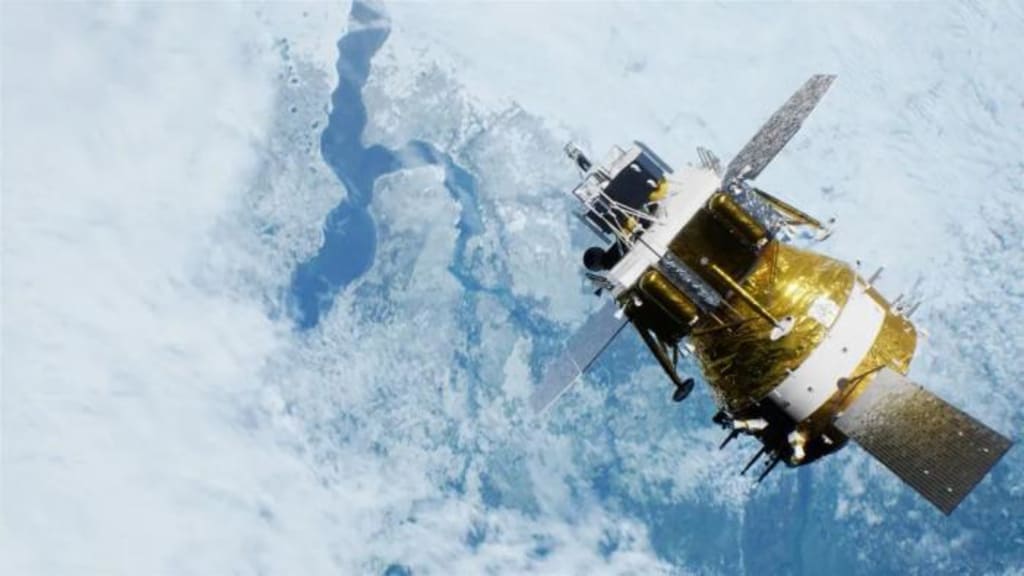
About 280 million kilometers away from Earth, an unmanned spacecraft with precious extraterrestrial samples is heading toward Earth: the unmanned spacecraft Osiris-REx, launched by NASA in 2016. In October 2020, the Osiris-REx probe successfully collected some samples from the surface of the Bennu asteroid, some of which were some rocky material. After completing the sample collection, the Osiris-REx probe continued to fly with the Bennu asteroid for some time, and on May 10, 2021, the Osiris-REx probe thrusters ignited for 7 minutes and left the Bennu asteroid to start its return to Earth. If the return process goes smoothly, the Osiris-REx probe will fly past Earth on September 24, 2023, with its sample capsule ejected and splashed down in the desert of Utah in the western United States. Since it will orbit the sun 2 times during its return, it will have traveled 2.587 billion kilometers.
In December 2020, our country's Chang'e 5 probe successfully brought back some precious lunar samples from the lunar surface. This is the first time that mankind returns to Earth after 44 years of sampling from the Moon. The success of Chang'e-5 probe marks our country's mastery of advanced technologies such as unmanned rendezvous and docking in lunar orbit, lunar surface sampling and lunar surface takeoff. Both the Osiris-REx probe and Chang'e-5 probe are retrieving samples from the outer planet, which one will be more difficult compared to the other?
Flight distance: Chang'e-5's destination is the Moon, which is about 380,000 km away from Earth, while the Osiris-REx probe's destination is the Bennu asteroid, which is close to 300 million km away from Earth, the farther the flight distance, the risk factor may be greater, as the mission time will be longer. From this point of view, it may be a little more difficult to travel to an asteroid hundreds of millions of kilometers away.
Signal transmission: We know that the probe relies on radio signals to communicate with Earth, and the strength of radio signals will appear to be reduced as the propagation distance increases. In the case of the same signal strength, the farther the distance, the weaker the strength of the incoming signal, trying to receive these weak radio signals, it is very difficult. From this point of view, it is a little less difficult to achieve communication with a probe near the Moon 380,000 kilometers away than with a probe hundreds of millions of kilometers away.
The United States has their deep space network, and our country also has a similar deep space network, our deep space network can also achieve communication with hundreds of millions of kilometers away from the SkyQuest 1 probe, that is, if we also launch probes to hundreds of millions of kilometers away from the asteroid, we can also communicate with these probes.
Attitude control: Whether it is the Osiris-REx probe or the Chang'e-5 probe, they all need to reach the surface of the planet for sampling, and the difficulty of this landing process is actually quite different. Compared with asteroids, the moon's mass is very large, which means the moon's gravitational force is greater, and when the probe lands on the moon, it is equivalent to a strong gravitational force pulling the probe downward, so the probe needs to activate the counter-thrust device to "resist" and finally reduce the lander's speed to 0 relative to the moon and stop at the moon's surface. The very small mass of the asteroid means that the gravitational force on the probe will not be very strong during landing, so the requirements for the probe's thrust reverser will not be particularly high, and as long as the thrust of the probe's engine is properly controlled, there will be no problems. Even if the Osiris-REx probe does not turn on the thrust reverser, the gravitational potential energy of the Bennu asteroid will not be very large, and theoretically the probe will not collide violently with the Bennu asteroid.
After completing the sample collection, the Osiris-REx probe needs to take off from the surface of the asteroid, and the Chang'e-5 probe needs to take off from the surface of the Moon to start its return to Earth. Since the gravitational force of the asteroid is small and the gravitational force of the Moon is large, the thrust requirement of the engine is smaller for takeoff from the surface of the asteroid and larger for takeoff on the surface of the Moon. In the asteroid surface takeoff, the probe engine can fly away with a little ignition, but not on the lunar surface. Therefore, it will be more difficult for Chang'e 5 probe to land on the asteroid, the moon, and to take off from the asteroid or the lunar surface. From the following motion picture, we can actually see that the Osiris-REx probe actually took off just by gently touching down with the Bennu asteroid, while the Chang'e-5 lander was on the lunar surface for a much longer time.
In addition, after "bouncing" from the surface of the asteroid or the moon, to really get rid of the gravitational force of the asteroid or the moon, you need to reach or exceed their escape velocity (i.e. second cosmic velocity), which is directly related to their mass. The mass of Bennu asteroid is relatively small, so its escape velocity is very small, and the probe can get rid of the gravitational force of Bennu asteroid with a small thrust. The Moon's escape velocity is much larger, reaching 2.4 kilometers per second, which means that the Chang'e-5 probe needs a stronger thrust to get rid of the Moon's gravity. From this point of view, the Chang'e 5 probe is also a little more difficult.
Overall, these two probes can sample the outer planet, are very advanced, each has its own characteristics, and both are very difficult. In terms of flight distance and signal transmission, the Osiris-REx probe is perhaps more difficult, while in the process of attitude control and return to Earth from the outer planet, the Chang'e-5 probe may be a little more difficult.
About the Creator
De pepper
Share a little science every day
About Binding Prometheus
I want to start actively advocating on behalf of my own work, and the most valuable part of my canon is, without a doubt, Binding Prometheus, the play I have been working on since 2019 and only finished in 2023 as part of my MA. The play itself is an amalgamation of a million different inspirations. On one end, it evokes the Ancient Greek myth-play, deriving its own title from the earliest extant work of Western drama we have, Aeschylus’s Prometheus Bound. On the other end, it borrows significantly from the sci-fi bulwarks from over the years, namely Mary Shelley’s Frankenstein and Karel Capek’s Rossum’s Universal Robots. The play could be an episode of Black Mirror, I fear. I don’t know. I’ve only ever seen one episode of Black Mirror.
By Steven Christopher McKnight16 days ago in Futurism
North America Generative AI Market Size and Forecast 2025–2033
The North America Generative AI Market is on the brink of a historic expansion. According to Renub Research, the market is expected to surge from US$ 6.19 billion in 2024 to US$ 84.27 billion by 2033, registering an exceptional CAGR of 33.67% from 2025 to 2033. This rapid acceleration reflects not only technological advancement but also the region’s deep-rooted digital infrastructure, concentration of skilled talent, and strong appetite for innovation across enterprises.
By Aaina Oberoi5 days ago in Futurism
Wild Card Weekend Recap: What Happens Now?
I think I figured out why I love Wild Card Weekend so much. It's because it's the first playoff anything of the calendar year. The NFL season starts in the fall, and once upon a time, the champion was crowned either on or slightly before New Year's. The evolution of the NFL schedule has resulted in the playoffs starting just into the New Year, and currently, the final week of the season falls on the first weekend of the New Year, with Wild Card Weekend coming a week after that. So yes, chronologically, the NFL's Wild Card Weekend serves as the first playoff anything of the calendar year.
By Clyde E. Dawkins4 days ago in Unbalanced



Comments
There are no comments for this story
Be the first to respond and start the conversation.