
Sexual Frustration in Long‑Term Marriage: Reviving Body and Mind After Ten Years Together
Sexual frustration after a decade of marriage tests identity, science, and love—revealing how routine erodes desire and how couples can resurrect it.

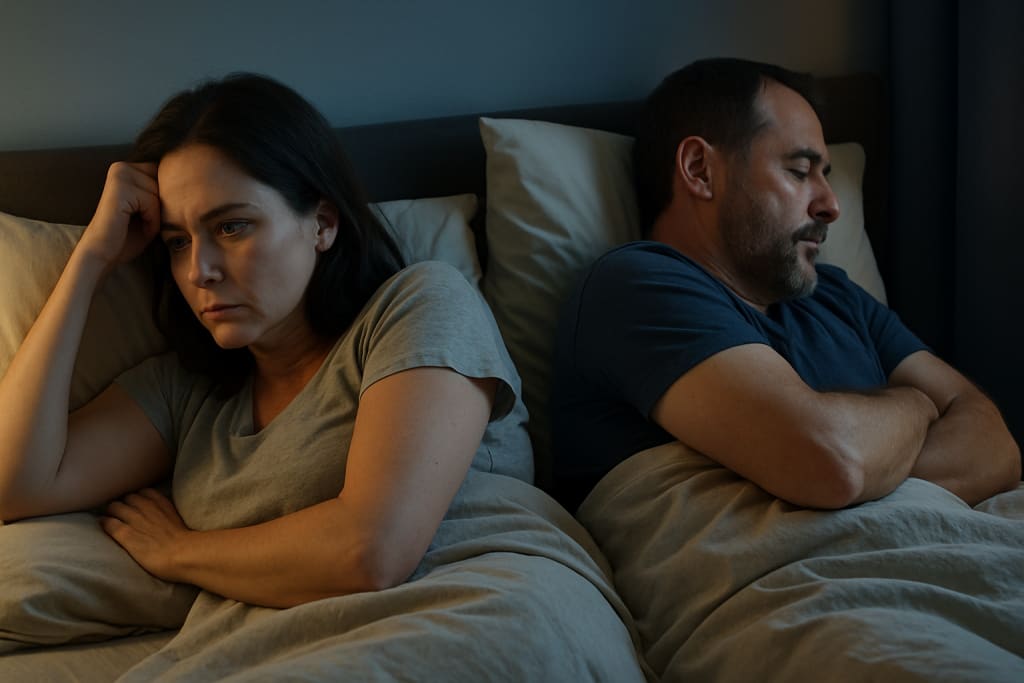
Erica wakes at three in the morning to the soft hum of the refrigerator and the louder silence of a husband who lies inches away yet feels miles offshore. Miguel is breathing evenly, turned toward the wall, a familiar outline in the dark; and still the distance between his shoulder blades and her fingertips feels wider than the bed, wider than the whole apartment. They have been married eleven years. They still laugh at the same sitcom reruns, still argue over the mortgage and the best way to load a dishwasher, but sex—once the gravity that pulled everything else into orbit—has collapsed into a faint, unreachable star.
Their story is painfully common. Surveys across two decades show the average frequency of marital sex drops by nearly half between year one and year ten, while clinical interviews reveal that one in three spouses wrestles with gnawing doubts of desirability. Yet statistics do little justice to the ache. Sexual frustration is not merely an unmet urge; it is a quiet erosion of identity, a late‑night interrogation that whispers, Am I still wanted?
Modern science views desire as a living loop rather than a lightning bolt. Hormones do slip—testosterone melts at roughly one percent per year after thirty, estrogen pivots dramatically during childbirth and perimenopause—but psychological context can sway desire even more. In a yearlong diary study, the most reliable predictor of next‑week arousal was not hormone level or sleep but whether each partner felt noticed in the previous forty‑eight hours. Desire blooms where attention lives.
That finding reframes erotic drought. Most couples approach the problem like mechanics: swap lingerie, add a scented candle, pencil in “date night” on the calendar. Such tactics can help, but only when they disrupt the deeper monotony of emotional autopilot. Neuroscience hints why. The brain’s reward circuit ignites whenever a partner delivers an unscripted kindness—a lunch‑hour voice memo, an impromptu dance in the kitchen, eye contact that lingers one heartbeat longer than necessary. Tiny surprises trigger dopamine, which primes the spinal reflexes that move blood the right direction.
Yet novelty cannot thrive on gimmicks alone. Therapists who spend decades guiding long‑married couples speak of the “demo moment,” the instant an authentic vulnerability surfaces after years of polite avoidance. It might be Miguel admitting that weight gain makes him shrink from bright bedroom light, or Erica confessing that scrolling phones between the sheets kills her last flicker of heat. The words may land clumsily—there might be silence, maybe tears—but once spoken, the truth becomes a live wire, sparking a different kind of electricity. Partners brave enough to stay in that charged space often report an unexpected aftermath: arousal arrives hours later, when the nervous system realizes it has survived honesty and can breathe again.
Physiology reinforces the turnaround. Genital blood flow rises when heart rate climbs through emotion—fear, laughter, anticipation. Couples who share even mild adventure—indoor climbing walls, midnight bike rides across the quiet suburb, heated debates over politics—show measurable spikes in sexual frequency the following week. Adrenaline primes the dopamine path that desire later walks. The thrill need not be exotic; it only needs to be shared.
For others, the barrier is not the mind but biology. Childbirth reshapes pelvic floor muscles; contraceptive shifts in progesterone can flatten libido; antihypertensive medication blunts the cascade that leads to erection. Shame often blocks conversation long before remedies can be explored. When partners finally name the physical hurdle, relief itself can reignite closeness. Suddenly vaginismus becomes a mutual puzzle rather than an individual failure, erectile dysfunction a shared journey through diet tweaks, therapy, and modern pharmaceuticals. Progress may be slow, but it replaces isolation with solidarity.
Culture adds another layer. E‑commerce algorithms push twenty‑second clips of impossible bodies at every scroll, warping baseline expectations; the average adult now encounters more explicit content in a week than previous generations saw in a lifetime. That saturation breeds a subtle numbness. Clinicians documenting porn‑induced erectile dysfunction note that the condition rarely stems from explicit material itself but from the escalating novelty it offers. A screen can deliver more visual variation in ten minutes than reality can provide in ten years, rewriting neural pathways until real‑life skin feels strangely quiet. Couples who detox from constant stimulation often describe an awkward lull, followed—if they persist—by a gentler, steadier current of responsiveness.
Children complicate the equation in quieter ways. Toddlers crash circadian rhythms, adolescents hijack privacy, teenagers linger in the hallway at night like unspoken chaperones. Sleep studies trace a direct line between chronic exhaustion and plummeting libido. Melatonin floods a worn‑out brain, throttling the dopaminergic spark before it can climb the spinal column. For parents like Erica and Miguel, the first step may be absurdly simple: a lock on the bedroom door, an undisturbed nap, a Saturday babysitter who walks the neighborhood for an hour so the apartment belongs to two adults again.
Longevity does not doom passion; it merely demands intention. Anthropologists catalog societies where long‑term pairings remain intensely erotic well into old age. Common threads emerge: public rituals that honor mature sexuality, intergenerational networks that share child‑rearing burdens, a cultural script that treats erotic connection as an evolving craft rather than a vanishing commodity. In Western suburbs, where couplehood can become a self‑contained bubble, replenishing desire often begins with stepping back into community—double dates, group hikes, choir practice—activities that allow partners to witness each other through fresh eyes.
Erica and Miguel, after months of strained half‑hugs, start playing acoustic guitar together on Sunday afternoons. Three chords, nothing fancy. One evening, mid‑strum, Erica looks up and catches Miguel studying her fingertips; the attention feels electric. They do not undress that night, but at dawn, with cereal bowls still on the counter, she kisses him first. His surprise sends a small shock through both bodies, a flutter that feels impossibly new. They will lose that spark again—tax day looms, the roof leaks—but they now understand the terrain. Desire is not a relic of year one; it is a living circuit that can be rewired.
Sexual frustration in a decade‑old marriage is both symptom and signal. It warns of complacency, points to unspoken fear, and invites reconstruction. Revival rarely strikes like lightning; it seeps, gathers, overflows in its own time. What returns is not the reckless heat of newlyweds but something sturdier—an ember protected by routine, fed by curiosity, brightened by the radical act of noticing.
When the hush in the bedroom finally cracks, it often sounds like a whisper rather than a roar. Yet that whisper carries the force of a vow renewed: We are still here. We are still choosing this. And the silence no longer owns us.
References
Psychology Today Staff (2025) Sex in Long-Term Relationships. Psychology Today. Available at: https://www.psychologytoday.com/us/basics/sex/sex-in-long-term-relationships
Dorin, J. (2017) ‘How to Keep the Passion Alive.’ Scientific American. Available at: https://www.scientificamerican.com/article/how-to-keep-the-passion-alive/
Vinney, C. (2023) ‘Overview of the Gottman Method.’ Verywell Mind. Available at: https://www.verywellmind.com/what-is-the-gottman-method-5191408
Cacioppo, S. and Cacioppo, J. T. (2013) ‘Lust: Sexual Desire Forges Lasting Relationships.’ Scientific American. Available at: https://www.scientificamerican.com/article/lust-sexual-desire-forges-lasting-relationships/
About the Creator
Jiri Solc
I’m a graduate of two faculties at the same university, husband to one woman, and father of two sons. I live a quiet life now, in contrast to a once thrilling past. I wrestle with my thoughts and inner demons. I’m bored—so I write.
You Know Her
Many people say, “I know her,” when they hear the name Mia Khalifa. They say it with confidence, as if they truly understand who she is and what her life means. But knowing a name is not the same as knowing a person. Mia Khalifa is one of the most searched names on the internet, yet she is also one of the most misunderstood public figures of our time.
By John Smith6 days ago in Filthy
United States Hotel Market Size & Forecast 2025–2033: Experience-Driven Travel Fuels a New Era of Growth
United States Hotel Market Outlook The United States hotel market is poised for steady and resilient expansion, rising from US$ 255.33 billion in 2024 to US$ 422.10 billion by 2033, reflecting a compound annual growth rate (CAGR) of 5.76% during 2025–2033. Growth is being driven by strong domestic travel demand, rising interest in experience-based stays, continued investment in hotel development, and the digital transformation of guest services. As leisure and business travel stabilize across the country, hotels of all categories—from luxury resorts to economy motels—are benefiting from shifting traveler preferences and renewed mobility.
By Marthan Sir5 days ago in Filthy
The Devil's Cut
“Comrade, finally you’re awake.” The voice was smooth, sensual. A flickering incandescent bar was all that lit the white, sterile room. All Vladimir remembered was everything going black. He tried to move his arms and found them strapped to the gurney.
By Matthew J. Fromm5 days ago in Fiction



Comments
There are no comments for this story
Be the first to respond and start the conversation.