
Blood and Cross: The Hidden Passions of Cloistered Hearts
Forbidden love, medieval convent scandals, and secret desires that defied faith and stone walls.

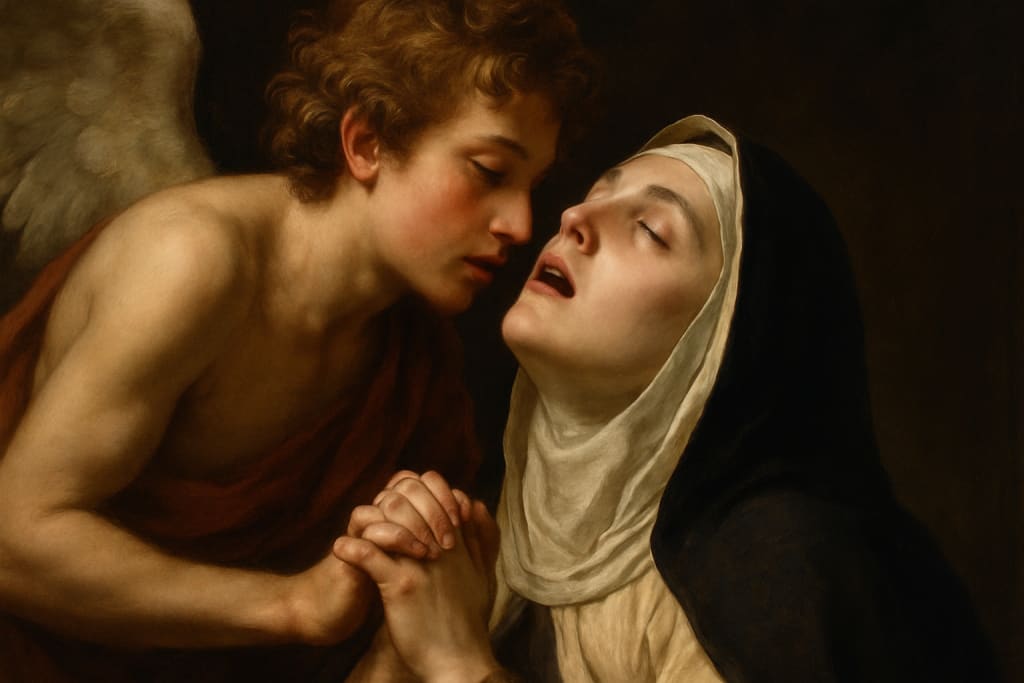
It was the winter of 1478 when snow lay heavy over the Santa Chiara convent near Bologna, whitening the cloister until it glowed like a prayer carved in marble. Inside, hearts burned with a heat the cold could not quench.
Sister Agnese, cheeks still flushed with the bloom of twenty summers, carried beneath her habit the most damning secret of all: a child. Conceived not in miracle, but in trembling, stolen moments with Fra Matteo—a monk whose fingers smelled of ink and whose words tasted of psalms whispered in the dark.
Their love was born in silence: exchanged glances behind incense smoke, secret meetings near the herb garden, kisses pressed against rough stone. Each embrace was both salvation and damnation, each breath a prayer and a sin.
When the abbess discovered the swelling of Agnese’s belly, the cloister turned into a tribunal. Matteo, the scribe of holy texts, became the victim of sacred law: castrated by decree, left bleeding in the convent cellar. Agnese, condemned to endless penance, birthed her child under flickering candlelight. The newborn was torn from her arms before the dawn bell tolled.
Their story became a footnote in church records: luxuria nefanda—forbidden lust. But desire had already written itself in blood and memory.
Within the veil: the garden of hidden fruit
Behind convent walls, chastity was the vow; but warmth, touch, and yearning were part of life’s breath. Nuns prayed side by side, slept in narrow cells divided only by thin partitions, and sometimes the line between spiritual devotion and human need blurred like wet ink.
At matins, a stolen glance across the choir could ignite a fire that nightly prayers could not smother. The confessional became a place not just of penance, but of whispered confessions of longing that slipped into trembling fingers and midnight visits.
Benedetta and the angel’s embrace
In the 17th century, Abbess Benedetta Carlini of Tuscany claimed an angel named Splenditello came to her at night. His embrace left her breathless, skin burning with forbidden heat. Yet the “angel” turned out to be Sister Bartolomea, her companion in faith—and flesh.
They shared more than prayers: nights tangled in linen, lips speaking devotion as bodies pressed close. When discovered, Benedetta lost her title, locked away in silent stone—but the memory of those nights burned brighter than any candle in the chapel.
Flight, flesh, and faith
Centuries earlier, in 14th-century England, Joan of Leeds faked her death to escape her vows. Slipping from the convent grave to a lover’s arms, she chose warm flesh over cold marble.
In medieval France, convent gardens were rumored to hide secret lovers: priests who came by moonlight, or young men paid in gold and silence. Punishments were brutal—public flogging, lifelong confinement—but even these could not silence desire entirely.
Ecstasy or sin?
For many mystics, devotion itself became entwined with desire. Christ was the “Divine Bridegroom,” His wounds imagined as places of union, His suffering a rapture that spilled over into the flesh.
Margery Kempe, in the 15th century, wrote of visions so vivid they left her sobbing and trembling, her body aching with love’s weight. Hers was a love that blurred the border between heavenly longing and earthly passion.
The pulse behind the stone
In the hush of cloisters, desire whispered through candlelit corridors, breathing life into walls built to stifle it. Some nuns embraced each other in hidden cells, some escaped to the arms of men, and some wove their longing into prayers so fervent they left tearstains on cold stone.
Stone walls and iron discipline could not kill what made them human. Their stories—part scandal, part testament to love’s stubbornness—echo still: in dusty manuscripts, in legend, and in the hearts of those who understand that faith and desire are never as far apart as they seem.
Blood sanctified the walls; the cross weighed on their shoulders. Yet behind every vow, hearts beat with dangerous, beautiful longing—forever alive, even in silence.
Sources
1. Brown, J.C. (1986) Immodest Acts: The Life of a Lesbian Nun in Renaissance Italy. Oxford University Press. Available at: https://global.oup.com/academic/product/immodest-acts-9780195042253 (Accessed: 2 July 2025).
2. Walker, C. (2003) Gender and Politics in Early Modern Europe: English Convents in France and the Low Countries. Palgrave Macmillan. Available at: https://link.springer.com/book/10.1057/9780230514376 (Accessed: 2 July 2025).
3. Fletcher, A. (2019) ‘Sex, Scandal, and Religion in Medieval England’, BBC History Magazine. Available at: https://www.historyextra.com/period/medieval/medieval-nuns-sex-scandals-joan-of-leeds/ (Accessed: 2 July 2025).
4. McAvoy, L.H. (2004) Authority and the Female Body in the Writings of Medieval Women Mystics. D. S. Brewer. Available at: https://boydellandbrewer.com/9781843840267/authority-and-the-female-body-in-the-writings-of-medieval-women-mystics/ (Accessed: 2 July 2025).
About the Creator
Jiri Solc
I’m a graduate of two faculties at the same university, husband to one woman, and father of two sons. I live a quiet life now, in contrast to a once thrilling past. I wrestle with my thoughts and inner demons. I’m bored—so I write.
Europe Online Travel Market Size and Forecast 2025–2033
Europe Online Travel Market Outlook (2025–2033) The Europe Online Travel Market is undergoing a powerful transformation as digital innovation, changing consumer preferences, and sustainability-driven choices redefine how Europeans plan and book their journeys. According to Renub Research, the market is expected to expand from US$ 215.05 billion in 2024 to US$ 560 billion by 2033, registering a strong CAGR of 11.22% from 2025 to 2033.
By Janine Root about 2 hours ago in Filthy
You Know Her
Many people say, “I know her,” when they hear the name Mia Khalifa. They say it with confidence, as if they truly understand who she is and what her life means. But knowing a name is not the same as knowing a person. Mia Khalifa is one of the most searched names on the internet, yet she is also one of the most misunderstood public figures of our time.
By John Smith6 days ago in Filthy
Wild Card Weekend Recap: What Happens Now?
I think I figured out why I love Wild Card Weekend so much. It's because it's the first playoff anything of the calendar year. The NFL season starts in the fall, and once upon a time, the champion was crowned either on or slightly before New Year's. The evolution of the NFL schedule has resulted in the playoffs starting just into the New Year, and currently, the final week of the season falls on the first weekend of the New Year, with Wild Card Weekend coming a week after that. So yes, chronologically, the NFL's Wild Card Weekend serves as the first playoff anything of the calendar year.
By Clyde E. Dawkins6 days ago in Unbalanced




Comments
There are no comments for this story
Be the first to respond and start the conversation.