
Why NASA Never Returned to the Moon: A Deep Investigation
Parafictional History


Like most Americans in grade school at the end of the last century, I learned about our first steps on the moon. I spent most of my life believing that we went to the moon the one time, made a big deal of it, brought back some moon rocks, and went about our lives. Later, of course, I’d learn that we mainly did it to show the world that we were more competent and advanced than our Soviet rivals. Who would have thought that the US government would dump millions of dollars into a clout-chasing Space Race?
Later in life, I was made aware of the theories claiming the moon landing was staged. Somehow, we’d realized that we had a chance of losing the race and so we faked the whole thing to make it seem like we crossed the finish line and left the Russians looking up at a cloud of our dust.
What many people don’t know is that there are, in fact, multiple documented moon landings: Apollo 11 on July 20, 1969; Apollo 12 on November 19, 1969; Apollo 14 on February 5, 1971; Apollo 15 on July 30, 1971; Apollo 16 on April 21, 1972; and Apollo 17 on December 11, 1972. Isn’t it interesting that the Apollo Program successfully landed on the moon six more times after that initial famed speech from Neil Armstrong, yet most of us hadn’t a clue that we’d gone back even once?

Conspiracy theories about Stanley Kubrick, missing stars, and the orchestration of what would be one small lie for man but a huge lie for mankind, one huge question remains: Why stop going back?
Most accounts would imply that there was simply no return on investment. The government was sinking millions into space exploration but not getting much out of it. Some samples brought back from the moon allegedly tell us about the solar system when it was young. They gave us a glimpse into the origins of the moon and how it may once have been a part of the Earth itself.
But it wasn’t space exploration that was ceased due to budgets and financial waste. It was only our visits to the moon that ended. The International Space Station was assembled with the global community seemingly coming together for an impressive feat of cooperation and technology. What could possibly be enough to bring about such unprecedented teamwork across borders and into orbit? And if we’re going to build in space anyway, why build something detached and floating rather than park on the moon?
As you might have guessed by now, those are the questions I came here to answer today.

The Kennedy Space Center in Cape Canaveral, Florida, thought of by many as the beginning of the journey to the moon, has seen its share of ups and downs—history making launches and the astronauts whose missions began there. It was here that I first met with an anonymous tipster, wishing to only be referred to as Prometheus. An unsettlingly cold handshake and an eerily monotonous greeting later, Prometheus and I sat on a park bench outside the center, gazing out over the water on a foggy morning as we discussed the history of NASA, including details never revealed publicly.
Prometheus had some interesting stories and theories that, were I in a different field, I would have likely laughed off as I wondered where he’d hidden his tinfoil hat. Thankfully, I’m not one to turn away new information, no matter how out of this world it may be. Prometheus claimed that much of what was shown to the public was indeed a performance, but not the launches or the moon landing itself. The performative pieces were in the motives. Prometheus told me that John F. Kennedy wasn’t only interested in getting to the moon to stick it to the Soviets, but he allegedly believed that there was someone there waiting for us. Prometheus even went on to tell me that those same inhabitants of the moon were not only there, but they weren’t looking for company.
This was a lot to take in, even for me. A long talk into the afternoon and beyond the clearing of the morning fog led me to even more curiosity and wonder than I’d arrived with. It was time for me to find some evidence to back up these claims. NASA must have some records somewhere to either confirm or deny the existence of lunar life.
Of course, there are publicly documented encounters from pilots and astronauts, but most of these have been debunked or discredited. Buzz Aldrin claimed a light moved alongside the Apollo 11 craft during the first successful mission to the moon. Later, he concluded it was actually just a reflection. John Glenn, during his famous orbit, had a similar light claim that was determined to be sunlight reflecting from a patch of ice crystals. During a mission on the ISS, Jerry Ross and Jim Newman reportedly saw an unidentified object floating nearby that was determined to be a thermal blanket that was somehow dropped outside... sure it was.
NASA’s official stance is that there has never been significant proof that extraterrestrial sentience exists. So, I knew they weren’t going to help me openly. During my flight to Washington D.C., I called in a favor from an old friend in town—someone I knew could get me access to the type of record rooms you need a keycard with special clearances to get into.
That same night, I took a two-hour flight from Orlando to D.C., where my favor was cashed in under the starless night sky of our nation’s polluted capital city. The right friend, a fake security badge, and a friendly smile were all I needed to pass as a trainee getting a tour of a facility only reachable via the famed underground tunnels of the capital district.
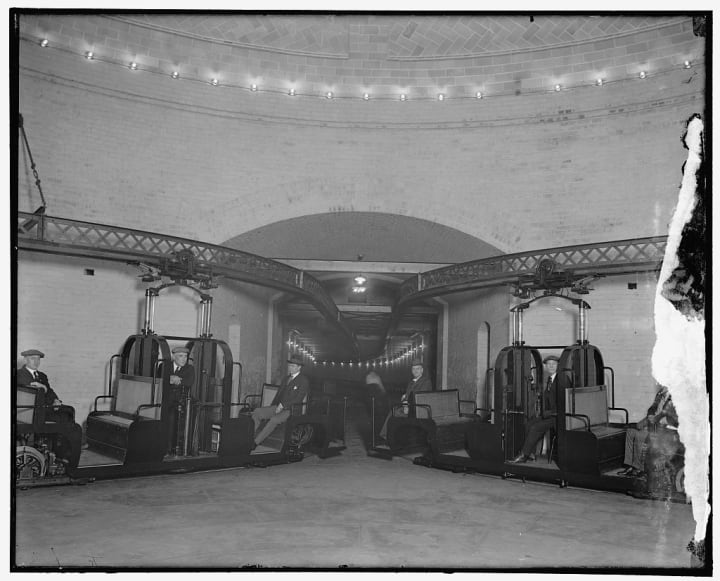
A vast labyrinth of vacant, emotionless corridors echoed with our footsteps as my friend led me to a room marked NASAX. His keycard swiped across the pad outside the door, causing a satisfying beep and a green flash accompanied by the clicking of a lock inviting me inside.
The door led to an airlock. I knew things were getting serious as we were misted with an anti-bacterial agent on our way into the hermetically sealed room. The smell of crisp, stale air greeted me with the pungency of an operating room. The room was lined with filing cabinets full of old records, many of which were stored on microfiche. The records went back further than the founding of NASA and even its predecessor the NACA (National Advisory Committee for Aeronautics). I spent the night reviewing hundreds of accounts of UFOs and UAPs tracing back to the founding of our country. It’s no secret that people have been reporting seeing things in the sky since antiquity, but many of these records had handwritten notes with words like “confirmed” or “multiple witnesses reported.”
After a few hours of skimming these records, I found what I was looking for—the Apollo Program. Cabinets full of records waited patiently to reveal their secrets to a lucky seeker. I was that seeker.
My friend, of course, couldn’t allow me to remove anything or take any photos, but I was able to study the contents of the records. Most notably for me were the tape recordings of Apollo 11 Mission debriefings.
I heard Neil Armstrong speak of the unsettling feeling of being watched. “I knew we were alone up there, but I couldn’t shake the feeling that someone was just out of sight the whole time.”
Buzz Aldrin described what he thought was an earthquake-like tremor, but no other astronaut could back up that claim through personal experience or any readings on their equipment. He stated that even though the reduced gravity had him barely touching the surface, it felt as though something was moving under his feet.
Michael Collins, who was on the mission but never actually stepped foot on the moon, recounted a visual from the command module. He described a cloud of dust a few meters from the landing site that looked like something had kicked it up from movement, but he never saw anything or anyone that he thought could have caused it.
The subsequent missions had similar reports though I could find no recordings from anything after 11, almost like they were intentionally excluded from even this locked away record room. What wasn’t hidden from the latter missions were some unexpected equipment orders with approvals from the highest officers of the day.
Every mission after Apollo 12 included order forms for firearms and explosives, documenting approvals from the Secretary of Defense, Robert S. McNamara with his signature and mysteriously initialed by PX. What could have happened on the second moon landing that warranted returning with explosives, and could it have anything to do with the fact that Apollo 13 had to return to Earth without landing?

The official reports show that an oxygen tank exploded aboard the service module for the mission. The emergency abruptly forced the flight path of Apollo 13 to be redirected back home. Thanks to the quick thinking and expertise of the crew, the astronauts made it home safe and sound.
An investigation conducted by a review board pointed to faults in voltage due to a design change, damaged Teflon, and an accident during pre-flight equipment testing as potential causes for the fire and explosion. Some might ascribe it to bad luck on account of the mission being number 13, but what if it wasn’t bad luck? What if it was sabotage from someone who didn’t want us going back to the moon?
Into the late hours of morning, I studied the available documents and dossiers, looking for anything that could truly validate Prometheus’ claims. As the clock ticked the night away, along with it went my hope at finding anything quite that tangible.
Eventually, time ran out, and I had to make my way back out of the underground and to a hotel. After an early morning nap—dreaming of lunar rovers and moonstones—I settled into the hotel lobby with a cup of coffee to review my notes, determined to find the missing pieces.
Somewhere, buried in the files of the night prior, I’d found a location I felt relevant enough to write down. With no other leads, I knew I must pursue this one. I grabbed a rental car and drove a few miles south into Virginia.
The coordinates I had led me deep into coastal marshland along that my rental couldn’t traverse. Resorting to travel on foot, I trudged through brackish water and muddy terrain until the abandoned facility gradually came into view. At first sight it was a dilapidated amusement park a cartoon villain might call home. As I closed in, an abandoned training facility for astronauts came into view.

It was the only training facility for space exploration that I’d ever seen with a shooting range. The buildings were rundown and sinking into the mud. Foundations that likely once supported Zero-G training modules and the like were now rusted and mostly buried in mud. Worn down base plates faintly read with familiar manufacturing names like Lockheed Martin and General Motors who had also collaborated on the construction of the Lunar Rover. Abandoned and stripped away, it was clear that this place was meant to be forgotten, but why?
Thankfully for me, as I was soon to discover, the site was not entirely devoid of historical value. At the center of the decrepit compound stood what appeared to be an office building. Marsh life had reclaimed most of it—Virginian flora climbing the walls and threading through cracked windows. As I fumbled my way through toppled, rusted office furniture overgrown with weeds, I even accidentally startled a mother muskrat and her kits.
At the heart of the building was a room containing nothing more than a grand desk and a framed painting of the Moon. This room wasn’t as overtaken as the rest of the structure, and when I took a closer look at the painting on the wall, I noticed something strange: fingerprints disturbed the dust along one edge of the frame. Someone had been here—recently.
It didn’t take long for me to realize the fingerprints had been from someone moving the painting. I followed suit and found a wall safe, dust-free and ajar. My heart thumped in my chest as the door creaked open from my pull. Dreading that someone knew I was coming and came here to clear out the safe, I looked inside. Much to my surprise, there was something there; a manila folder marked Top Secret. With trembling fingers, I grabbed the folder, threw it on the desk, and flipped it open with the excitement of a child on Christmas morning.
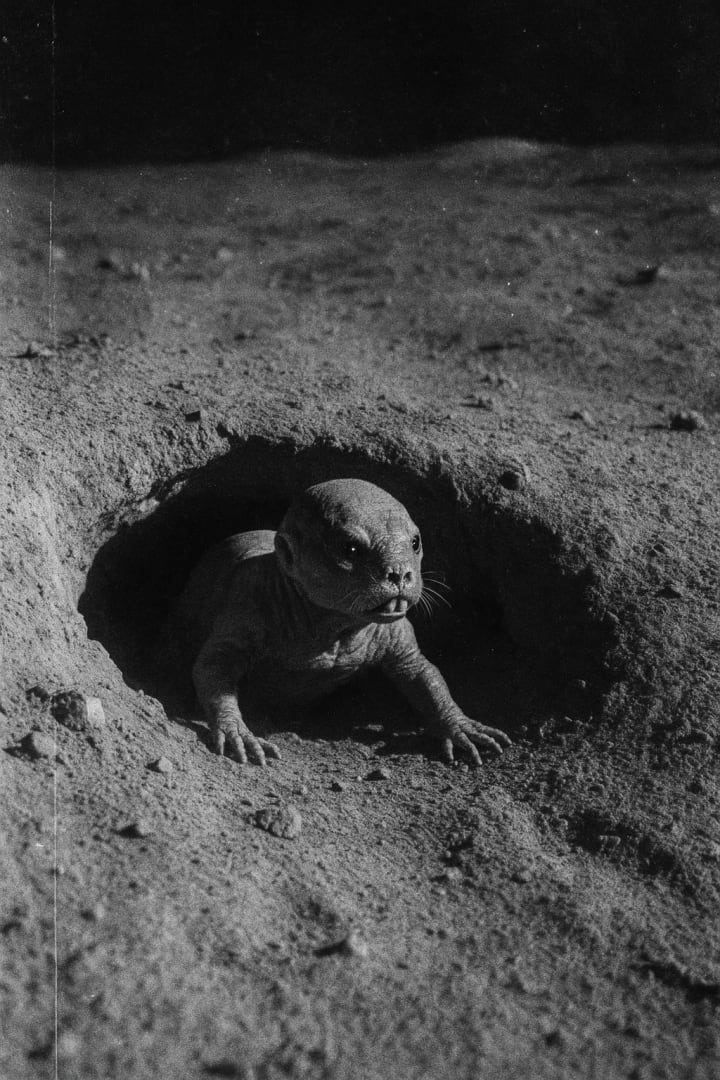
This was it: the last piece of the puzzle, a stack of black and white photos, each with handwritten dates that lined up with the Apollo Missions from 12 through 17. I will not even attempt to describe the creature(s) in the images I found, but I’ve included the clearest photo for your review.
Had someone left this for me on purpose? If so, who?
At the bottom of the stack of the photos was one that didn’t include the same type of creature. Instead, it showed something I hadn’t guessed I’d find here, or anywhere...Prometheus. He was standing there on the moon in plain clothes, no space suit. How could this be? The man who put me on this trail was also at the end of the proverbial rainbow. He has since become unreachable.
Now looking back at everything, I find myself wondering why. Why did Prometheus send me after this? Is he hoping I can prevent history from repeating itself with the scheduled launches of the current Artemis Program? Is it a warning about our neighbors in orbit?
Either way, since the completion of the Apollo Program, man’s giant leap has changed to running laps. We circle the Earth in a contraption of our own making, waving at the moon as we pass. Safety lives on the ISS where humanity knows it is hopefully alone, rather than trying to share the moon with what we clearly determined were not our friends.
Liam Einhorn is a fictional investigative journalist, studying the supernatural and paranormal history of the world. He is the lead reporter for Paranormal History, a branch of Tales from a Madman, and one small piece of the mind of the Madman.
If you'd like to read more from this series, it all began here: America's Unsung and Unseen Occult Operatives
†This is a work of parafiction. Real historical elements are blended with fictional characters, agencies, and events.
About the Creator
Tales from a Madman
.. the figure in question had out-Heroded Herod, and gone beyond the bounds of even the Prince's indefinite decorum.
The Masque of the Red Death
Edgar Allan Poe
Keep reading
More stories from Tales from a Madman and writers in Fiction and other communities.
Tesla's Treasure Chest
Tesla's Treasure Chest By: Liam Einhorn There are few immortal treasures to a journalist like myself: an unfiltered look at the JFK files; an unaccompanied tour of Area 52; a glimpse into the true origins of the pyramids. Any of those would stir the investigative mind, but perhaps not as much as the offer of a lifetime I present to you now.
By Tales from a Madman3 months ago in Fiction
THE EXTRA CHAIR
The first time the chair appeared, it was already set for dinner. Marianne noticed it when she brought the pot roast to the table. There were five place settings instead of four. Five forks aligned like silver ribs. Five water glasses catching the yellow light.
By Ajan Lori Abei6 days ago in Fiction




Comments
There are no comments for this story
Be the first to respond and start the conversation.