
Tesla's Treasure Chest
Parafictional History
Tesla's Treasure Chest
By: Liam Einhorn
There are few immortal treasures to a journalist like myself: an unfiltered look at the JFK files; an unaccompanied tour of Area 52; a glimpse into the true origins of the pyramids. Any of those would stir the investigative mind, but perhaps not as much as the offer of a lifetime I present to you now.
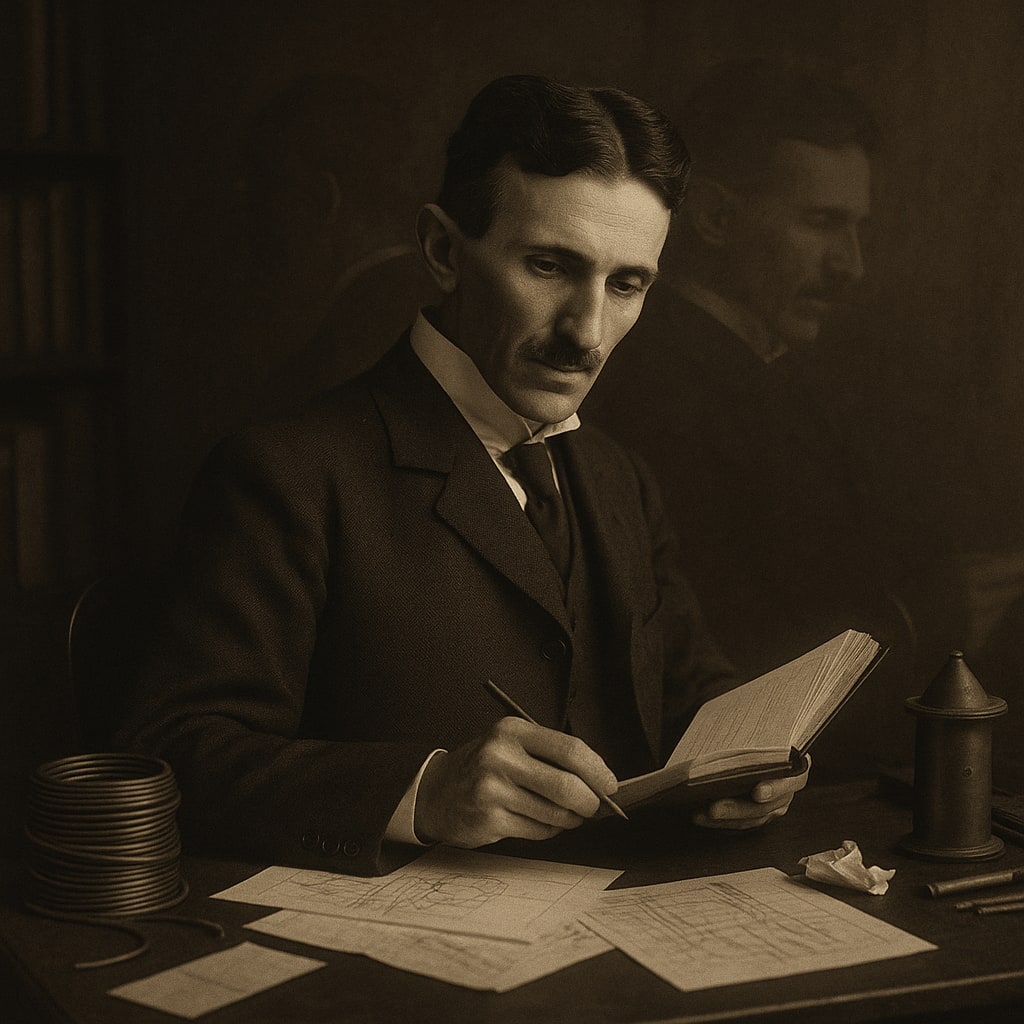
A dear friend who chooses, probably wisely, to remain anonymous invited me far from civilization, beyond any mapped trail. After a flight over the Atlantic Ocean, two rental cars, and a long walk into the dark woods, I finally found my friend in a clearing outside the town of Smiljan, Croatia, birthplace of Nikola Tesla. They greeted me with the treasure chest of my wildest dreams—one of the mysterious trunks that disappeared from records after the death of the famed inventor.

Under the cover of moonlight, they revealed to me that they’d borrowed the lost trunk from Tesla’s hotel room—one of the trunks that the FBI, John G. Trump (yes, that Trump family), and the OSS claimed never existed after promptly seizing them from his home.
The almost mythic father of modern electricity had died in his hotel residence at the age of 86. The American government, and likely many others, all sought to either peruse or bury his research and development after a long life of out-of-this-world inventions and claims.
Whether it was his alleged war-ending ‘Death Ray,’ his promise of a free energy source for all peoples of the world, or the earliest developments of automata—now recognized as the first remote control devices—Tesla’s files could contain the most world-changing notes of modern history.
I spent the night in the woods with a flashlight, a spread of Tesla’s diagrams and research notes, and—most crucially—the black notebook his nephew once reported missing. Even I, with my ever-open mind and my love of the hidden world, struggled to believe what I’d found in those notes.
Tesla furthered his claims that the human brain is actually a receiver, not a generator. He believed that it was a chemical machine translating consciousness into thought and action. He coupled this with his concepts for wireless electricity.
We already know his experiments in Colorado reportedly transmitted wireless electricity. Up to two miles away, bulbs he’d staked into the ground lit up, powered by an energy-emitting tower using the ground as a conductor. Local records even indicated that nearby horses' shoes had been affected by the emitted charges.

His notes additionally proposed that if the brain runs on electricity and is a receiver of consciousness, then it could also be possible to transmit consciousness. His diagrams showed a tower much like the one that was designed but never completed at Wardenclyffe due to his financial backing being pulled by JP Morgan.
Tesla even referred back to his early work with radio-frequency control. One of his most famous inventions was a remote-control boat. It’s no secret Tesla believed that automata would eventually become a regular part of our lives, but this went much further. His notes connected all the dots and led me to a previously unheard-of site where Tesla had continued his exploration of consciousness and electricity.
After a brief nap in my rental car shortly after sunrise, physically exhausted but spiritually charged, my highest priority had become finding this mysterious site referenced in the notebook. A map in Tesla’s notebook led me to a cave hidden in the Catskill Mountains. The only indicator that I was in the right place was the remnants of what appeared to have once been a radio tower on the peak above. As I proceeded past the mouth of the cave, I was greeted with an unexpected yet familiar sound—the hum of electricity.
Deep in the cave, I found an iridescent bulb, somehow still buzzing with a faint glow. It was just enough illumination to reveal that I was in a long-abandoned laboratory. At its center, an operating table sat with straps for the neck, wrists, and ankles. I used my flashlight to review the diagrams hung on the cave walls.

They depicted a human body with meticulously detailed designs for an additional nervous system made of copper wiring. It seemed to me that Tesla was truly designing a way to transfer consciousness from one mind to another. I pulled out desk drawers, which were mostly empty aside from a small stack of carbon copies.
I was astounded to see copies of death certificates and other records of Tesla’s life, like newspaper clippings announcing his death. These were things that could have only come to be there after his passing. So who could have brought them there? Even more astounding was another note scribbled in an unsteady hand, different from comparisons to Tesla’s other notes.
"7 January 1943, I fell in the New Yorker and rose in the Catskills. Success!"
My jaw hung open as I processed what I was seeing, the pieces coming together in my mind. On that fateful day, a real-life wizard of electricity also became a necromancer. Perhaps after a life in constant scrutiny, Nikola Tesla had chosen to live a new life out of the public eye. Perhaps he’s even repeated the process and still inhabits a new body today, riding the lightning and watching the world turn.
Either way, I returned the documents to where I’d found them and left the lab otherwise untouched. That is, aside from a note left for whoever may find it next—or return. My exact message is only for them, dear readers, but I’ll give you a hint: I would absolutely love to be the next person to interview the ‘late’ Nikola Tesla.
Liam Einhorn is a fictional investigative journalist, studying the supernatural and paranormal history of the world. He is the lead reporter for Paranormal History, a branch of Tales from a Madman, and one small piece of the mind of the Madman.
If you'd like to read more from this series, it all began here: America's Unsung and Unseen Occult Operatives
†This is a work of parafiction. Real historical elements are blended with fictional characters, agencies, and events.
About the Creator
Tales from a Madman
.. the figure in question had out-Heroded Herod, and gone beyond the bounds of even the Prince's indefinite decorum.
The Masque of the Red Death
Edgar Allan Poe
Keep reading
More stories from Tales from a Madman and writers in Fiction and other communities.
America's Unsung and Unseen Occult Operatives. Runner-Up in Mismatch Challenge.
America’s Unsung and Unseen Occult Operatives: The Moonwatchers By: Liam Einhorn You’ve likely heard the stories of the brave souls storming the beaches of Normandy. You may have even heard of the famed Code Talkers, immortalized by Hollywood in the film Windtalkers. My pursuit into the supernatural sides of history—the ones the powers that be don’t acknowledge—led me to a dank basement, smelling of mildew and secrets. There, I learned of a group you haven’t heard of… a secret unit of the US military kept confidential even in whispers.
By Tales from a Madman4 months ago in Fiction
A Historic Declaration
We the People of the Husbands of the United States of America, in Order to form a more perfect Union, and I mean you...with me...establish Justice, insure domestic Tranquility, provide for the common defence, promote the general Welfare, and secure the Blessings of Liberty to ourselves, after Puberty, do ordain and establish this Declaration of Co-Dependence.
By Gerard DiLeo5 days ago in Humans



Comments (1)
Man I love this genre, great work!