
Why CHILDREN see what adult can't
Their perception may diminish as they mature
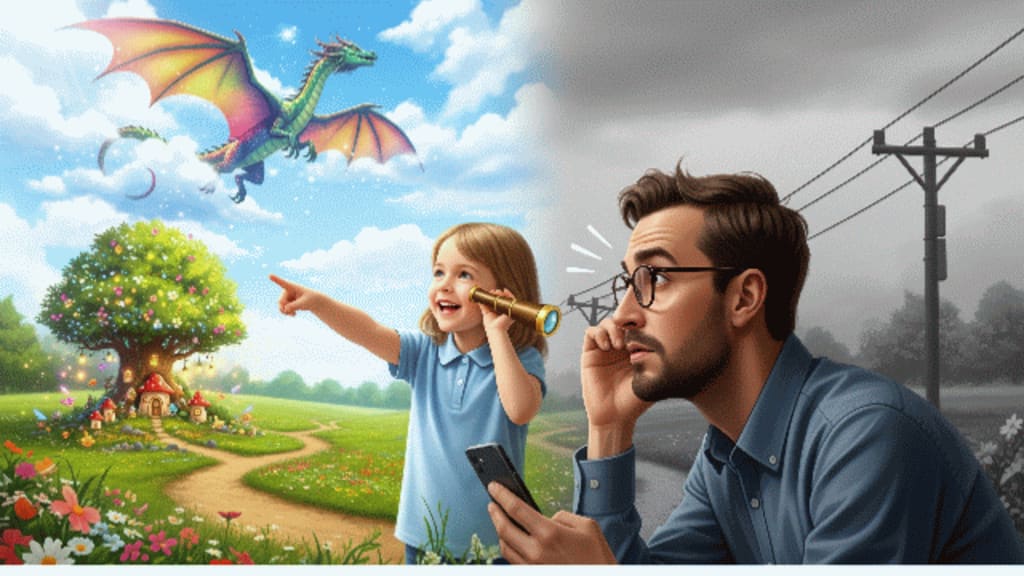
Children have always been associated with a strange sensitivity an ability to stare into empty corners, speak to unseen “friends,” or react to spaces adults feel perfectly comfortable in. Parents often dismiss it as imagination, but across cultures, this pattern is too consistent to ignore. Why do children seem to perceive what adults can’t? Several theories scientific, psychological, and metaphysical offer possible explanations.
1. Their Minds Are Still Open
From a developmental perspective, children interpret the world with fewer filters. The adult brain constantly categorizes, rationalizes, and explains away ambiguous stimuli. Children, however, process everything as it comes raw, unfiltered sensory information. This makes them more aware of subtle sounds, shifts in light, or movements adults may instantly ignore.
In other words, their perception is less restricted. What an adult might dismiss as a shadow, a child may treat as an actual presence.
2. Higher Sensory Sensitivity
Children especially between ages two to six have heightened hearing, sharper peripheral vision, and greater sensitivity to sudden stimuli. Their brains are wired to detect potential “threats” or unfamiliar shapes quickly, a survival trait that fades as cognition becomes more logical.
This heightened awareness sometimes mirrors what people describe as “seeing things.” While it may simply be sensitivity, many parents note that the reactions often seem targeted at a specific corner, door, or dark space.
3. Imagination vs. Pattern Recognition
Children naturally create narratives to make sense of the unknown. When they see shapes or shadows, their imagination fills in the blanks. However, their imagination is not random it often responds to patterns adults no longer notice.
Scientifically, this explains part of the phenomenon.
But it doesn’t explain why children across different countries consistently describe similar figures: tall shadows, “old people,” or “friends” no one else can see.
4. Cultural and Spiritual Interpretations
Most cultures believe children have a thinner spiritual “veil.” Many traditions teach that infants and toddlers can see entities, energies, or presences adults have become desensitized to. Whether one believes this or not, it is interesting that this belief appears in Asia, Europe, Africa, and the Americas.
Some claim that as children grow, logic, fear, and social conditioning gradually close that perception essentially “training” them not to see.
5. Memory Imprints and Emotional Echoes
Another theory involves emotional energy. Certain spaces hold strong emotional “echoes,” and children might be more sensitive to them. This doesn’t necessarily refer to spirits, but rather the leftover psychological weight of events that occurred in a place.
Adults have learned to tune out subtle emotional cues; children have not.
6. The Uncomfortable Question
If children are indeed more open and perceptive, an unsettling question remains:
Is their sensitivity revealing something real that adults have learned to ignore?
Whether explained by neuroscience or spirituality, the pattern is undeniable: children look at the world differently. They see more possibilities and perhaps more presences than adults.
About the Creator
Miss Persephone's Manual to a Seemingly Ordinary Life
Miss Persephone was found at the dining table, her blue eyes swollen, her tears arriving and retreating like the tides of the ocean. Earlier that day, her family had visited her in the retirement home where she had lived for eight years. It was her eightieth birthday.
By Imola Tóth2 days ago in Fiction




Comments
There are no comments for this story
Be the first to respond and start the conversation.