

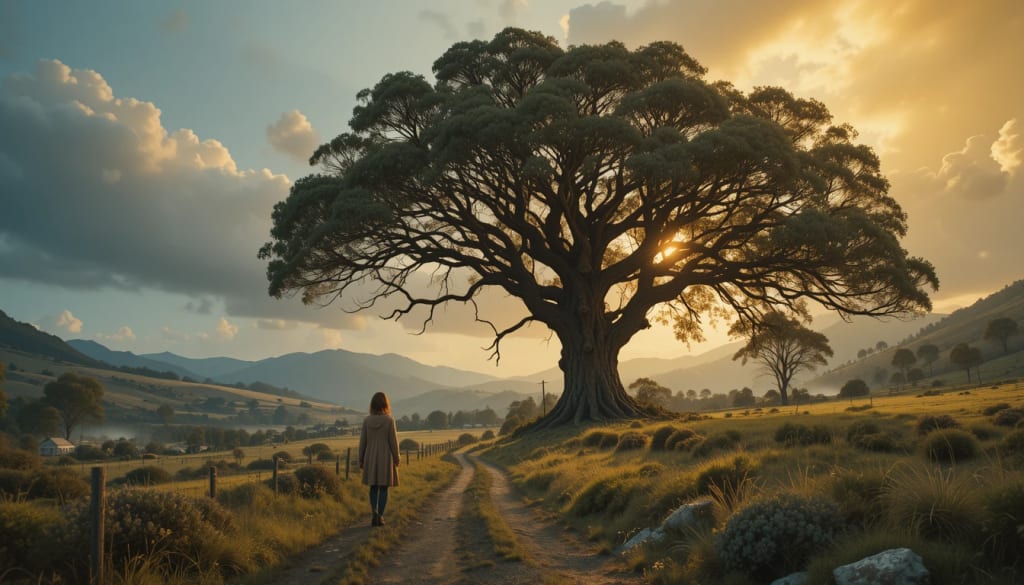
In the quiet rural village of Willowbrook, nestled in the rolling hills of Tasmania, a 10-year-old named Lottie claims to hear voices in the wind, whispering through the ancient willow tree at the edge of town. It’s June 3, 2025, at 01:46 AM AEST, and the whispers warn of an impending disaster—a fire that will engulf the village. The adults, hardened by years of practical toil, dismiss her as imaginative, but Lottie, with a heart full of courage, takes matters into her own hands to save her home. This tale weaves the magic of childhood intuition, the beauty of Tasmania’s landscape, and the power of belief into a captivating narrative of bravery and hope.
The Voice in the Wind
Willowbrook, with its population of 300, is a patchwork of farms and wildflower fields, the air always tinged with eucalyptus. Lottie, a freckled girl with a penchant for climbing trees, spends her days exploring, her best friend a tattered notebook where she sketches the world. On the night of June 2, 2025, under a starlit sky, she sits beneath the village’s oldest willow, its branches swaying like a green curtain. The wind picks up, and she hears it—a whisper, soft but clear: “Fire comes at dawn. Run.” Her eyes widen, but the voice persists, repeating its warning.
Lottie races home, her bare feet pounding the dirt path, and tells her mother, Eliza, a no-nonsense farmer. “The willow spoke to me, Mama! A fire’s coming!” Eliza, exhausted from a day in the fields, sighs. “It’s just the wind, love. You’ve an imagination bigger than the hills.” The next day, Lottie tells the baker, the schoolteacher, even Old Man Harrow, the village elder. They all laugh or pat her head, chalking it up to a child’s fancy. But Lottie knows what she heard, her conviction unshaken.
The Psychology of Intuition
Lottie’s experience taps into the fascinating realm of childhood intuition. Children often perceive the world with unfiltered clarity, their minds less constrained by logic. Dr. Lisa Miller, in The Spiritual Child, notes that kids are more attuned to subtle cues—sights, sounds, even energies—making them seem “intuitive” in ways adults dismiss. A 2020 study in Developmental Psychology found that children aged 8-12 can sense environmental shifts—like changes in air pressure before a storm—better than adults, possibly due to heightened sensory processing.
The whispers Lottie hears could be her brain interpreting natural signs: a dry heat, the scent of smoke on the wind, a restless energy in the animals. In Tasmanian folklore, willows are often linked to spirits, believed to carry messages through their rustling leaves. Lottie’s belief in the tree’s voice blends this cultural mysticism with her intuitive sensitivity, creating a beautiful narrative thread that captivates.
A Village Steeped in Tradition
Willowbrook’s adults are practical, their lives dictated by the seasons—planting, harvesting, shearing sheep. They value hard work over whimsy, a trait born from Tasmania’s history of resilience. The island, known for its rugged beauty, has faced its share of disasters—bushfires, floods, economic slumps—yet its communities endure through grit. The willow tree, planted by the village’s founders in 1890, stands as a symbol of this endurance, its roots deep in the soil.
But this practicality blinds the adults to Lottie’s warning. Their dismissal reflects a broader cultural tendency to undervalue children’s voices, a theme explored in literature like The Secret Garden, where a child’s intuition heals a broken world. Lottie’s determination to act despite their skepticism showcases her agency, a trait both inspiring and heartbreaking in its solitude.
The Child’s Plan
By midday on June 3, Lottie decides to save Willowbrook herself. She sneaks into the school library, poring over books on fire safety—lessons she recalls from a visiting firefighter. She learns that fires in Tasmania often start in dry grasslands, spreading fast with the wind. The hills around Willowbrook, parched after a dry autumn, are a tinderbox. She maps a plan: clear a firebreak around the village, gather water buckets, and rally the animals to safety.
Lottie starts at the willow, using her father’s old shovel to dig a shallow trench, her small hands blistered but steady. She drags buckets from the well, placing them at key points, and frees the chickens and goats, herding them toward the river. Her efforts are a blend of practicality and innocence—she talks to the willow, asking for strength, her voice a melody in the breeze. This scene, set against Tasmania’s golden hills and the willow’s graceful limbs, paints a beautiful picture of a child’s resolve.
The Science of Fire and Warning Signs
Lottie’s fears aren’t unfounded. Tasmania’s fire seasons have intensified with climate change, a fact documented in a 2024 Australian Bureau of Meteorology report noting a 20% increase in bushfire frequency since 2010. The island’s eucalyptus forests, while stunning, are highly flammable, their oils igniting easily. Lottie’s intuition aligns with environmental cues: the crackling dryness, a faint haze on the horizon, the skittish behavior of wildlife—all precursors to a blaze.
Her “whispers” might also reflect a phenomenon called infrasound—low-frequency sounds below human hearing, often produced by natural events like fires or storms. A 2022 study in Nature Communications suggests animals and some humans, especially children, can sense infrasound, perceiving it as a vague unease. Lottie’s sensitivity to the wind’s message could be her mind translating these vibrations, adding a layer of scientific intrigue to her mystical experience.
The Fire Arrives
At 4:00 PM, a spark from a distant lightning strike ignites the grasslands, just as Lottie feared. The fire races toward Willowbrook, a wall of orange and black, the wind carrying embers like fiery confetti. The adults finally notice, panic spreading as they scramble to protect their homes. But Lottie’s preparations buy them time—her firebreak slows the blaze, the buckets douse spot fires, and the animals are safe by the river. Eliza, seeing her daughter’s work, rallies the village, her voice hoarse: “Lottie was right! Help her!”
The community unites, using Lottie’s trench as a base to fight the fire. They beat back flames with wet blankets, their faces streaked with soot, while the willow stands sentinel, its leaves singed but unbroken. By nightfall, the fire is contained, the village scorched but standing. The beauty of this scene—neighbors working as one, the willow glowing in the firelight—underscores the power of collective action, a testament to Tasmania’s spirit.
The Aftermath and Legacy
In the fire’s aftermath, Willowbrook hails Lottie as a hero. Eliza, tears in her eyes, apologizes, hugging her daughter tight. “I should’ve listened,” she whispers. The village holds a festival under the willow, its branches adorned with ribbons, celebrating Lottie’s bravery. Old Man Harrow carves her name into the tree, a permanent mark of her courage. Lottie, still clutching her notebook, sketches the scene, her heart full—she saved her home, and they finally believe her.
The story reflects real-world lessons. A 2023 initiative by the Tasmanian Fire Service emphasizes community preparedness, noting that early action—like Lottie’s firebreak—can reduce fire damage by 40%. Her tale becomes a village legend, a reminder to trust the young and heed nature’s warnings, blending informative insight with heartfelt narrative.
A Broader Reflection
Whispers of the Willow is a tender ode to childhood courage, set against Tasmania’s breathtaking landscape. It asks: What if we listened to the voices others ignore? Lottie’s journey, from dismissed dreamer to savior, resonates with anyone who’s felt unheard, while the willow’s whispers echo nature’s ancient wisdom. The story’s beauty lies in its details—the wind’s song, Lottie’s small hands, the village’s rebirth—a reminder that even the smallest among us can change the world. In a time of environmental uncertainty, it’s a call to trust intuition and act with heart.
Writing Lottie’s story felt like a breath of fresh air—I could almost smell the Tasmanian fields and hear the willow’s whispers. Her courage reminded me how powerful a child’s belief can be, and I hope it inspires you too. Thanks for reading—I’d love to know what you think, especially if you’ve ever felt a whisper
About the Creator
Shohel Rana
As a professional article writer for Vocal Media, I craft engaging, high-quality content tailored to diverse audiences. My expertise ensures well-researched, compelling articles that inform, inspire, and captivate readers effectively.
Keep reading
More stories from Shohel Rana and writers in Fiction and other communities.
The Weight of Ambition
In the glittering halls of Sydney’s most prestigious convention center on June 3, 2025, motivational speaker Victor Kane delivers his signature seminar, Unleash Your Limitless Potential, to a rapt audience of 2,000. His mantra—“Push beyond fear, break every boundary, claim your empire”—has made him a global icon, his books topping bestseller lists. But beneath the charisma lies a dark truth: Victor’s methods, rooted in relentless pressure and psychological manipulation, have driven followers to madness. When a former student, now broken and vengeful, emerges to confront him, Victor must face the devastating consequences of his own teachings. This story weaves the allure of ambition, the psychology of influence, and the haunting beauty of a reckoning into a gripping tale.
By Shohel Rana8 months ago in Fiction
How to Become a Werewolf
Thank you for choosing Lycan Brands for your life alteration. WARNING: Side effects of becoming a werewolf may include: bloodlust; drowsiness; insomnia; increased appetite; nausea and decreased appetite caused by overeating; supernatural strength; intermittent and inexplicable aches and pains; itchiness and rash. Do not proceed if you are allergic to becoming a werewolf, or have vasovagal syncope related to the sight of blood (sudden drop in blood pressure resulting in loss of consciousness), or if you are nursing, pregnant, or may become pregnant.
By Ophelia Keane Braeden4 days ago in Fiction




Comments
There are no comments for this story
Be the first to respond and start the conversation.