
Where We Left the Watch – Part 3: The Room With No Clock
The final clue leads to a home with no clock, and a love that finally speaks its name.

Where We Left the Watch – Part 3: The Room With No Clock
By Mahboob Khan
It took me six days to text her after the call.
Not because I didn’t want to. But because I did — more than I realized. And when something feels that important, you start to hesitate. You wonder if maybe the magic was in the distance, in the waiting, in the not-quite.
But she didn’t wait for me to figure it out.
Instead, she sent me a picture.
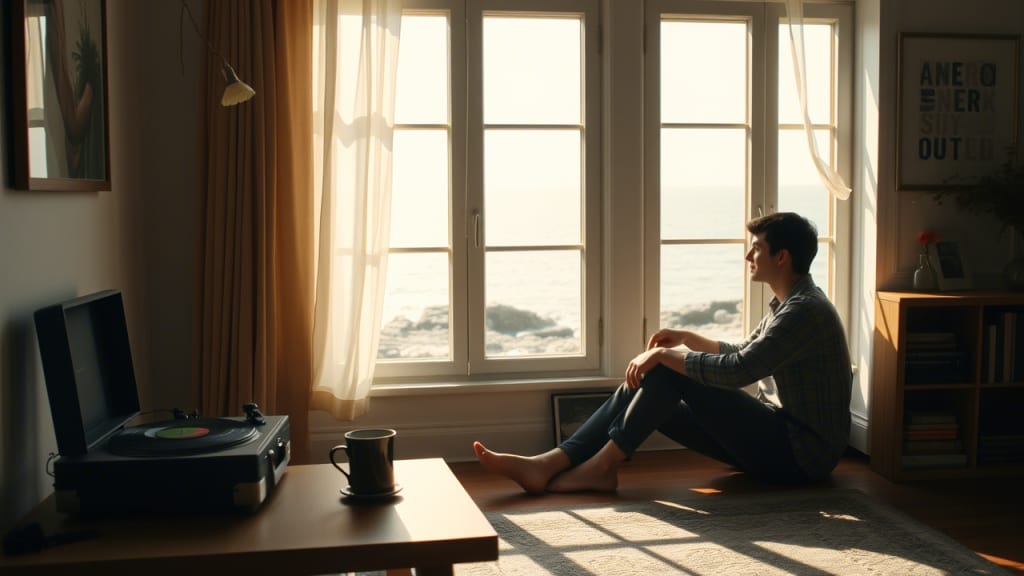
A small, sunlit room. A record player. A mug. A view of the sea.
“I found a place,” the caption said.
“There’s no clock. Thought you might like that.”
Two weeks later, I was standing at her door.
Same red ribbon, now tied to the doorknob.
She opened it like she wasn’t surprised.
“I knew you’d come,” she said, softly. “You just needed to take your time.”
The place smelled like citrus and old pages. Her scarf was hanging on a hook. A kettle was whistling.
For a moment, we didn’t say anything. And in that silence, I realized something:
We had never needed words to recognize each other. Not really.
She showed me the room.
It overlooked the cliffs. There was a single bookshelf, a messy table with dried paint stains, a drawer full of blank postcards.
“This is where I come to write,” she said. “Where I let memories fall apart and rearrange themselves.”
I turned and smiled.
“Do I get a drawer?”
“You get a whole shelf,” she said, and we laughed like we were still at the flea market, bickering over ceramic frogs.
That night, we didn’t talk about the past.
We sat by the window. Listened to records. Shared the couch without touching — not because we were afraid, but because it felt sacred, this pause between old rhythms and new ones.
When the record finished, I finally asked, “Why now? Why did you leave all those clues instead of just asking me to stay?”
She didn’t answer right away.
Then she said:
“Because I wanted to know if you remembered the version of me you fell in love with. Not the one time changed.”
“And did I?” I asked.
She looked at me.
“You remembered better than I did.”
We stayed up until 2 a.m., talking about everything and nothing — from the lighthouses of Maine to what we’d name a cat if we ever got one (she voted for ‘Captain Whisker’, which I strongly opposed).
The next morning, she made coffee and toast. We ate in that little room with no clock, where time finally felt like something we didn’t have to chase.
And then — only then — did we say the words.
“I love you,” I said, because I didn’t want her to guess anymore.
Not through postcards. Not through watches. Not through lighthouses or riddles.
She looked up from her coffee, the tiniest smile tugging at the corner of her mouth.
“Took you long enough,” she said.
Then added, softer, “I love you too.”
Epilogue
A year later, we still visit the flea market.
Booth 27 is now ours. We rent it once a month. Sell old books and odd objects and give away free postcards to anyone who looks like they might need a memory.
And we still have the silver watch — broken, ticking once, like a whisper from the past.
But we don’t need it anymore.
Because now, every morning, every ordinary moment, feels like a memory worth keeping.
And this time, we’re writing them together.
T H E E N D
About the Creator
Mahboob Khan
I’m a writer driven by curiosity, emotion, and the endless possibilities of storytelling. My work explores the crossroads where reality meets imagination — from futuristic sci-fi worlds shaped by technology to deeply emotional fiction.
Keep reading
More stories from Mahboob Khan and writers in Fiction and other communities.
A Seat at the Table
Mina never thought much about family dinners. She had her own apartment, her own life, and her own rules. She told herself she didn’t need anyone to share meals with, that she preferred solitude, and that cooking for one was simpler, cleaner. But tonight, the smell of roasted chicken drifting from her mother’s old kitchen down the hall made her pause. It wasn’t just the aroma—it was memory wrapped in warmth, and it clung to her like a familiar voice calling her home.
By Salman Writes7 days ago in Fiction
📢 Raise Your Voice Thread: 01/22/2026
Our “Raise Your Voice Threads” are hosted most alternating Thursdays at 12PM ET to offer creators more avenues to uncover exceptional stories on Vocal. As we are continuously searching for fresh creators and inspiring stories, this thread provides an opportunity to exchange and discuss the stories that have moved and motivated us on Vocal.
By Raise Your Voice by Vocal5 days ago in Resources




Comments
There are no comments for this story
Be the first to respond and start the conversation.