
Where the Birds Waited for Her
A woman's gentle routine leaves behind an echo of hope that nature never forgets

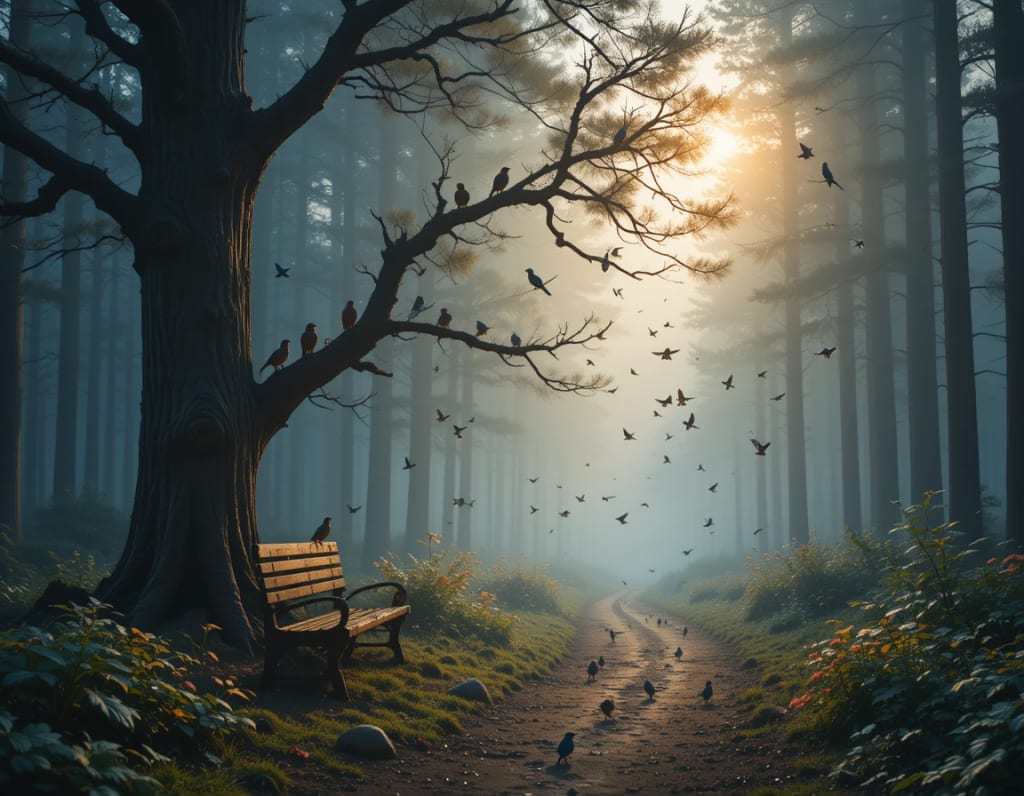
Where the Birds Waited for Her
Written by Shah Zeb
Every morning at 6:45 AM sharp, Eleanor stepped onto her small balcony with a cracked ceramic bowl full of seeds. Her balcony overlooked the modest garden she tended to herself, a little square of green in an otherwise graying suburban neighborhood. A line of small wooden birdhouses hung from the awning above, painted in pale blues and gentle pastels. They looked like a row of forgotten memories, faded but tender.
The birds came with the sun.
Chickadees first, then cardinals, then the plump mourning doves who always arrived late, like tired guests at a Sunday brunch. She had names for them all—not based on science or species, but on feeling. The tiny brown one with the crooked wing was Pip. The red-breasted visitor was Clara. The loud, bossy one with the attitude? That was Detective.
Eleanor was 82 and lived alone. Her husband had passed away ten years earlier, and her daughter, now grown, lived two states away with children of her own. They called weekly, sent cards on birthdays, and promised to visit more often. Eleanor never resented the distance. She understood life moved fast, and she had made peace with her solitude. Her birds, however, were daily guests she could rely on.
"Morning, Clara," she'd whisper, gently tossing seeds across the railing. Clara would hop once, then twice, before pecking the ground gracefully. Pip would flap around anxiously, waiting for his moment. The ritual was always the same, as familiar to Eleanor as her own heartbeat.
The neighbors had noticed her little ritual, though few ever spoke of it. They thought of Eleanor as kind but quiet, the sort of neighbor who’d smile softly but never overstay a conversation. Some of the children had called her the Bird Lady. One summer, a group of them had even drawn bird footprints with chalk leading up to her gate.
And then, one morning, Eleanor didn’t come out.
At first, the birds waited on the roof and railing like always. Pip fluttered his wings in a nervous rhythm. Clara perched on the balcony's edge, her head cocked toward the window. Detective let out two loud chirps and flew away.
But Eleanor’s window remained still.
By noon, the seeds remained in their ceramic bowl by the kitchen sink.
She had passed away in her sleep.
The news trickled slowly. A concerned neighbor noticed the mail piling up. The garden, always tidy and lovingly trimmed, was beginning to wilt. A wellness check was made. Her daughter arrived two days later, her face pale and lips pressed into a thin line. She stood on the balcony in the early morning, clutching the bowl of seeds in her hands.
She scattered them.
And the birds came.
Pip landed first, more hesitant than usual. Clara followed. Even Detective made a rare, quiet appearance, as if sensing something different. Eleanor’s daughter wept behind the curtain of her long sweater sleeves as the little wings fluttered and dipped, feeding in silence.
In the weeks that followed, the balcony stayed empty.
But the birds kept coming.
Every morning at 6:45 AM.
The neighbors noticed. The woman was gone, but the birds—dozens of them—still came. They lined up on the balcony railing, perched on the old birdhouses, and waited. No food was there, but they came anyway. Pip still flapped nervously. Clara still tilted her head, scanning the window.
It became a quiet mystery.
A retired teacher who lived across the street wrote about it in the neighborhood newsletter. Someone else posted a photo online, captioned: “She’s gone, but they remember.” The story spread. Comments flooded in. “Nature remembers kindness.” “Proof of soul.” “Not all routines die with us.”
One morning, a child from the neighborhood—maybe nine or ten—climbed the gate and placed a small bowl of seeds on the balcony. Her parents scolded her later, but the next morning, when she returned with her father, the seeds were gone. Birds, full and bright, fluttered into the sky as she beamed.
So began the second ritual.
Neighbors took turns. They left seeds. Hung new birdhouses. Repainted the railing in Eleanor’s favorite pale blue. The garden was weeded and watered. Even the mailman brought a bag of sunflower seeds one morning, leaving it neatly by the gate.
Eleanor’s daughter visited on the anniversary of her passing. She stood among people she’d never met—neighbors, children, elders. Together, at 6:45 AM, they watched as the birds came again.
And waited.
The ceremony was brief. No speeches. Just seeds scattered, and wings rising into the morning light.
Someone had made a small plaque:
“She gave, they remembered. Eleanor’s Birds.”
Years passed.
The house eventually sold to a young couple. They kept the garden. Refilled the feeders. The tradition stayed. Tourists even visited sometimes, drawn by the quiet beauty of it. The birds kept coming. Not because of habit. But because, perhaps, they felt something there.
Something left behind.
Not all goodbyes are echoes. Some are seeds.
And some seeds bloom with wings.
About the Creator
Keep reading
More stories from Moonlit Letters and writers in Fiction and other communities.
The Man Who Sat in Silence for 10 Years
The Man Who Sat in Silence for 10 Years Written by Raza Iqbal In the small village of Bramble Hollow, nestled between misty hills and forgotten trails, there lived a man named Elias Wren. No one had heard his voice in ten years. Not even a whisper.
By Moonlit Letters8 months ago in Fiction
The Safety Bell
Pity hung from the funeralgoers' faces. They were something out of a nightmarish painting; not sure what to do with their mouths, some pinching them closed, others looked like they were caught mid scream. Most of the women had watering eyes that they tried to avert from meeting Albert’s. For some reason, it made him feel ashamed.
By Nikki Torino Wagnerabout 16 hours ago in Fiction


Comments
There are no comments for this story
Be the first to respond and start the conversation.