
When the Sea Stopped Moving — and the World Began to Break
One morning, the ocean fell silent. Not a wave, not a ripple. What came next changed everything

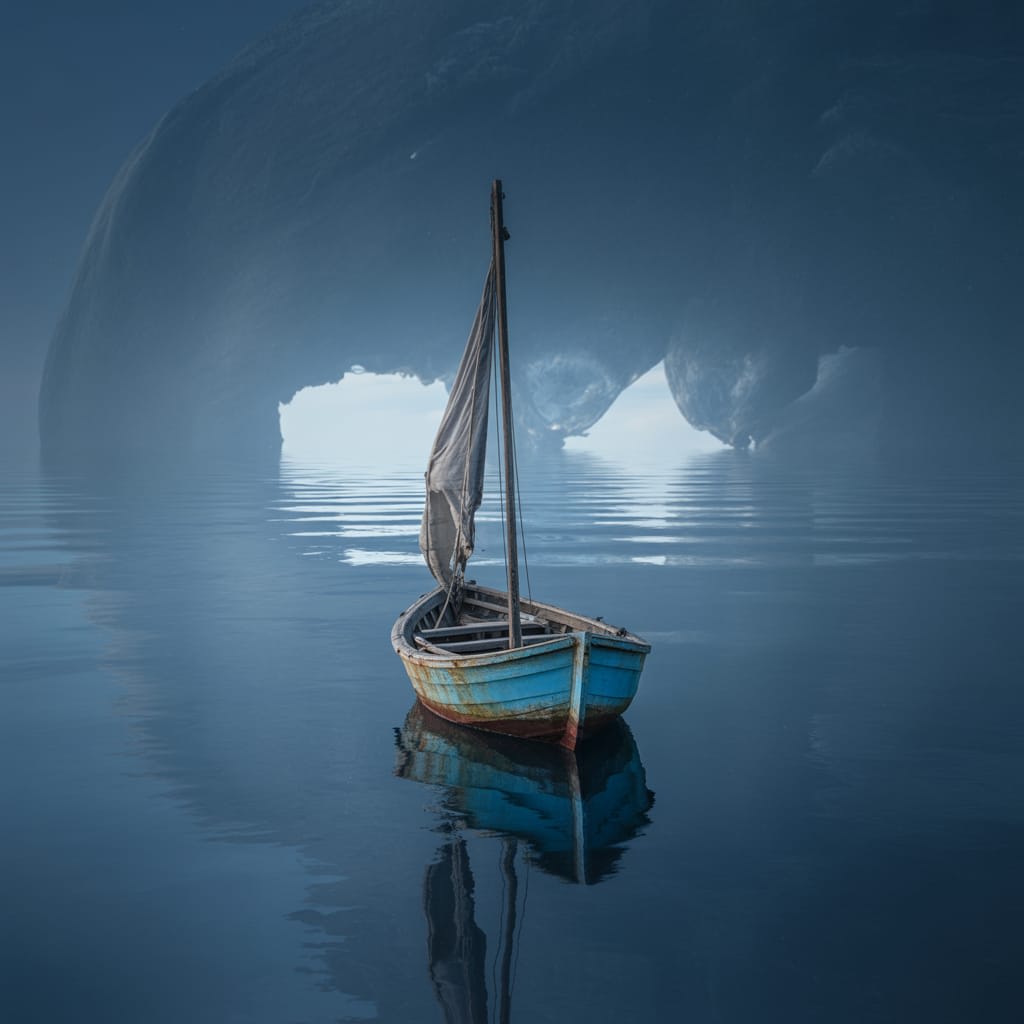
It started as silence.
No gulls, no waves, no wind — just a vast, glassy ocean stretching to the horizon. At first, people thought it was a rare calm. But within days, the stillness spread across the globe. Shipping lanes froze. Fish vanished. And beneath the Pacific, something impossibly large began to wake.
I’ve lived on the coast my whole life.
I know the sound of the ocean in my bones — the restless hiss of foam on sand, the bass thud of distant swells breaking against the jetty, the soft creak of the pier as the tide lifts it like a sigh. It’s not just background noise; it’s the heartbeat of this place.
So when I woke that morning and heard… nothing, my body noticed before my mind did.
I lay there in bed, staring at the slatted ceiling, waiting for the low, rhythmic pulse of water against the shore. But all I heard was the whine of the refrigerator in the kitchen and the faint ticking of the wall clock. No gulls. No wind. Just absence.
I pushed myself up and stepped to the window.
The ocean was there — a smooth expanse of dull blue stretching into the distance — but it was wrong. It wasn’t calm; calm still breathes. This was still. The surface looked like glass left to cool, a flawless mirror reflecting the thin streaks of dawn. Not a ripple, not a shiver of movement. The horizon line was a ruler’s edge, sharp enough to cut your eyes if you stared too long.
I thought maybe it was a trick of the light, or that my sleepy brain wasn’t processing it right. I threw on yesterday’s clothes and ran barefoot down to the beach.
By the time I got there, I wasn’t the only one.
Old Manny, the fisherman who’s usually halfway to the reef by sunrise, stood ankle-deep in the water, his net limp in one hand. A couple of joggers had stopped mid-stride, eyes fixed on the horizon. Even the stray dogs that haunt the dunes were pacing instead of barking.
I stepped onto the wet sand. My own reflection stared back up at me, sharp and undistorted, like I was standing on a slab of black marble. I bent to touch the water — it was cool, perfectly still. No pushback, no subtle tug from a current.
“This isn’t right,” Manny muttered, not looking at me. “The tide’s due in fifteen minutes. It’s not moving.”
We stood there, waiting. But the line where sea met sand stayed exactly where it was, as if someone had pressed pause on the world.
By eight a.m., the pier was crowded. Tourists were leaning over the rail, recording the water with their phones. Some laughed nervously, calling it a once-in-a-lifetime sight. Others whispered, voices edged with unease.
I’m a meteorologist by trade, working with the small coastal research station outside town. My first instinct was to check the tidal monitors. I called Alina, my colleague, who answered before it finished ringing.
“Tell me you’re seeing this,” she said, no greeting.
“I’m on the pier right now,” I said. “It’s… frozen. Is that even possible?”
“Our sensors are flatlined,” she said. “No tide charts, no wave action, zero current speed.”
“That’s not—” I stopped. “Are they malfunctioning?”
She was quiet for a beat. “Every station up the coast is reading the same thing.”
By noon, it was global. The BBC ran a breaking chyron: OCEAN STILLNESS PHENOMENON BAFFLES SCIENTISTS. CNN had live footage from beaches in Australia, Iceland, Chile — all showing the same eerie tableau.
Scientists tried to explain it: seismic activity disrupting currents, extreme atmospheric pressure, some rare combination of lunar and solar gravitation. But none of those theories held up. The oceans weren’t just slowing; they had stopped entirely.
Shipping lanes froze. Ferries sat in place mid-route. Fishing trawlers drifted on dead water.
And then the marine life began to vanish.
It started with the gulls — they didn’t dive for fish because there were no fish breaking the surface. The dolphins stopped appearing along the inlet. By the second day, the crabs weren’t in the shallows. Manny came by my office and slammed his empty net on the desk. “Three generations I’ve fished these waters,” he said, voice shaking. “Never come home empty. Not once. Until now.”
That night I walked the beach alone. The air was too still; even the wind seemed to have lost its script. The moonlight turned the water into a sheet of silver, so perfect it reflected stars I couldn’t even see in the sky.
And then I noticed the smell.
The ocean always has a scent — salt, brine, life. But now it smelled faintly metallic, like wet coins.
I took a sample back to the lab. Under the microscope, the water looked wrong. The plankton were gone. The salt crystals had arranged themselves into bizarre, symmetrical patterns, like frost on glass.
When I sent the images to Alina, she didn’t reply for two hours. When she did, her text said only: You need to see this in person.
Alina had been analyzing seismic data from the Mariana Trench. The stillness hadn’t spread from random points along the coastlines — it had started from a single location, an impossibly deep part of the Pacific. At 03:14 GMT, every underwater current in the world stopped, beginning there and rippling outward in a perfect sphere.
“What’s down there?” I asked.
She shook her head. “Nothing we’ve ever mapped. But the sonar picked up something… reflective.”
“Reflective?”
She turned her monitor toward me. The sonar image showed a shape — too geometric to be natural, too massive to be man-made. A structure, lying miles beneath the ocean floor, pulsing with a faint rhythm.
My brother Mark was on a research vessel studying deep-sea thermal vents, somewhere off the Philippines. He called once a week, but I hadn’t heard from him since before the stillness began. His ship’s transponder signal was still in the same coordinates, unmoving.
I tried the satellite phone. No answer.
That night, I dreamed of him standing on the deck, looking down into water so clear it was black. In the dream, something beneath the surface opened an eye the size of the boat.
When I woke, my hands were shaking.
By the fourth day, weather patterns collapsed. Without the ocean currents regulating heat, temperatures swung wildly. Storm systems formed and died within hours. Crops withered inland from heat spikes. Coastal cities reported unprecedented humidity.
Then came the sound.
It started low, like a hum you feel in your bones before you hear it. By evening it had grown into a constant, subsonic vibration coming from the ocean itself. People reported headaches, nosebleeds, even hallucinations.
Alina played a recording of the vibration in the lab. It wasn’t random — it was patterned, like whale song slowed down until each note was a minute long.
“You think it’s alive,” I said.
She didn’t answer.
When the UN announced a deep-sea expedition to investigate the source, I volunteered immediately. My brother was still out there — maybe stranded, maybe worse — and I couldn’t just watch from the shore.
We launched from Guam, a crew of twelve scientists and divers. The still water made for a smooth voyage, eerily smooth. No spray, no pitch, no roll. Just silence and the hum, growing louder as we approached the coordinates.
At night, the stars reflected perfectly on the surface, so it felt like we were sailing through the sky.
On the fifth day, we reached the point. The water here was darker, as if the light itself refused to sink.
We sent down the ROV first. The feed showed miles of nothing — black water, drifting motes of silt — until suddenly the structure filled the screen.
It was colossal, stretching beyond the edges of the camera’s view. Its surface was smooth, segmented like armor plates, each one etched with lines that shimmered faintly. The hum was deafening here.
And then one of the plates moved.
Not much — just enough to reveal the blackness beneath wasn’t empty. It was watching.
The feed cut to static.
We argued for hours on the deck. Some wanted to surface and broadcast what we’d seen. Others said we should leave it buried — if it had stopped the ocean with a thought, what else could it do?
That night, I went to the stern to clear my head. I thought I saw movement — the first wave in days, rippling toward us. Relief surged in my chest.
But it wasn’t a wave. It was the surface itself, rising.
The water beneath the ship bulged upward, lifting us as if we were on the back of something vast. For one impossible moment, I swear I saw the curve of a shell, the size of a continent.
Then it sank again, leaving the sea perfectly still.
The hum stopped.
And the silence that followed was worse.
The next morning, the ocean was still — but not in the same way. It was heavier, denser. The air tasted like metal again.
No one spoke about what we saw. But that night, as I stood alone on the deck, I realized the stars were wrong.
The constellations had shifted.
And in the far distance, beyond the horizon, something was rising.
About the Creator
Muhammad Sabeel
I write not for silence, but for the echo—where mystery lingers, hearts awaken, and every story dares to leave a mark
Keep reading
More stories from Muhammad Sabeel and writers in Fiction and other communities.
Men on the Moon
Nobody at NASA gave a goddamn about the weather in Jersey. This fact, as true and as simple as it was, had not stopped my Aunt Rosie from pacing around the parlor all morning and pressing her face to the front window in search of thunderstorms. My mother had yelled at her for smearing rouge on the glass, and she, of course, had yelled right back. And soon, everybody was yelling.
By Muhammad Sabeel6 months ago in Fiction
The Devil's Cut
“Comrade, finally you’re awake.” The voice was smooth, sensual. A flickering incandescent bar was all that lit the white, sterile room. All Vladimir remembered was everything going black. He tried to move his arms and found them strapped to the gurney.
By Matthew J. Fromm3 days ago in Fiction


Comments
There are no comments for this story
Be the first to respond and start the conversation.