
When Stars Forget to Shine
When the Universe Starts Counting Our Lives in Light

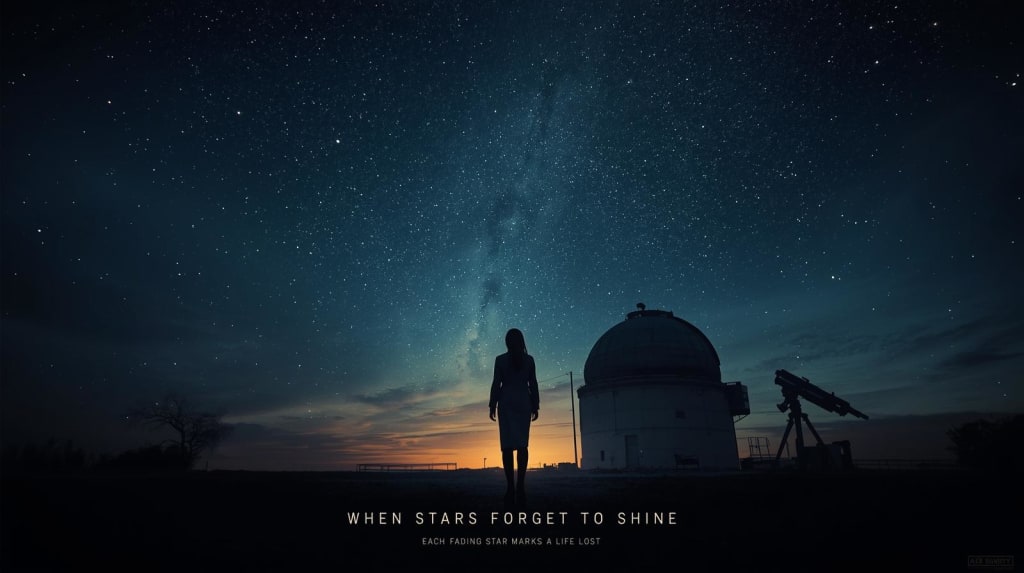
When Stars Forget to Shine
When the Universe Starts Counting Our Lives in Light
Dr. Aanya Mehra had always believed the universe was a grand equation complex, beautiful, but ultimately explainable. As one of India’s leading astrophysicists, she spent her nights at the Himalayan Sky Observatory, where the stars felt close enough to touch. But on a cold November night, as she stared into the velvet dark, she saw something that defied science.
A star had vanished.
Not dimmed, not exploded erased. One moment it was there, blazing steadily on her monitor. The next, it was gone. No supernova, no collapse. Just silence where light had been.
At first, she blamed the telescope. Then the software. But the next night, another star disappeared. Then another. Within a week, hundreds were gone random points scattered across constellations, vanishing like words erased from the sky.
The scientific community buzzed with confusion. Was it a cosmic event? A new form of dark matter? A glitch in observation?
But Aanya noticed something others hadn’t.
Each disappearance aligned with a timestamp and every timestamp matched a human death somewhere on Earth.
It started as coincidence. A nursing home fire in Canada. A bus crash in Kenya. A hospital blackout in Tokyo. When she plotted the events, the pattern was undeniable. Every time someone died, a star winked out. Not metaphorically. Literally.
Her discovery spread quietly at first through encrypted emails, late-night calls, and data logs too strange to publish. Then journalists got wind of it. The Death Constellation Theory, they called it. Social media turned it viral. Hashtags trended, prayers flooded timelines, and people began watching the sky not for wonder, but for loss.
Governments tried to suppress panic. Religious leaders called it divine judgment. Scientists demanded evidence.
Aanya had it and wished she didn’t.
Night after night, she stayed awake at the observatory, her eyes burning from sleeplessness and grief. The stars, once her solace, now felt like a countdown. She watched the heavens dim, a slow erosion of existence itself. People began holding vigils for the stars. When the light goes, they said, a soul is gone.
It changed how humanity lived.
People became gentler, kinder afraid to cause harm, as if their cruelty might steal a piece of the sky. Others turned desperate, searching for ways to make their light eternal. Entire religions were reborn overnight, worshipping the stars as living memory.
Aanya avoided the cameras and the chaos. She buried herself in equations, seeking logic in the impossible. Then, one evening, while cross-referencing the latest data, she froze. A new name had appeared in her predictive model her own.
Aanya Mehra.
Next disappearance: 2:47 AM, November 15th.
Star Designation: HSC-9A3.
Coordinates: Orion Belt, upper right.
Her heart pounded. The pattern had never been wrong.
For the next two days, she tried everything medical tests, simulations, statistical analysis. She was healthy, rational, alive. But every variable, every projection, led to the same conclusion.
She was next.
The night of November 14th was silent and clear. The observatory’s glass dome reflected a sky half-empty. Aanya sat before her telescope, her breath misting in the cold air. She thought of her father, who’d taught her to name the constellations. She thought of her students, who’d once believed science could explain everything.
And she thought of the stars those brilliant witnesses to our brief lives.
At 2:46 AM, the world outside was still. Aanya adjusted her lens toward Orion. The star her star shimmered faintly, as if struggling to stay. Her chest tightened, not in fear, but in awe. For the first time, she felt the universe wasn’t something to study, but something to belong to.
She whispered softly, If the stars forget to shine, maybe they’re just going home.
The monitor flickered. The coordinates blinked once, twice and went dark.
When dawn broke, the observatory’s logs showed one final entry, automatically saved by the system:
Across the world, millions woke to find one more star missing from Orion’s belt. News outlets ran the story another light gone, another mystery deepened.
But that night, an intern at the observatory swore she saw something strange in the sky a faint new glow forming just beyond the constellation’s edge. A star too dim to register yet, but growing.
And for the first time in weeks, people looked up not in fear, but in hope.
About the Creator
Farooq Hashmi
Thanks for reading! Subscribe to my newsletters.
- Storyteller, Love/Romance, Dark, Surrealism, Psychological, Nature, Mythical, Whimsical
Keep reading
More stories from Farooq Hashmi and writers in Fiction and other communities.
The Silent Village
The Silent Village When Silence Speaks Louder Than the Dead The road to Edevan was quiet too quiet for a place that once echoed with children’s laughter, church bells, and market chatter. Now, the village stood in an eerie hush, its houses shrouded in fog and its people moving like ghosts. No voices, no greetings, not even the sound of prayer.
By Farooq Hashmi4 months ago in Fiction
Lightning Never Strikes Twice
The distant rumble, the sudden deluge, the crescendo of sound, the flash of light, the explosive energy — it never gets old. I became an amateur storm chaser about two years ago. My wife, Cindy suggested it. Sort of. She said, "Alex, you know this cancer is killing me. I've come to terms with that, but you're smothering me. Go join a band, write a book, or become a storm chaser, for all I care. I love you, but you need a hobby."
By Julie Lacksonen6 days ago in Fiction
Crystal Banaba
“Emergency landing requested!” Rachel repeated in a shaky voice. Peering down through thick clouds, she saw an island that seemed to have popped up out of nowhere. It even had its own airstrip! Was she hallucinating, coming out of the storm that nearly split her Cessna? Or was she dead already, with her mind projecting an island that shouldn’t be here?
By Lana V Lynxabout 17 hours ago in Fiction
A Knight of the Seven Kingdoms Series Review (Season 1)
As one of the biggest properties in fantasy, A Song of Ice and Fire remains immensely popular with audiences. After reaching far into the past with House of the Dragon, a second spin-off was on the cards. A Knight of the Seven Kingdoms serves up a bite-sized slice of action and drama, but it still claims a spot among the best small-screen titles.
By Robert Cain7 days ago in Geeks


Comments
There are no comments for this story
Be the first to respond and start the conversation.