
The Silent Village
When Silence Speaks Louder Than the Dead

The Silent Village
When Silence Speaks Louder Than the Dead
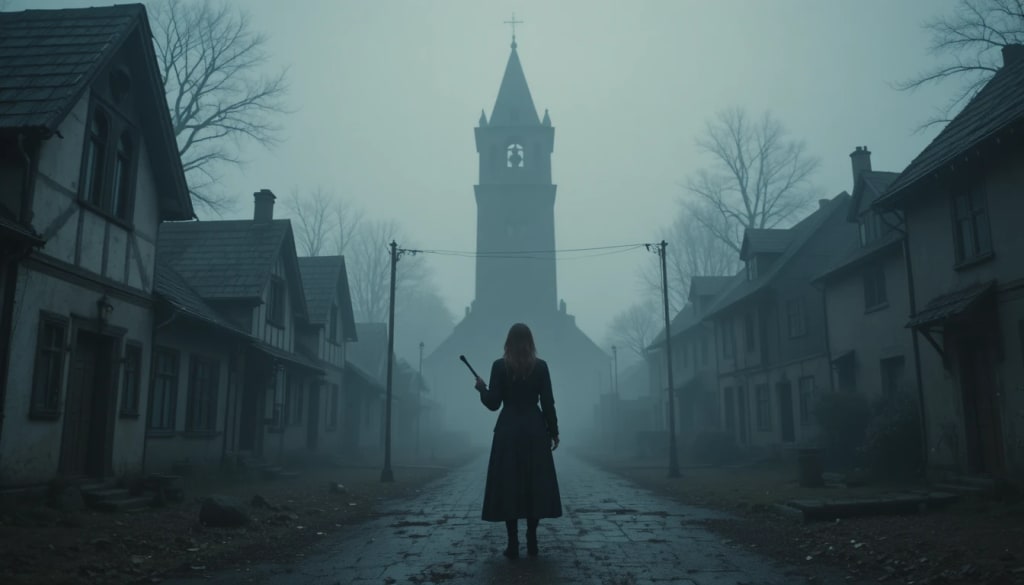
The road to Edevan was quiet too quiet for a place that once echoed with children’s laughter, church bells, and market chatter. Now, the village stood in an eerie hush, its houses shrouded in fog and its people moving like ghosts. No voices, no greetings, not even the sound of prayer.
For journalist Lena Morris, this silence wasn’t just strange it was haunting. She’d come to write about the “Vow of Silence,” a ritual the entire village had taken after a national tragedy five years ago. No one had spoken a word since. Some called it a spiritual penance, others a collective madness. But the truth, Lena believed, lay buried somewhere between grief and guilt.
Her arrival drew curious eyes, but no words of welcome. The mayor, a gray-haired man with deep-set eyes, handed her a note instead of speaking:
“You may stay in the old schoolhouse. Please respect our silence.”
Lena nodded, uneasy. As night fell, she unpacked her recorder and camera, documenting the village’s ghostly calm the people communicating with gestures, chalkboards, and fleeting glances. But when she played her audio back later, something froze her blood.
There was a voice. A faint whisper.
“You shouldn’t have come.”
She replayed it again and again, but the villagers around her remained silent, unaware or pretending not to hear. She brushed it off as static, fatigue, or her imagination. But the next day, the whispers grew louder.
It began in the church a crumbling structure at the village’s heart. Lena wandered inside, the air thick with dust and candle smoke. The pews were empty except for a single child, sketching on a piece of paper.
When Lena approached, she saw the drawing: a burning house, people running, and above them, a black cloud shaped like a face. Before she could ask anything, the child looked up and pressed a finger to her lips. Silence.
And then Lena heard it again.
“They burned because they spoke.”
She spun around no one was there. The child had vanished.
Her hands trembled as she left the church. Something was deeply wrong with this place.
In the following days, Lena tried to uncover the truth. Old records revealed that Edevan had once been the site of an industrial accident a factory explosion that killed dozens. The company responsible had silenced survivors with hush money. But when the scandal finally broke, the villagers were blamed for “lying,” for ruining reputations. In shame and anger, they had sealed their own lips forever.
But silence, Lena realized, had not brought peace. It had only trapped their pain.
That night, as she reviewed her recordings, the voices returned this time, louder and more desperate.
“Listen to us.”
“Set us free.”
“They made us quiet.”
The lights flickered. Shadows gathered near the window, shaping themselves into blurred outlines of faces mouths open in eternal screams. Lena stumbled back, dropping her recorder.
And in that moment, she understood. The village wasn’t haunted by ghosts. It was haunted by unspoken truth the collective guilt of people who had chosen silence over justice.
At dawn, Lena ran to the square, desperate to break the curse. She stood before the villagers, her voice trembling.
“You don’t have to stay silent!” she cried. “They can’t hurt you anymore!”
Her words shattered the stillness like glass. For a heartbeat, no one moved. Then the mayor stepped forward, his eyes wet with tears. Slowly, painfully, he opened his mouth.
And whispered the first word spoken in five years:
“Sorry.”
The fog lifted. The church bell rang a sound the village hadn’t heard since the tragedy. People began to weep, laugh, shout. The air filled with life again.
But when Lena checked her recorder one last time, there was a final whisper, calm and clear.
“Thank you for listening.”
She left Edevan the next morning, the sun rising behind her. The silence was gone, but its echo stayed within her soft, haunting, and eternal.
The Silent Village” explores how silence can both protect and imprison. It delves into collective guilt, trauma, and the haunting power of truths left unspoken. In breaking the silence, the villagers reclaim not just their voices but their humanity.
About the Creator
Farooq Hashmi
Thanks for reading! Subscribe to my newsletters.
- Storyteller, Love/Romance, Dark, Surrealism, Psychological, Nature, Mythical, Whimsical
Keep reading
More stories from Farooq Hashmi and writers in Fiction and other communities.
The Last Library on EarthThe Last Library on Earth
The year was 2197, and the world no longer read books. Words no longer lived on paper, bound between covers that smelled faintly of dust and time. They lived in data streams cold, sterile, and owned by one corporation: Infinitum. Every idea, every story, every scrap of recorded knowledge flowed through its servers. What people read, what they learned, even what they remembered all filtered, approved, and sold back to them in digital form.
By Farooq Hashmi5 months ago in Fiction
The Legend Of El Dorado
For centuries, humanity has remained captive to the mesmerizing glow of gold. Throughout history, this precious metal has driven nations to war, kings to madness, and explorers to the ends of the earth. Yet, within the annals of history, there exists a name that sparked more obsession than any other — El Dorado. This was the legendary city said to have streets paved with gold, palaces covered in pure sheets of the precious metal, and a king who dusted his entire body with gold powder before diving into a sacred lake. It was the ultimate dream of wealth, a mirage that lured thousands to their doom.
By Literary fusion2 days ago in Fiction



Comments
There are no comments for this story
Be the first to respond and start the conversation.