


The beginning was so small that I almost missed it.
After the bell rings, my classroom usually empties slowly, much in the way bars do at last call when everyone lingers a little longer than they should. It never fails—someone lingers to spill the day’s hottest tea, someone else gathers the Chromebooks and slides them into the cart while pretending not to listen, and at least one kid asks to borrow my pink, English teacher coded cardigan tomorrow because the air conditioning in this building seems personally offended by human comfort. I call them “my child”, when they say something so obvious or ridiculous, threaten to throw someone out the window in a voice that makes the good students laugh as I gather my patience together and ask them to start collecting bail money because “today is finally the day”. Eventually the hallway wins and carries them off, but the room never quite lets them go. The blue LED lights that line the ceiling are still glowing. The gold frames across the back wall—Bad Bunny, Tupac Shakur, Gabriel Garcia Marquez, Margaret Atwood, Octavia Butler, Sarah J. Maas, George Lucas, & Kubrick—my silent proof that language belongs to everyone.
On my desk, a Darth Vader Pez dispenser guards The Leaning Tower of Essays besides my copy of Othello, which is definitely older than my students. Normally I would begin straightening the room, stacking papers, erasing the board, turning the LED lights off before the custodians make their rounds, but that afternoon in particular, I stood still with one hand resting on the cardigan draped over the back of my chair, staring at the pink milk-crate on my desk without deciding why I had put it there.
The milk-crate looked wrong on my desk.
It looked too deliberate. Too practical. Too final for a room that usually ran on vibes, caffeine, and the feral energy of other people’s children. I reached instead to The Leaning Tower of Essays—the ones I delusionally promised myself I would grade before tomorrow. The stack tilted slightly as I grabbed the top paper free, as if the whole thing would finally surrender and collapse.
Xiomara was carefully written across the top of the page in a handwriting that tries very hard to be taken seriously. Her biographical research paper was about Ronald Reagan, a topic that she chose after hearing me jokingly blame him for half of the problems that we’re still dealing with today. Two pages of careful sentences and one brilliant line in the middle which is circled in my signature pink:
“Maybe the biggest changes in history don’t look important when they first happen.”
To which I wrote on the margin, yasssss queeeennn.
Beneath hers was Mateo’s essay, which argued, in not so many words, that reading is a form of psychological warfare and ended with a silent confession that he had never finished a book cover to cover before this year—a fact that flattered me for hours after I read it.
The tower leaned again when I slid it back into place. I steadied it the way you would something fragile without admitting that it might fall.
My copy of Othello rested beside the stack; its spine permanently bent open from years of teaching the same lesson. The book slipped slightly when I nudged the essays back in place and fell open to a page I didn’t need to read to recognize.
I am not what I am
My students always laugh when I write that line on the board and someone inevitably points out that Iago is a D-1 hater—their words, not mine. I usually tell them that sometimes people say one thing while quietly morphing into something else. It’s a good answer, if I do say so myself. The kind that sounds thoughtful enough to write down in a manuscript.
Except, I never really considered that it might apply to me.
The room had gone quiet without me so much as noticing. The blue lights still glowed on the ceiling. The essays leaned quietly beside me. My eyes drifted back to the pink milk-crate sitting on my desk, which suddenly looked less like storage and more like a very silent accusation.
I reached into the crate before I could talk myself out of it.
The first thing I found was a 5x7 picture frame, the cheap gold kind that somehow manages to look expensive if the light hits it at the right angle. Kevin’s face stared back at me from behind the glass, frozen in the ear-to-ear smile as he hugged me after one of our school’s water days.
He graduated years ago now, but the frame has lived on my shelf of trinkets ever since he gave it to me on the last day of school. “You need a picture of your only son,” he said while placing it carefully between my BB-8 Pez dispenser and my Darth Maul Funko Pop.
Kevin liked to reintroduce himself whenever he walked into my room. He’d point to himself like a public service announcement and tell the class, “She may have given birth to daughters, but I am her only son.” I ran my thumb along the edge of the frame.
The strange thing about teaching is that the kids grow up faster than the room does.
The next thing I pulled from the crate was a handmade book, the covers slightly bent in the corners from being carried around in her backpack for too long. Patty, one of my creative writing students, had made it years ago, writing and illustrating it completely by hand. I remember being so impressed with her story about a little blond girl—who Patty later admitted was inspired by her baby sister—who discovers a unicorn and secretly decides to keep it as her pet. Every page was filled with bright colored drawings and sentences that made it painfully clear how much she truly loved that child.
She had taken it home at the end of the semester, but a few weeks later she brought it back and placed it on my shelf of trinkets with a signature pink Post-it note that read:
“I want you to keep it, so you don’t ever forget me.” Little did she know that students like her are never the ones that you forget.
The third thing I pulled from the crate was a birthday card.
The construction paper had softened at the folds from being opened too many times, the front decorated with hand-drawn purple balloons that had started to fade around the edges. Inside, the handwriting was messy and uneven, the letters large and determined in the way children write when they are trying very hard to get every letter right. My daughters had made it for me when they were about five and seven.
Happy Birthday Mommy! it read in purple and green marker. Beneath it was a roughly sketched picture of Pinkie Pie, Rainbow Dash, and Twilight Sparkle—our favorite My Little Pony characters.
I ran my thumb along the edge of the handmade card. For a moment the classroom felt so far away. I set the birthday card down carefully beside Kevin’s picture and Patty’s book.
The bottom of the crate held a manila folder. The kind that always feels heavier than it should. I already knew what was inside before I even opened it. The kind of papers that teachers learn to recognize by texture alone.
The first page was an evaluation form, its tidy boxes filled with generous comments from the observation itself, followed by the familiar list of paperwork items that apparently mattered just as much. I had learned over the years that the first part of those forms was about teaching, and the second part was about surviving.
Beneath that was a printed email. The subject line read: Friendly Reminder—which, in administrator language, is usually the first sign that the message will be neither friendly nor a reminder of anything you’ve forgotten. The body politely informed me that the ESE accommodations in my lesson plans needed to be documented and reflected on the student work I collected. The message ended with three exclamation points and a sentence thanking me in advance for being a “team player.”
Under that was a testing schedule.
So many highlighted days where my planning period had quietly disappeared in the name of helping out. Proctoring. Coverage. Lack of Progress meetings. The slow rearranging of hours that eventually leaves you wondering when exactly the day became longer than you remember agreeing to.
I flipped past those pages and there it was.
The resignation letter.
Three paragraphs. Eighteen lines. the kind of language people use when they are trying to sound grateful while feeling completely fucking exhausted. I had written it two weeks ago at the kitchen table after everyone else in the house had gone to sleep, the glow of the laptop reflecting off my Golden Girls “thank you for being a friend” mug that had gone cold.
Please accept this letter as a formal notice of my resignation …
I had stared at that first sentence for a long time before writing the rest. The strange thing about it was how calm it had felt. Not dramatic. Not even particularly sad. Just practical. The way something begins to look when you’ve been thinking about it quietly for longer than you meant to admit.
I hadn’t signed it yet. I rested the page on top of the folder and leaned back against the desk.
The classroom had grown darker without me noticing. The blue LED lights still hummed softly above me, washing the ceiling in the same dim glow my students always said made the room feel like a spaceship. Thirty-two desks sat in their careful rows; the chairs pushed in unevenly the way they always are when teenagers are involved.
Kevin’s picture leaned against Patty’s unicorn book. The birthday card rested beside them, its construction paper edges curling slightly upward like it was still trying to be held.
The milk crate sat open on my desk.
For a moment I looked at everything together—the essays, the trinkets, the small pieces of all the people who had passed through this room and somehow left parts of themselves behind.
Funny thing about beginnings. Most of the time they don’t feel like beginnings at all.
I picked up the letter again, smoothing the crease with the side of my hand. Tomorrow morning the hallway would fill with voices again. Someone would stay behind to spill the day’s hottest tea. Someone would pretend not to listen while collecting the Chromebooks. Someone would ask to borrow my cardigan because the air conditioning still hadn’t learned mercy.
Thirty-two students would walk through that door carrying stories I hadn’t heard yet.
I set the letter back inside the folder and slid it into the milk crate.
The room was quiet, as if it were waiting to see what I would do next.
About the Creator
Jennifer Vasallo
Educator by day, writer by night. Millennial. Lover of literature, films, taking pictures, surrealist art, cafecito, cultura, travel, making memories, and my familia. Join me on this wild ride we call life from my perspective🖖🏼
Keep reading
More stories from Jennifer Vasallo and writers in Fiction and other communities.
The Imagined Life of Ana Luzia Morales. Winner in You Were Never Really Here Challenge.
Ana Luzia Morales woke up in her Manhattan apartment to find that the sun had forgotten how to rise. It hung instead in the corner of the sky like a child’s crayon scribble smeared behind the oppressive grey clouds. The city outside her bedroom window moved like a memory on fast forward—vivid, restless, and somewhat out of synch.
By Jennifer Vasallo 8 months ago in Fiction
A mixed marriage
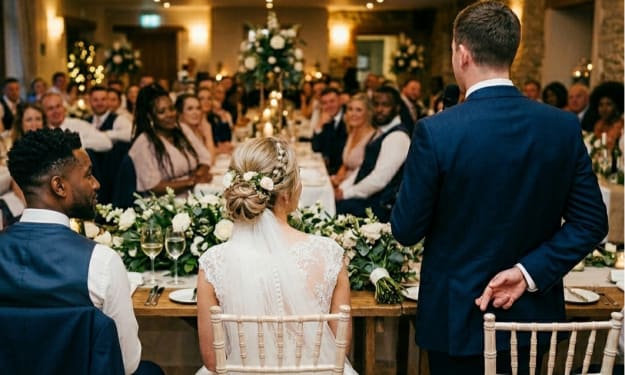
We all know that this is a mixed marriage (pause for effect)... Between an accountant and a human being (pause for laughter)... and I know you wish the bride and groom every happiness, as I do. I have known Brad and Juliette since we were children. We still argue about that first kiss. Was it me, or was it Brad, who first pressed their lips against that rosy red cheek… or… have you told her the truth yet, Brad? (Pause for more laughter). Well, Bradley, old buddy, you old Romeo, your plight now prevails. You have won the hand of your Juliette (pause for more effect). You won her fair and square... well square, at least (more laughter). Congratulations, Bradley, you have the bride of your dreams. Well done Juliette, you have at last made up your mind. I know… because... you made that crystal clear... this morning… over breakfast.
By Raymond G. Taylor5 days ago in Fiction




Comments
There are no comments for this story
Be the first to respond and start the conversation.