
The Imagined Life of Ana Luzia Morales
A surreal journey where memory, grief, dreams, and imagination blur while revealing that some goodbyes never truly happen, and some lives never truly end.



Ana Luzia Morales woke up in her Manhattan apartment to find that the sun had forgotten how to rise. It hung instead in the corner of the sky like a child’s crayon scribble smeared behind the oppressive grey clouds. The city outside her bedroom window moved like a memory on fast forward—vivid, restless, and somewhat out of synch.
Inside, the apartment—which sometimes had four walls and sometimes it didn’t—the coffee brewed itself halfway in its old fashioned Moka pot, simmering and stopping just before the aroma turned real.
Ana Luzia stuck to her routines. She walked the hallway whose light flickered in asynchronous rhythms. She paused to look in the bathroom mirror that didn’t always reflect her correctly. She wandered down the tree-line streets before the world filled with people and read a book that she couldn’t remember buying on a bench that she wasn’t quite sure existed the day before.
In short, Ana Luzia had learned long ago not to question the things that did not make sense because some lives, she knew, were made from the leftover pieces of someone else’s story.
While most of her mornings blurred into sameness, this one Wednesday in particular—not the first, and certainly not the last—the envelopes started to appear on her doorstep even though no one ever knocked. The envelopes were always the same. They were neatly rested on her everyone is welcome here doormat, poorly sealed, and unmarked but for a smudged, faded green Crayola thumbprint in the corner.
Inside there was always a single page: a lined composition notebook paper that was ripped from its edges and held a crude drawing of a tall, golden skinned woman with short brown hair, standing next to a little brunette haired girl with bright green eyes underneath a scribbled sun and a muted rainbow. The woman in the picture wore a short red picnic dress kind of like the one that Ana Luzia had never owned but remembered wearing.
Ana Luzia would always turn the paper over in hopes that she would find a name, a message, or a clue as to who was sending her these envelopes, or if they were even meant for her, but every single time the paper drew a blank and didn’t tell her its secrets. Even though the envelopes were never truly addressed to her, Ana Luzia had the unmistakable hunch that these were for her eyes only and every single time, she would stare at the paper with a sense of unknown longing, placed the envelope in her drawer alongside the other trinkets she doesn’t remember collecting, but couldn’t seem to get rid of.
That night, Ana Luzia tossed and turned in her bed like platanos in a frying pan. She dreamt of a lush backyard brimming with yellow wildflowers and Manzano banana trees—a place she did not recognize yet knew as intimately as a secret. In this backyard, a plastic slide leaned crookedly against a chain-link fence atop the small mound at the edge of the property. A little white storage shed that served as an excellent hiding spot, sat nearby. Sidewalk squares, numbered in fading chalk, stretched across the concrete like a forgotten game.
At the edge of her vision, Ana Luzia saw a little girl sitting cross-legged on a faded cartoon mouse blanket with her siblings. Her curly hair was pulled into frizzy pigtails, and her t-shirt was streaked with pink chalk. She was drawing.
Ana Luzia couldn’t move. She was frozen solid at the border of her dream as she watched the children sketching stick figures from their imaginations. Then, she saw it: the little girl’s drawing—a woman in that same red dress that Ana Luzia thought she recognized, but never really owned.
When the child looked up and away from her drawing, her eyes flickered past the dream’s boundary and locked eyes with Ana Luzia as if she had always known that she was there.
“You’re not supposed to be gone,” the girl whispered to Ana Luzia.
Ana Luzia woke to the soft thud of a crayon rolling off her nightstand—the same green crayon she thought she had put away. But when Ana Luzia got up to turn on the light, nothing had fallen. The crayon was never there to begin with.
+++
The room smelled like a mix of eucalyptus, lavender, and old books. Neutral tones softened the space, but Melissa sat swiftly at the edge of the couch, like if she wasn’t sure she was allowed to settle in. Her fingers picked at the hem at the edge of her sleeve while the clock on the far wall ticked louder than it should have.
Dr. Solis crossed her legs, notebook over one knee and said, “So, Melissa what brings you here?”
Melissa gave a short, reflective, somewhat nervous laugh and replied, “Honestly? I’m not even sure. Things just feel … off lately. Like I am walking through my life with someone else’s memories.”
Dr. Solis didn’t interrupt and listened intently.
“It started with dreams,” Melissa continued. “They weren’t nightmares, per say, but they were incredibly vivid. It always starts in this backyard. There are banana trees, chalk drawings, and my siblings. I haven’t lived anywhere like that in decades and yet it feels like mine. Like home.”
Melissa’s voice wavered but she didn’t stop.
“And there was someone there. A woman. She’s always nearby. Watching. Not in a creepy way. More like she’s waiting. Like I left her behind.”
Dr. Solis tilted her head. “Do you know her?”
Melissa shook her head. “Not really, but I think I did when I was little. Or … perhaps I made her up?”
There was a silent pause in the conversation and Melissa glanced around the room nervously, her shoulders tense, as if she were holding something back—grief or shame—from surfacing too quickly. Melissa took a deep, grounding breath and continued “She had a name.” she added quietly. “Ana Luzia.”
The moment Melissa gave breath to that name, something shifted. It was as if the light in the room dimmed imperceptibly and a pressure bloomed in her chest—like a thousand elephants were dancing on her heart threatening to break free from the confines of the skin that kept it together. She exhaled slowly, took a deep breath, reminded herself that she was safe, and continued.
“Lately, I’ve been seeing Ana Luzia in places outside of my dreams. Sometimes, she is there at work while I am with a client, other times she is at the grocery store while I’m walking through the fruit isle. She never speaks, never seems to frighten me. She just … smiles. Like if she has known me my whole life.”
Dr. Solis looked up from her notes, her expression carefully neutral, but tinged with concern. “Does this person mean anything to you?”
Melissa hesitated. “I don’t know for sure,” she said finally. “My mom told me I used to spend a lot of time with my grandmother when I was little. Before she died, that is. I don’t remember much, just bits and pieces. A backyard with banana trees. A soothing voice. The smell of oregano, Fabuloso, and stale smoke.
Melissa blinked, her expression flickering with uncertainty.
“But I don’t think I ever knew her name.”
+++
The rain was falling sideways.
Ana Luzia stood at the window, both hands pressed to the glass, watching the droplets slide upward along the pane like gravity had recently changed its mind. Outside, Manhattan glimmered in all its glory—buildings blinked in and out of view, traffic moved backwards, muffled as if under water, and the Statue of Liberty hung upside down, suspended by a thread from atop the Empire State Building.
Behind her, something scrapped along the floor.
She turned. Her whicker rocking chair moved and planted itself beside the wall where her favorite bookshelf and record player onced lived. The wall that used to hold the entrance to the hallway leading to her living room. Except now, it was a kitchen—one with checkered linoleum tiled underfoot, pots stored in the oven, and a crooked yellow rotary phone mounted on the wall. There was something about this place that made her throat tighten.
Ana Luzia blinked, and the room rearranged itself all over again. This time, the ceiling flickered and hummed like a lullaby playing from an old music box—which, after giving it some thought, was decidedly, not her music box at all, but a record player spinning out of tune.
She tried to steady herself. To shake the dizziness that was overwhelming her. To ground herself in her routines, in the familiar, her routines. But the Moka pot on the stove that brewed her cafecito in the morning was shrieking like an injured bird and refused to brew a cup in protest. The hallway light clicked on by itself. The walls pulsed, faintly, like a heartbeat inside plaster.
And then came the sound.
Faint at first. A hum, really. Soft and low. Old. Familiar. Not hers, not exactly, but it was buried somewhere deep in the lining of her bones.
Aruru mi nina, aruru mi amor
Aruru pedazo de mi corazon.
Ana Luzia closed her eyes. Her lips moved without permission, following the words to the faint song. She didn’t know where she learned that lullaby, but she knew instinctively like skin or blood, that it belonged to someone that she loved.
She pressed her hand to her chest.
Something was changing.
Someone was calling her back.
+++
The office smelled the same—eucalyptus, paper, soft detergent—but this time Melissa didn’t sit at the edge of the couch. She folded into it slowly, cautiously, as if bracing for a fall.
Dr. Solis looked up from her notes of the previous session. “Have the dreams returned?”
Melissa nodded. She rubbed her temple and replied “The dreams are starting to feel more vivid ... it’s like the past is leaking into my world. I’ll be doing something normal, something completely inane—brushing my teeth, pouring myself a cup of coffee, driving to work—and out of nowhere I’m there again. I’m back in the yard with the banana trees, the Fabuloso, the chalk, the … smoke. It’s weird, really, how it just comes and goes whenever it pleases.”
Dr. Solis kept looking at Melissa with neutrality but didn’t interrupt.
Melissa’s voice softened with something like nostalgia. “I remember the old plastic slide that burned our legs every time my siblings and I would race down. And the chalk drawings. We would spend so many hours out there drawing stick figures, suns, and rainbows. Those were good days.”
Her fingers tightened slowly around her knees.
“But then there was this one afternoon … I honestly can’t tell if its real or if it’s something that I made up as a kid, but regardless, I remember drawing a woman in a red dress. This wasn’t the first time I had drawn her. This woman was always part of my imaginary world. But this time …” she stopped in the middle of her sentence and her throat bobbed. “… this time I could hear sirens.”
Dr. Solis straightened her back in her chair and leaned in ever so slightly. “Do you remember what happened next?”
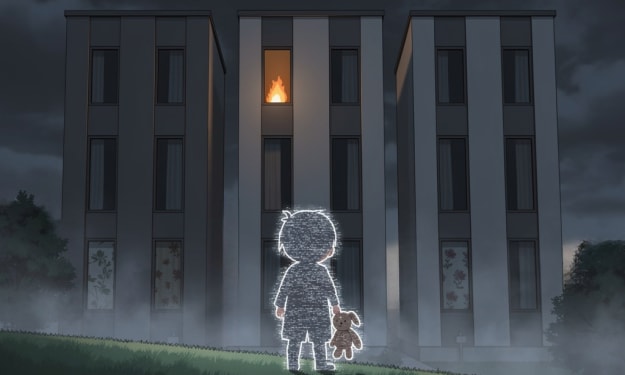
Melissa stared at her hands and for the briefest of moments, she swore they had pink chalk dust on them. “I think, although I can’t say for sure, but I think I was outside when it happened. I remember yelling. I remember my brother screaming. He was terrified. I remember, thick, black smoke pouring out the back window of the house. I remember the way that it curled into the sky like it was alive. Like it had a will of its own.”
She blinked slowly, and for some reason unbeknownst to her, a tear fell from her eye.
“There was a cigarette. Someone left it in the kitchen. I think it was my grandmother who may have left it there, but I can’t say for sure. I remember her always promising us that she would quit, but I remember finding packs stashed in weird placed—in the blue Royal Dansk Danish Butter Cookies tin that housed her sowing supplies, in the spice cabinet next to the sazon complete, and lord knows where else.”
The room fell silent except for the ticking of the clock.
“I don’t remember much after the fire. Just that we moved and I never saw her again after that. I asked my mother about her a few times over the years, but … I think …” her voice cracked. “ … I think she died in that house, and I suspect that I blocked it out. On purpose.”
Dr. Solis said nothing at first. She only nodded. Her expression gentle but unreadable. “Melissa, what you’re describing sounds like post-traumatic stress. Sometimes, when we experience deep trauma, the mind protects itself by burying these traumatic memories for a little while. Repressing it. Your subconscious may have created Ana Luzia as a way for you to hold on to some pieces of your grandmother without facing the trauma directly.”
Melissa nodded, tears falling freely now.
“I don’t know if she’s real … or if she’s just what’s left of my grief.”
+++
Somewhere between the pulsing hum of her rearranged apartment, Ana Luzia remembered.
It came in flashes.
The hiss of oil on a stove.
The ribbon of cigarette smoke curling to the curtain.
The clink of a spoon in a mug.
The laughter of children outside.
She wore her red dress. The one she hadn’t owned but always remembered.
The way the kitchen smelled of oregano and coffee grounds, the warm floor beneath her bare feet.
She turned her back for a second and that was all it took.
A flicker.
A gasp.
A flame where there hadn’t been one.
She remembered calling out.
She remembered coughing a breath from her torn lungs.
“Melisssaaaaa….,” she called.
But she never made it to the door.
Ana Luzia pressed her hand to her chest now, in this version of her home where furniture rearranged itself and light bent sideways.
“I was real.” She whispered. And just as she uttered those words, her apartment exhaled around her in relief.
+++
Melissa stood in the middle of the backyard.
The banana trees were taller than she remembered. The plastic slide glistened under a cotton candy sky. Chalk drawings cracked the pavement. There were stick figures, crooked suns with smiles, a rainbow, and at the center stood a woman with a red dress.
Ana Luzia appeared atop a faded cartoon blanket on the concrete, smiling as if not time had passed at all.
“You came back,” she said.
“I think I never really left”, Melissa replied.
The air was warm and quiet now. Melissa sat down beside her on the faded cartoon mouse blanket that should have disintegrated years ago. The moment her fingers touched the ground, the memory stuck to her—not like lightning, but like something ancient finally rising from the depths of nothingness.
“I remember now,” she whispered. “You were inside. I was outside drawing.”
Ana Luzia tilted her head, her eyes reflecting something tender, yet terribly sad.
“You were always drawing me,” she said. “Even after.”
Melissa swallowed hard “I thought you were someone that I made up.”
“You made me real.” Ana Luzia said, her voice a little more abrasive now, lined with smoke. “That was more than enough.”
The backyard around them began to flicker. The chalk drawings floating up from the concrete one by one, disintegrating into air. The plastic slide collapsed in on itself, swallowed by the soft hum of nothingness.”
Melissa looked down at her strangely weightless hands. “I don’t understand,” she said. “Am I … Did I …?”
Ana Luzia didn’t answer at first, she only offered up that same warm smile—the type that was soft around its edges and makes goodbyes easier to bear. And after a while, she finally replied, “I am what’s left.”
Melissa’s breath caught, but it didn’t hurt. Not anymore.
The cotton candy sky unraveled before them and morphed into a pale mist. The chalk was gone. The banana trees floated away like little yellow butterflies. Only the two of them remained. They were two figures made of memory, loss, and love, suspended in the space between before and after.
“Do I have to go?” Melissa asked.
Ana Luzia leaned in, pressed a kiss on Melissa’s forehead, and ever so gently whispered “mi nina, you already did.”
+++
Melissa opened her eyes.
The room was washed in soft sunrise, light stretching across the floor like a second chance.
She stood up slowly. No pain. No elephants on her chest.
She walked towards the window, drew the curtains back slightly, and the world shimmered with delightful uncertainty.
She finally took a deep breath.
Inhaled—
One.
Two.
Three.
Four.
Five.
Whatever this was, it felt beautiful.
And she was no longer afraid.
About the Creator
Jennifer Vasallo
Educator by day, writer by night. Millennial. Lover of literature, films, taking pictures, surrealist art, cafecito, cultura, travel, making memories, and my familia. Join me on this wild ride we call life from my perspective🖖🏼
Keep reading
More stories from Jennifer Vasallo and writers in Fiction and other communities.
Salomé's Locket
It has been thirteen years since the invasion. We were out manned, out gunned, and out willed. The Metataurians were a force to be reckoned with and it was clear that they weren’t leaving until their mission was complete. At first, there were peace talks with all the major governmental figures of this planet, but this was merely a façade. The Metataurians did not intend to actively partake in peace talks. What they wanted was a distraction. They needed to buy enough time to build their ‘reeducation’ camps while the humans of the world bickered and argued over fickle matters, as they usually do. Once they arrived, they treated our planet like their new home. We did not know it at the time, but prior to invasion, the Metataurians had run various espionage missions on our planet. During these missions, they concluded that we were a society of hyper connected creatures who did not know how to use our interconnectivity as a force of good. They knew our digital connectivity had the potential to create bonds, but more importantly, they quickly realized that it could be used as a tool to create wedges among the people of this planet. They knew we hated each other for things like gender identity, culture, race, religion, sexuality, political ideologies, etc. They knew that we had weaknesses. They knew some of us were gullible. They knew we were greedy and self-preserving; they even knew that we were quick to hide behind the anonymity of a digital screen. Like every dynasty from the past, with the knowledge of our weaknesses, they did not hesitate to extort it.
By Jennifer Vasallo 5 years ago in Fiction



Comments (10)
Congratulations on your win! It was a worthy story.
This was a fascinating story! I felt drawn to it, to your characters. Like a vivid dream, the kind you don't want to wake from. I loved this line: “I don’t know if she’s real … or if she’s just what’s left of my grief.” Well done!
Imagination at its finest. Congratulations 🎉 .
Congrats. Lovely writing.
Tremendous and viscerally astounding story!!! Congrats you deserve it
Congratulations on your winning entry. It was powerful and engaging.
Awwww thank you so much everyone! I’m honestly shocked and I’m literally crying like a dumbass. I read sooooo many great entries and I truly didn’t think I had a shot. Im mostly a poetry writing kinda girly, and I’ve only written magical realism twice in my life but ughhhh this is so validating. I appreciate you all for taking the time to read it and comment such nice things.
Wooohooooo congratulations on your win! 🎉💖🎊🎉💖🎊
Amazing work and a well deserved win! Feel like Vocal kept this a fun secret by not putting it out as TS, but I hope it gets the reads it so richly deserves
Jennifer, this is stunning from the opening partagraph describing the sun and the no smell of coffee to the daily surreal life that we experienced along with our protagonist. This is so vivid and beautiful to soul crushing to acceptence. Congratulaions , it was a p[lessure to read this story.