
What remains of celeste
The leather maiden (chapter 5, final)

The boutique stood preserved like a chapel.
It had once buzzed with waiting lists, white-gloved consultants, and the soft click of heels on marble. But now, velvet ropes barred the entrance like funeral cords. Beneath the golden signage — ADELINE in looping, delicate serif — tourists gathered to pose for photographs, quiet as if in a cemetery.
It had become a site of pilgrimage — Adeline’s final studio, the last place she was ever seen. She had walked in one rainy evening and never walked out.
The doors had remained locked since that night. No one knew who held the key.
Production stopped that day. No statements. No successors. The employees were dismissed one by one. No whispered press releases. Just silence — and an empire that collapsed into legend overnight.
But her bags… they remained.
No one carried them casually anymore. Not since the rumors began.
They sat in glass cases in the homes of reclusive collectors. They were auctioned behind encrypted platforms, their provenance traced with forensic precision. A single Adeline piece could buy you a Manhattan penthouse or a European vineyard.
Each bag was a masterpiece.
Each bag was a ghost.
Each bag was a question.
The rarest among them — the one that froze even the most hardened collectors in reverence — was the pale one.
A small handbag, unassuming in shape. But its texture… its tone… the soft, luminous pink-ivory tint… no one had ever seen hide like that. Not from cow, or calf, or lamb, or any animal catalogued in fashion or agriculture.
And the scent.
Roses. And rust.
They said there was a note inside. No one ever confirmed it, but the story persisted.
“If I cannot carry love, I will carry myself.
And if I cannot be held, then let me hold.”
— A.
Some called it metaphor. Others weren’t so sure.
One woman — a museum curator — claimed she heard a sound coming from it once, after hours. Not quite a whisper. More like breathing. She quit the next day and refused to speak to journalists.
Another collector had the bag sealed in lead glass, claiming it made her dog cry every time she walked near it.
And then there were the forums. Thousands of them. Deep-web threads, conspiracy pages, obsession groups. Some said Adeline was murdered. Some said she ascended. Others believed she had cursed the world with something sacred — or profane — stitched into that final piece.
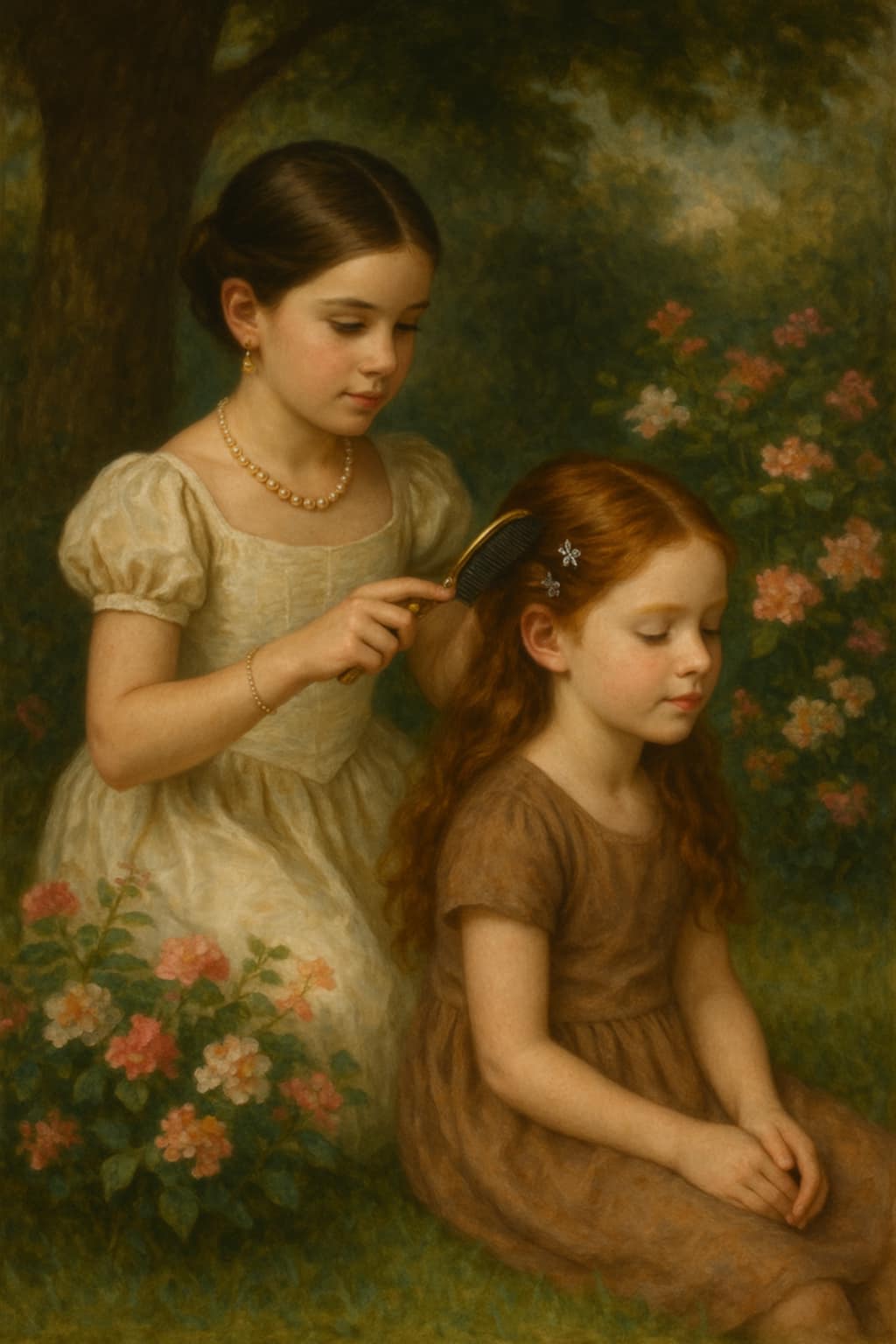
A few believed the story of Celeste. They dug up archives. Found the obituary. Tracked down grainy photographs of the two girls as children. One pale and glowing, the other red-haired and watchful, always slightly behind.
A retired journalist, once obsessed with the case, published a long-form exposé called “The Tanner’s Daughter”. In it, she claimed to have traced the lineage of the hides. She said the shades of Adeline’s bags weren’t just rare — they were impossible. Not dyed. Not bleached. Grown.
She was institutionalized three months later after an anonymous envelope arrived at her door.
Inside it was a scrap of soft skin — pale, perfumed.
And stitched into the edge: “You looked too close.”
Meanwhile, fashion houses tried to replicate Adeline’s work. They dissected her designs, reverse-engineered her stitching. They tested leathers from every animal, tried chemical textures, used AI patterning.
But they couldn’t replicate it.
Not the shape. Not the feel.
Not the soul.
Because that’s what Adeline had poured into her work — not just craft, but obsession. Grief. Love distorted by silence. Her bags weren’t made. They were extracted. From memory. From heartbreak. From herself.
And the final one — the pale one — was the last thing she ever touched.
One of her apprentices once spoke anonymously to a podcast. She said that in the weeks before her disappearance, Adeline had become strangely serene. She had begun working at night, humming songs no one recognized. She spoke less. She smiled more.
The apprentice remembered, with a shiver, seeing Adeline sewing with one hand — while the other arm bled slowly into a bowl beside her.
No one ever found her body. No blood. No note. Just the handbag. Placed carefully in the boutique window one morning — when no one had opened the store.
And the note inside. Still legible, still intact, in handwriting that matched her old sketches.
“If I cannot carry love, I will carry myself."
People interpreted it differently. Some said it was madness. Others said it was devotion — a final union between body and craft. A devotion so intense that she offered herself as the material. Not for sale. Not for display. But for memory.
She had vanished — but she was never forgotten.
In the years that followed, the world grew louder, faster, crueler. Trends came and went like insects. Influencers rose and fell. CEOs became faces no one cared to remember.
But her name endured.
Adeline. The red-haired leathersmith who stitched her sorrow into legend. The girl who turned grief into art, obsession into legacy, and love into an artifact no one could ever fully understand.
And somewhere — behind museum glass, in locked collections, in the trembling hands of those who dared carry her legacy — her bags endured.
Warm to the touch.
Breathing.
Waiting.
---
About the Creator
E. hasan
An aspiring engineer who once wanted to be a writer .
Becca
"Everything is so... flat." Denille said stupidly as she looked around her new neighborhood. She looked around at the muted desert where even the smallest sign of life seemed to have given up. The plant life was shrubs that were half cooked by the heat and where there should have been a lawn, a mess of white rocks laid glistening in the sun. Even the sky looked stretched thin, like the sun had ironed it smooth. She’d moved from Riverside, where at least there were hills, but here in Barstow, everything felt baked and brittle.
By Sara Wilson7 days ago in Fiction



Comments
There are no comments for this story
Be the first to respond and start the conversation.