
What other animal parties, drinks alcohol, and gets drunk like humans?
Animal gets drunk like humans.
A British group of researchers recently published a study on wild chimpanzees in West Africa. For the study, scientists installed hidden cameras in the chimpanzee's habitat. The researchers were amazed to see the footage captured by that camera.
After examining the footage captured by the camera, scientists found that chimpanzees also drink alcohol and get drunk like humans.
A team of researchers from the University of Exeter, conducting research in the Cantanhez Forests National Park in Guinea, said that a camera installed in the national park captured chimpanzees eating African breadfruit. At this time, the chimpanzees were seen sharing the fruit. Chimpanzees do not usually share food. Later, lab tests showed that the fruit contained alcohol.
The fruit, African breadfruit, falls from the tree and slowly ferments on the ground. This fermentation produces a small amount of alcohol in these fruits. The study found that the alcohol content of each fruit is less than 1 percent by volume.
Although the alcohol content is very low, they eat so much fruit that quite a bit of alcohol enters their bodies during the day - just like we sip light beer.
The researchers say that the chimpanzees are sharing fruit instead of eating it alone. This is significant information. Because chimpanzees do not always share food. So the relationship of this behavior to fermented fruit could help us understand the animal's behavior. We need to learn more about whether they deliberately seek out alcoholic fruit and how they metabolize it. This behavior may be an early evolutionary stage of 'formal feasting', which we need more time to understand.
However, chimpanzees are not the first in the animal kingdom to consume intoxicants. Apart from chimpanzees, many other animals are addicted to drugs. Let's take a look at the activities of these addicted animals.
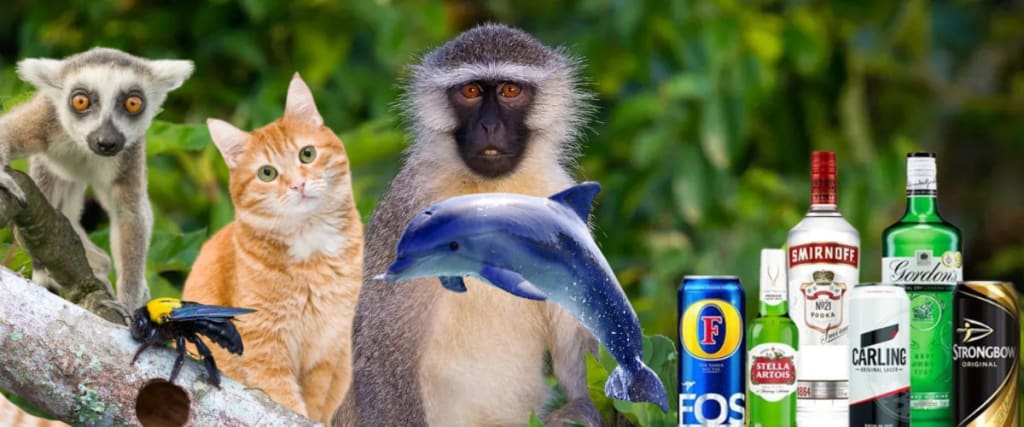
Vervet monkeys
In the Caribbean islands, some Vervet monkeys, especially young ones, show a strange tendency to drink alcohol. The reason for their habit is thought to be the consumption of fermented juice obtained from local sugarcane farms. On the island of St. Kitts, their violence has reached such a level that they often attack tourists at bars or beaches and steal glasses of alcohol. Even their drunken state after consuming alcohol is quite clear. Such as staggering, unprepared behavior and even becoming overly friendly.
Interestingly, these monkeys also have alcohol addiction like humans. Some of them drink excessively, some occasionally and some do not drink at all.
Dolphin
When you think of the ocean, dolphins come to mind – the dorsal fin on their backs, the sight of them swimming through the water at high speed, and even playing pranks on each other. Dolphins are considered intelligent marine animals. Like humans, they have a system of communication like language. They communicate with each other and even socialize like humans.
Dolphins are socially skilled, intelligent, agile, lively, and playful animals. Many aspects of their emotions are similar to humans.
You will be surprised to know that these dolphins also get drunk like humans! They have a wonderful mechanism for getting drunk.
In 1995, marine biologist Lisa Steiner described a strange scene.
A group of rough-toothed dolphins were seen playing with sea squirts near the Azores Islands. They were biting the pufferfish and passing them around with their mouths as if they were not fish but footballs.
Pufferfish release a toxic chemical called tetrodotoxin as a defense mechanism. It is thought to have an intoxicating effect on dolphins. This strange behavior of dolphins was also highlighted in the 2014 BBC documentary “Dolphins – Spy in the Pod”.
But here a question remains.
Tetrodotoxin is not generally considered a “psychoactive” substance.
Small doses of it cause drowsiness, dizziness, and lightheadedness. Large doses can cause severe poisoning.
For this reason, marine biologist Christy Wilcox believes that the idea that dolphins were intentionally ingesting the poison is quite dubious.
Cat
Among pets, cats are very dear and close to humans. Who can ignore the cat's cute meow and charming look? Although it may sound surprising, about 70 percent of domestic cats are very attracted to and react to a plant known as catnip.
The scientific name of this plant is Nepeta cataria. Not only domestic but also some wild cats, including tigers, are attracted to it. However, it is not clear what percentage of wild species react to it.
Cats sniff the smell of this plant, lick it, and sometimes bite it, and some rub their cheeks and bodies against the plant and become intoxicated with enjoyment with their whole body.
Signs of extreme excitement immediately appear. Body shaking, excessive salivation, and even the cat's sexual arousal increase.
This reaction in cats is caused by a substance called Nepetalactone in the plant. This substance is poisonous and mainly protects the plant from insects. Although the level of this toxic substance is so low that it does not pose any danger to cats.
If you want, you can also give catnip to your pet cat. Just give it a little, and see how your beloved animal reaches the seventh level of happiness.
Bees
Bees play a major role in sustaining human civilization. Bees play a leading role in pollinating food crops produced in the world every year, 30 to 35 percent of the food crops produced every year. Bees collect nectar from flowers to make honey. Honey is a carbohydrate-rich food, which contains about 350 kilocalories per 100 grams.
A research paper published by the University of Haifa in 2010 showed that bees collect more nectar from flowers rich in nicotine and caffeine than from other flowers. This indicates the bees' addiction to these addictive substances.
Lemur
A species of black lemurs from Madagascar also get drunk. However, their process of getting drunk is quite surprising. They are seen getting drunk with a type of poisonous centipede found in the forests of Madagascar. They bite these poisonous millipedes or centipedes. As a result, the toxic substance produces a kind of saliva in their mouths. The lemurs rub this saliva on their bodies. It is believed that this poisonous saliva, rich in cyanide, saves lemurs from insects and prevents diseases like malaria. However, they also get drunk at the same time. They are seen lying on tree branches when intoxicated. In a documentary broadcast on the BBC, lemurs are seen getting drunk by biting centipedes. Intoxicated, they repeatedly rub the saliva and centipedes on their bodies for pleasure.
About the Creator
My New Book is Finally Here
My poetry collection Beautiful and Brutal Things is done. It's actually done and finally published over 270 pages. Over a year of my life went into this book. More than a year, really. Long days at my computer, sometimes seven days a week because I couldn't stop even when I probably should have. Then two months of editing that felt harder than the writing itself. But it's finished, and I'm still standing, and the book is real.
By Tim Carmichael4 days ago in BookClub



Comments
There are no comments for this story
Be the first to respond and start the conversation.