
What If We Traveled Through a Black Hole?
Journey into the Unknown: Unraveling the Secrets of Black Holes

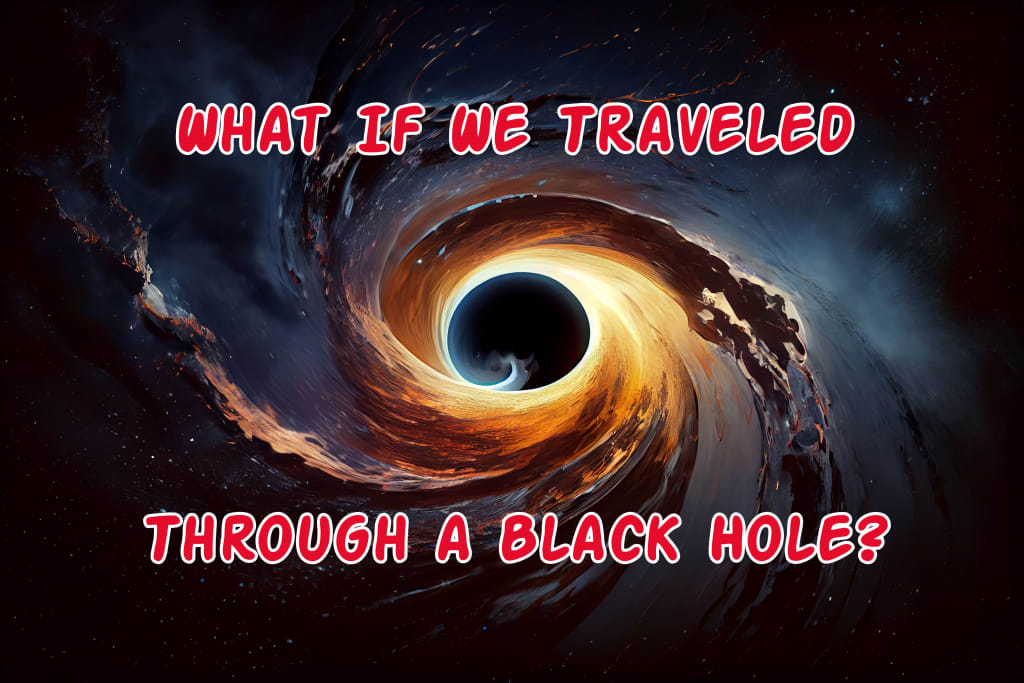
In the depths of the universe lie black holes - dark, enigmatic entities that voraciously consume everything unfortunate enough to venture near their Event Horizon. But could there be more to these cosmic monsters? What if you dared to plunge into their unfathomable depths? Could you survive the journey through a black hole? Let's explore what might happen in such a daring odyssey.
Black holes are not fundamentally different from other massive objects in the universe, except for their incredible density. At their core lies a singularity, an infinitesimally small point where all matter is compressed to its utmost. The more matter within a black hole's singularity, the more powerful its gravitational force. Some black holes, remnants of stars with masses exceeding ten times that of our sun, possess an immense gravitational pull. Surrounding every black hole is its event horizon - the point of no return.
Once you pass this threshold, there's no turning back, and unless you could travel at the speed of light, escape would be futile. The fate of anything beyond the event horizon remains shrouded in mystery, for once something enters, no communication can ever return. Most likely, gravity would tear you apart, atom by atom, leaving little hope for survival. Yet, suppose you were exceptionally fortunate and encountered an extraordinary black hole - a charged one, harboring a unique secret: a one-way wormhole connecting it to a white hole.
White holes are peculiar cosmic phenomena, unlike black holes that consume everything, these enigmatic counterparts only emit matter into space, never to let anything enter. If you managed to cross the event horizon of this charged black hole and wormhole combination, prepare for a mind-bending experience. As you approach the outer region of the black hole, you'd witness stars contorted around a perfect circle of darkness, a mesmerizing sight fleeting as you speed towards the gravitational behemoth.
The immense force exerted by the black hole would stretch and distort your body, turning you into an elongated, spaghetti-like form. But just before succumbing to this ghastly fate, you'd enter the wormhole, escaping the black hole's clutches. However, this is no ordinary black hole; it has two event horizons. While traversing the space between these points of no return, you might not realize the transition, seemingly floating in a state of weightlessness.
As you plunge further, the black hole before you would appear to grow larger and larger, a terrifying spectacle intensified by the harrowing process of spaghettification. Time would seem to dilate, with a mere 20 seconds feeling like an eternity. As you near the inner horizon, an astonishing phenomenon unfolds: the black hole seemingly halts its expansion, then remarkably appears to shrink. Yet, it is merely a trick of relativity, known as relativistic beaming, playing with your perception.
The light from the rest of the universe around the black hole's edges would appear brighter, further confusing your senses. Finally, passing the inner horizon, you would be engulfed by an energetic, dazzling burst of light, an awe-inspiring moment unlike any other. This is no ordinary burst, but a magnificent testament to the wonders and perils hidden within the mysterious realm of black holes.
To truly comprehend the implications of such a journey through a black hole, we must delve into the realms of theoretical physics and delve into the ideas that our current scientific understanding only begins to touch upon. At present, our knowledge of black holes and the nature of spacetime relies heavily on Einstein's General Theory of Relativity, which provides a remarkable framework for describing gravity as the curvature of spacetime by massive objects.
However, when we venture into the domain of black holes, the known laws of physics seem to break down, and we encounter a phenomenon known as a singularity - an infinitely dense and small point where our understanding of physics no longer holds. At the singularity, the gravitational forces become infinitely strong, and spacetime itself is warped beyond comprehension.
To truly understand the dynamics of a black hole, scientists strive to unite the theories of General Relativity and Quantum Mechanics into a single theory of quantum gravity. Such a theory would allow us to explore the mysterious interior of a black hole, revealing what lies beyond the event horizon and potentially shedding light on the nature of singularities.
One intriguing proposal is the idea of a "firewall" surrounding the event horizon, where the laws of quantum mechanics come into play and create a barrier that could incinerate any matter or information that attempts to cross it. This idea has sparked significant debate among physicists, and its resolution remains an open question.
Moreover, black holes may not be mere isolated objects in space but could form vast networks or even serve as gateways to other regions of the universe or parallel universes. The concept of wormholes, akin to theoretical tunnels in spacetime, connects distant points in the cosmos, potentially providing shortcuts for interstellar travel. The combination of a charged black hole and a wormhole, as speculated earlier, brings to light the tantalizing possibility of interdimensional travel and parallel universes.
Such conjectures lead us into the realm of science fiction and speculative physics, where the boundaries between what is known and what is imagined blur. While these ideas are grounded in scientific principles, they often surpass the limits of empirical observation and enter the realm of hypothesis and theoretical exploration.
In conclusion, the journey through a black hole is one of the most captivating and mysterious notions in cosmology and theoretical physics. As we venture into the unknown depths of the universe, our understanding of black holes is bound to evolve, and new questions will arise, leading to even more audacious speculations. Whether black holes merely remain awe-inspiring spectacles in the distant cosmos or offer gateways to other dimensions and parallel universes, their study will continue to captivate the imaginations of scientists and the public alike. Only through continued research and exploration will we gain insights into these cosmic enigmas, revealing the secrets they hold and expanding our understanding of the universe we call home.
About the Creator
Salman Sabbir
Experienced content writer with a passion for crafting engaging and informative articles. Skilled in SEO, research, and storytelling. Let's create captivating content! 📝
Reader insights
Outstanding
Excellent work. Looking forward to reading more!
Top insight
Expert insights and opinions
Arguments were carefully researched and presented
Keep reading
More stories from writers in Fiction and other communities.
What Happens To Your Brain When You Stop Multitasking
Digital technology is the culprit that is causing us to doom scroll when tired, disengaged and unmotivated with the content that motivated you to log onto your device to consume in the first place. That is only the beginning. In the modern workplace (and even when filing cabinets were around, I confirmed this with my adopted parents to get my facts right); reading files while you are supposed to be present to the caller on the other end of the phone line is another classic example of multitasking that causes your brain (although adaptable and intelligent) to lose focus and concentration.
By Justine Crowley5 days ago in Psyche
'Till Death We Do Art
There would be nothing divine in this world without art. Nature may surpass the divine to all intents and purposes, but like everything it absorbs and is absorbed by, it remains here, stuck on the surface of this world, ever-present, physically bound to the universe.
By Avocado Nunzella BSc (Psych) -- M.A.P a day ago in Art



Comments (1)
Such a nice article man. Keep it up👍