
What if Oliver Stone made a film on Donald Trump?
Let's Imagine!
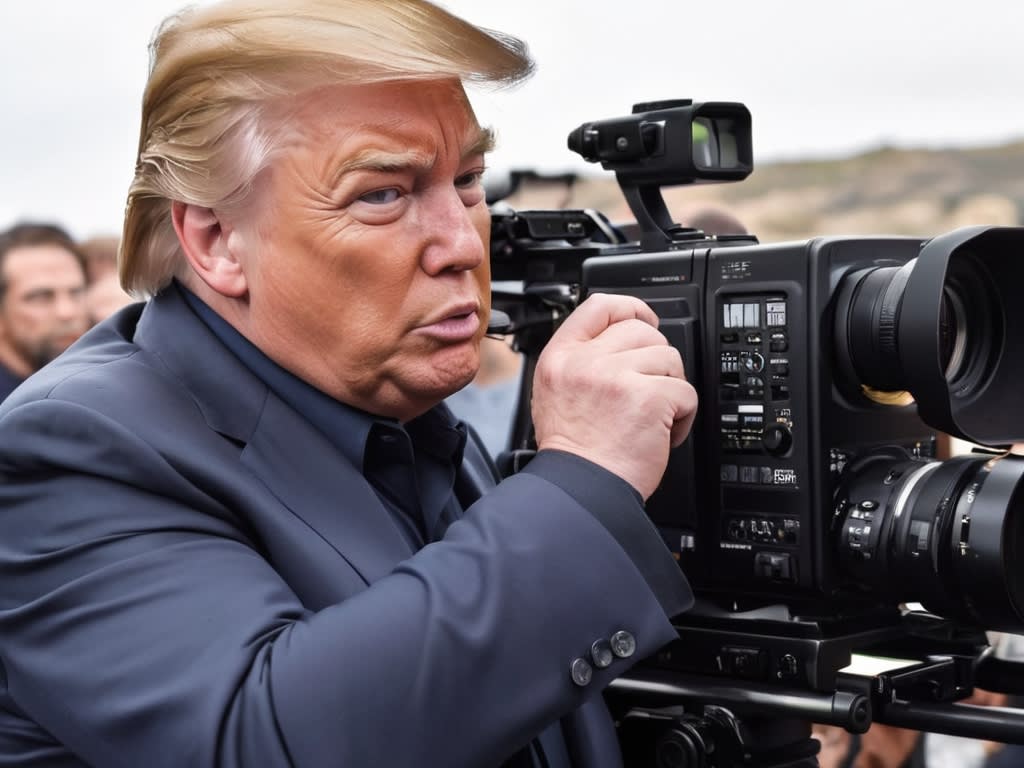
Embarking on the cinematic frontier of political intrigue, Oliver Stone, a maestro unafraid of controversy, has woven narratives of power, conspiracies, and presidential complexities throughout his storied filmography—JFK, Nixon, and W. standing testament to his audacious exploration of the political landscape. The tantalizing prospect of Stone delving into the dramatic tapestry of the Trump presidency, an endeavor ripe for his distinctive touch, invites speculation on the potential contours of such a cinematic odyssey.
Immersing ourselves in Stone's trademark style, one envisions a departure from the conventional biopic, with a focus as precise as a surgeon's scalpel. Perhaps, the lens would zoom in on the crucible of Trump's 2020 reelection campaign and subsequent defeat, capturing the seismic events from within the inner sanctum of the president's circle.
In a climactic scene, we find ourselves amidst the tension-drenched White House on election night. Trump, surrounded by family and aides, witnesses the unraveling of his political fate with a crescendo of unease. Each battleground state falling to Joe Biden becomes a hammer blow to the president's psyche, culminating in a tempest of baseless accusations, a torrent against the perceived culprits—the "radical left" and the "fake news media." The camera, a relentless voyeur, stays close to Trump's visage, capturing the tumult of rage, despair, and panic as power slips through his fingers. Intercut with jubilant Biden supporters, Stone weaves a tapestry where fiction dances with fact, offering a subjective yet relatable portrayal of history unfolding.
Alternatively, Stone might opt for a slow-burning character study, a gaze fixed on a post-presidential Trump navigating the quietude of Mar-a-Lago. In lingering close-ups, the film delves into Trump's post-presidential musings, seeking vindication and relevance through cable news and tweets. Intimate moments with Melania and his children unveil the labyrinth of a bruised ego, while alliances with figures like Giuliani and Bannon unveil not just manipulation but a profound insecurity fueling Trump's enduring grudges.
As the narrative progresses, Trump's desperation takes center stage. Lawsuits, rallies, endorsements—all futile attempts to reclaim lost control. The film culminates in a poignant shot at Mar-a-Lago, an isolated Trump, a deposed monarch in the ruins of a palace built on falsehoods.
Stone, known for his subjective lens, might, in this instance, opt for a departure. A meticulously researched fictionalized account could zero in on definitive moments, unraveling not just criminality and incompetence but the deeper psychological dysfunctions. Trump's binary worldview, arrested emotional development, narcissism—all laid bare without overt editorializing. Stone's most devastating political indictment could emerge by dramatizing Trump's words and actions with unflinching accuracy, allowing objectivity to overpower subjective biases.
Provocative and polarizing, an Oliver Stone film inevitably sparks controversy. Yet, in capturing the essence of the Trump phenomenon, this imagined project could transcend biases, offering a complex, warts-and-all vision that mirrors the intricate nuances of a surreal chapter in American history. A cinematic document that, like Stone's Nixon, might help reconcile rather than exacerbate political divisions, beckoning us to reflect on the intersection of media and politics.
The room was eerily quiet as Trump stared blankly at the television screen, his face an emotionless mask. Around him stood Ivanka, Jared Kushner, Eric, and Donald Jr., tense and ashen.
As another state was called for Biden, Trump suddenly swept his arm across the table, sending papers, a soda can and glass crashing to the floor. His family flinched at the violent outburst. Trump fixed his blazing eyes on Jared.
"I blame you for this!" Trump shouted, jabbing his finger. "Your lousy campaign strategy and mind-numbing speeches put me to sleep!"
"Sir, we did everything we could," Jared replied evenly. "But the pandemic--"
"Don't give me excuses!" Trump bellowed. "Where's Bill Barr? He was supposed to find those extra votes! He's another dead weight around my neck!"
Melania touched his arm gingerly. "Donald...it's late honey. Maybe we should--"
Trump furiously shook her off. "Shut up Melania! Can't you see my whole world is falling apart! I'm the greatest president God ever created and these morons are trying to destroy me!"
His eyes were wild now, his face mottled red. He grabbed his phone and stabbed out a tweet branding the election corrupt and fraudulent. His family watched helplessly as madness and denial swallowed him whole.
I aimed to capture Trump's volatile temperament and refuse to accept defeat through emotional outbursts and lashing out. Let me know if you would like me to expand the fictional dialogue in any other directions!
As we conclude this speculative journey, stay tuned for more articles delving into the confluence of media and politics, where free speech is defended, bias is critiqued, and the spotlight is cast on quality journalism shaping our world. Your engagement is welcomed as we navigate the ever-evolving landscape of the media-political nexus.
About the Creator
Sherif M. Awad (Film Critic)
Born in Cairo-Egypt, Sherif M. Awad is a film professional who worked as a programmer and curator since 1990.
Websites: https://linktr.ee/sherifmawad
YouTube: https://linktr.ee/sherifmawad1
Keep reading
More stories from Sherif M. Awad (Film Critic) and writers in Fiction and other communities.
Top 5 strange sightings in the USA during 2023
Embarking on a fascinating journey into the mysterious realms of2023, this year has been filled with sightings and events that defy conventional understanding. From the captivating allure of unidentified flying objects to the downright surreal happenings within the United States, we are approaching the end of a truly eventful year that has left observers bewildered and scratching their heads. Let's uncover five extraordinary stories that have captivated our attention.
By Sherif M. Awad (Film Critic)2 years ago in Horror


Comments