
Visiting Hours
A maidservant visits her mistress' grave.


My mistress died of a broken heart.
At least, that was what her father, Datu Balintawak, had proclaimed. It was all he could say, really, for she had spoken of her love for Gat Delfin until her dying breath. To call it anything else would be an insult to her memory, and for all his faults, her father loved her very much.
But I knew the truth. I was Dayang Rosita’s closest friend and confidante, after all. I walked with her during those nights she met Gat Delfin in secret, those nights the moon fled from the sky. We crept out the back of the house and toward the far end of the bamboo fence that separated our land from that of her love. I never said a word, out of fear and out of love—but mostly out of love.
I knelt now in front of their burial mound, a sweet scent lingering in the air amidst the smell of damp earth. She was here. I was certain of it, even though I could not see her. They both were; if I closed my eyes, I could imagine their voices echoing in the wind, whispering sweet nothings to one another. Gat Delfin had instructed his men to bury him here. Dayang Rosita had begged her father to do the same.
My mother once told me a secret, which she learned from her mother, and her mother from her mother’s mother. Each of us, Nanay said, had four souls. The first soul is the kararua, which only leaves the body after death. The second soul is the karkarma, which fear can chase out of the body. It can even be stolen. Aniwaas, the third soul, can emerge during sleep and wander toward places the body holds dear, while the fourth soul is called the araria, the soul of the departed that visits our world to perform a duty it had failed to do in life or to visit relatives and friends.
My mistress did not die of a broken heart. No, her aniwaas left to wait for Delfin to come back from the war—here, in their secret place—and before he could return, she woke up.
It was part of my job as her maidservant, but I woke her up.
Now her aniwaas was lost to her, forever. It lingered here, by the burial mound, smelling of flowers—and still waiting.
Did it matter that Gat Delfin was dead by the time they brought him home, and she would’ve, perhaps, perished in turn from her grief? We could not have known that for sure. My mistress had been strong. Strong enough to pursue her love for the son of our sworn enemy, to attempt to talk her father out of waging war even if we all knew he would not be swayed. Gat Delfin’s father, Datu Gagalangin, had moved the fence and stolen a part of our land. Datu Balintawak could never have let that gone unpunished.
I wanted to come clean. My guilt at leading my mistress to ruin had been gnawing at me since I realized what I had done. But even if I wanted to, I could not dishonor her memory. Nor could I take away the kindness of letting her father and our people continue to believe she had died from a broken heart. There were far more painful ways to die.
“Forgive me, please, Dayang,” I sniffed as I laid down a garland of small, white flowers. They had no scent, but they were her favorites. I’d thought it a fitting peace offering, even though I knew there could be no absolution for my mistake.

Her voice answered: There is nothing to forgive, Marisol.
A strangled cry escaped my throat. “I do not deserve your kindness.” Despite my efforts to contain it, my emotions broke through the walls I had built to keep the monster of guilt away. I broke down.
Please, accept it, my faithful friend, she insisted. It was not your fault.
I didn’t know how long I remained hunched over her grave, crying. I stopped only when her sweet scent enveloped me, stronger this time. Confused, I blinked away tears to try to see where it was coming from; a part of me hoped I would find myself in her embrace.
The flowers. They smelled like her now—of sweetness, of kindness, of love.
A rooster crowed, and I looked up at the sky. The stars were beginning to fade as the colors of a new day crawled their way out of the horizon.
Now go, Marisol, the aniwaas of Dayang Rosita urged. Go, before you wake up, too.
---
Author's Notes
Hi! I'm Marie, a Filipino speculative fiction author and book reviewer currently based in the UK. I wrote this in response to a poll I ran on Twitter for the theme of my Valentine's short story. I initially said a romance, but, eh, a bittersweet love story is sometimes better than a happily ever after 🫣
While this is based on and uses elements of Filipino myths and folklore, this is set in a fantasy world and is part of an upcoming book series. Artistic liberties, therefore, have been respectfully taken.
The story is based on the legend of the sampaguita (Jasmine sambac), the Philippines' national flower. The word sampaguita supposedly originates from the phrase sumpa kita which means, "You are my vow," though I only alluded to that part (with Delfin and Rosita being loyal lovers to the end).

And instead of a wreath or bouquet, I used a garland because that's how sampaguita flowers are commonly used in the country. As written by Christopher Chanco in his article:
It’s present at every major life event imaginable, from baptisms to funerals to school graduations to your regular Sunday mass. It’s a national symbol. It’s the cradle-to-grave Filipino flower.
It’s also the stuff garlands are made of, strung together to create something of a cross between a pearl necklace, a rosary and the Hawaiian lei, flowery wreaths draped around the necks of tourists and sweethearts.
It’s a garland of fragrant sampaguita, whose role it is to adorn the necks of wooden saints with jewels that wilt in the summer heat.
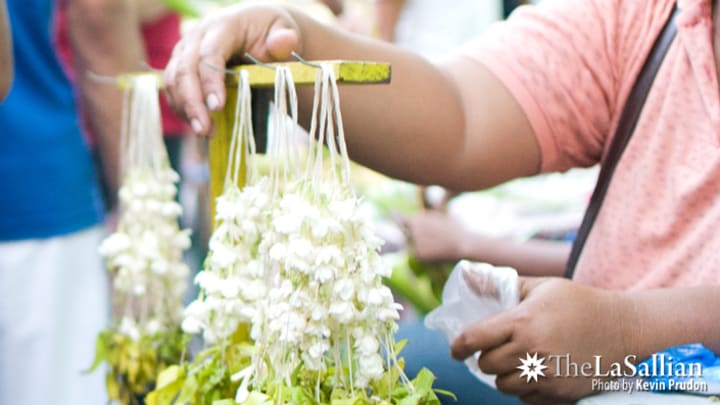
The other part I didn't use was how the flowers just sprung up from the graves. I thought I could do a different interpretation for that. I also did not let the lovers meet during the full moon, because... well, it's much easier to sneak out and remain undetected when it's dark, isn't it?
Now, Balintawak and Gagalangin are actual locations in the Philippines, though in the story they're used as part of the leaders' titles, in the format of Datu + Place Name (more on the honorific below). Balintawak is a district in present-day Quezon City, while Gagalangin is a quarter in Tondo.

As I mentioned in the beginning, however, this story will be part of a fantasy book series, so the locations will likely be renamed in the final published version to prevent confusion.
For the honorifics, I used the three-class social structure of the Tagalog (one of the country's ethnic groups) for this story. It consists of the maginoo (royalty), the maharlika (freemen and warrior nobility), and the alipin (serfs and slaves). Members of the maginoo class were referred to as Ginoo. Proper names of the maginoo nobles were preceded by Gat (short for "pamagat," which originally means "lord" or "master" though now it means "title" in modern Tagalog) for men and Dayang (lady) for women.
While the Datu were maginoo who ruled over a single community or were part of a larger settlement. They constituted a council and answered to a sovereign ruler, referred to as the Lakan.
The last thing I want to highlight is the belief on the four souls, which is actually from the Ilokano, another ethnic group in the Philippines. I didn't stay "consistent" and use the Tagalog belief, though it's interesting too; they have the kaluluwa, which is the soul of the deceased, and the kakambal, which is the soul of the living person. Like the aniwaas in the story, the kakambal may travel around at night and some particularly bad encounters are the cause of nightmares. It also becomes a kaluluwa after death. (For the other ethnic groups' beliefs about souls, check out this article!)
The world of Filipino myths, folklore and legends is a very rich one because the Philippines is inhabited by many different ethnolinguistic groups with many different beliefs and traditions. It is my hope, through this project, to introduce more readers to that wonderful world via accessible fiction stories. 🩷
---
You can find more info about me and my books, and also subscribe to my newsletter for more content, here. And if you like what I do, please also consider supporting me on Ko-fi! 🩷 https://ko-fi.com/mariesinadjan
Also check out my upcoming release, Among Thorns and Stardust ✨

About the Creator
Marie Sinadjan
Filipino spec fic author and book reviewer based in the UK. https://linktr.ee/mariesinadjan • www.mariesinadjan.com
Reader insights
Outstanding
Excellent work. Looking forward to reading more!
Top insights
Expert insights and opinions
Arguments were carefully researched and presented
Compelling and original writing
Creative use of language & vocab
Eye opening
Niche topic & fresh perspectives
Heartfelt and relatable
The story invoked strong personal emotions
On-point and relevant
Writing reflected the title & theme
Easy to read and follow
Well-structured & engaging content
Excellent storytelling
Original narrative & well developed characters
Keep reading
More stories from Marie Sinadjan and writers in Fiction and other communities.
Funeral Pyre
This was written for the Snow Micro Challenge. --- They’d passed through this forest before. He sensed traces of her magic still—in the air, among the trees, in the snow that had thawed and reformed countless times over. The trail was faint, but it would have to do.
By Marie Sinadjan2 years ago in Fiction
Flower Bloom 369
FLOWER Bloom 2/25/26 Wednesday By Mariann Carroll Karen had been with Tony for 7 years. Tony started acting strangely after her surgery. He would mow the lawn in the rain and be on his cellphone. He started pushing Karen away. Tony came clean about seeing someone. Karen moved out two months later. Karen moved in with a friend. She felt betrayed.
By Mariann Carroll6 days ago in Fiction
The Language of Absence
The stovetop ticked as the burner cooled, a rhythmic, cooling sound that bit into the silence of the kitchen. John didn’t move. He sat at the pine table, his fingers tracing the wood grain, waiting. He watched the steam curl toward the ceiling, a white plume turning grey in the dim morning light. Only when the heat had settled into a low, radiating warmth did his daughter, Mara, enter the room.
By Tim Carmichaelabout an hour ago in Fiction


Comments (3)
Very different from what I would usually read, however, I found myself quickly intruiged.
Very interesting captivating story
One of the most interesting pieces I've read on this page, and your career intrigues me. Keep writing!