
Victory Points Are Counted, Not Felt
Submission to the “Craft Over Catharsis” Challenge

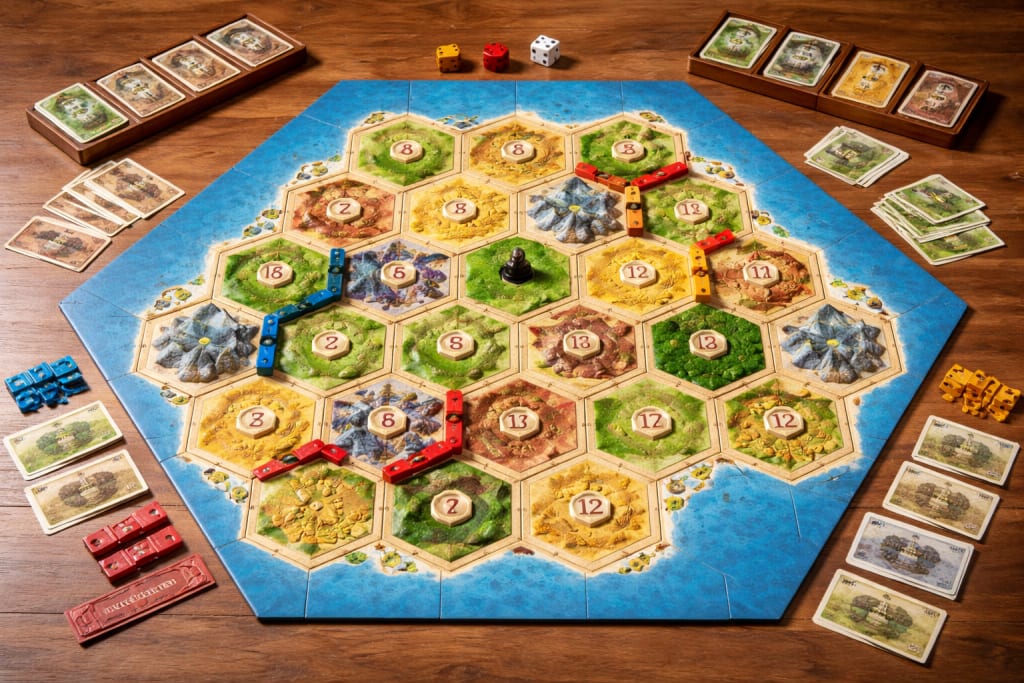
OBJECTIVE
Accumulate 10 Victory Points.
COMPONENTS
• 1 board made of hexagons (19)
• 1 desert (1)
• 18 numbered tokens
• 95 resource cards (wood, brick, sheep, wheat, ore)
• 25 development cards
• 16 cities
• 60 settlements
• 72 roads
• 2 special cards (Longest Road, Largest Army)
• 1 robber
• 3–4 people who will claim they are “just playing for fun”
• 1 person who will take it personally anyway
• 1 person who will say “it’s not personal” right after doing something personal
• Me
SETUP
1. Unfold the board. Make the hexes touch. No gaps. No overlap. The world begins only after it clicks into place.
2. Place the number tokens. The 6s and 8s get attention like they’re celebrities. Everyone stares at them. Everyone pretends they aren’t.
3. Put the robber on the desert, where nothing happens and everything is waiting.
4. Each player chooses a color. Colors are easy. People are not.
5. Place one settlement and one road. Then another settlement and another road. This is the only time the game lets you build backwards to make it fair.
DEFINITIONS
• Rule: A promise the table agrees to keep.
• Strategy: A plan that survives contact with other people’s plans.
• Luck: A word said loudly when someone else wins.
• Win: Proof that the system works, at least in this room, for this long, under these lights.
TURN ORDER
On your turn:
1. Roll two dice.
2. Distribute resources.
3. Trade (optional).
4. Build (optional).
5. End your turn.
Repeat until someone reaches 10 Victory Points or until the table collapses into accusations.
⸻
PHASE 1: THE ROLL
I like the beginning most because it’s clean.
Two dice hit the table and the universe speaks in an integer. Not a vibe. Not a “maybe.” Not a discussion. A number.
The dice don’t care how my day went. The dice don’t care what I meant. The dice don’t care if I explained myself correctly. They land and there it is.
A 9.
The 9s pay out sheep. Sheep arrives in my hand with zero negotiation. No one argues whether I deserve it. No one asks what I was “really trying to say.” The game checks the board, sees my settlement touching the 9, and gives me what the rules promised.
That’s the kind of relationship I understand.
⸻
PHASE 2: RESOURCE DISTRIBUTION
The table watches the board like it’s alive.
People don’t realize how much they reveal during resource distribution. They act like it’s neutral, mechanical. It isn’t. It’s the moment you find out who believes in scarcity.
Someone sighs every time they get brick. Someone smiles every time they get wheat. Someone says “must be nice” when another player gets ore, as if ore is a moral judgment.
I take my cards and stack them in a certain order.
Wood. Brick. Sheep. Wheat. Ore.
It isn’t required. It doesn’t change the game. It only changes my brain, which is the part that needs changing most.
The table continues talking in half-jokes and half-threats. A person mentions “alliances.” Another person says, laughing, that they’re “coming for you.” Someone else says they’re “not paying attention” as they count every resource I pick up.
I don’t mind any of it because the rules don’t mind any of it. The rules stand there like a referee that never gets tired.
⸻
PHASE 3: TRADING
Trading is where the game pretends it’s about social skills.
People like to say strategy games are about people. That’s not entirely wrong. But it’s also not what I’m here for.
Trading is bargaining, and bargaining is messy, and messy is where life usually lives. People offer things they don’t mean. People reject things dramatically. People make “jokes” that are also offers and offers that are also threats.
“Two sheep for one brick.”
“No.”
“Come on, you’re not even using brick.”
“I will eventually.”
“That’s not a reason.”
“It is in this game.”
That’s what I like. In this game, “eventually” is a reason. Plans are allowed to exist without being explained in an emotional tone.
I watch the board, not the faces.
The board tells the truth more reliably.
A player to my left is building near the ore. Another player is stretching roads like they’re trying to lasso the coastline. The person across from me is collecting wheat and pretending they aren’t.
I know what’s happening, and I don’t need anyone to confess it.
I trade with the bank.
Four sheep for one brick.
It’s expensive. It’s blunt. It’s honest. No one can take it personally because it doesn’t involve them.
There’s comfort in paying a rate that never changes.
⸻
PHASE 4: BUILDING
This is the part the box promises. Tiny pieces turn into territory.
I build a road.
I place it carefully, aligned, connecting to my existing network. Roads are commitments you can point at. They have direction. They don’t drift.
Someone says I’m expanding too fast.
They’re not wrong. They’re also not describing the whole thing.
I build a second road.
Now the shape is clearer. My roads are not random. They have intention. There is a location I am moving toward, and the game lets me move toward it one segment at a time, paying the correct resources each time.
In life, you can pay the correct resources and still not get the road.
In this game, payment works.
Wood plus brick equals road.
It’s so simple it feels illegal.
I build a settlement at the end of the road, and the table makes a noise that means I did something correctly and they don’t like it.
The settlement sits there like a stamp.
Mine.
Not because I argued. Not because I convinced anyone. Because I followed the procedures the same as everyone else.
“Nice placement,” someone says, and it’s not exactly a compliment.
I nod anyway.
⸻
SPECIAL RULE: THE ROBBER
When someone rolls a 7, the robber moves.
The robber is the game’s way of admitting that people will target each other. It formalizes the ugliness so it doesn’t infect the whole table. If you’re going to be mean, be mean inside the box. Follow the steps.
A 7 appears like a punchline.
Hands go to resource cards. People count. People complain. People narrate their suffering as if the game asked for a speech.
I check my hand. I have too many cards. I discard half.
It’s not fair. It’s also not personal. It’s arithmetic.
The robber gets placed on the hex that hurts someone else most. Someone always thinks it’s about them even when it’s obviously about probability.
The robber comes to me eventually, of course. That’s how the game stays balanced. It doesn’t let you get comfortable for too long. It just lets you get comfortable enough to keep playing.
When the robber lands on my best hex, I don’t argue.
I just adjust.
That’s what I came for. A world where adjustment is possible.
⸻
MIDGAME: WHEN THE BOARD STARTS TALKING BACK
Early game is possibility. Midgame is pressure.
In the beginning, the board is open, like an empty planner. In the middle, it’s a crowded schedule. Roads intersect. Settlements fence off. Every build is also a limit.
People start looking at me more.
Not because they like me. Because I’m close to something.
Someone counts my points out loud. People do that when they want to make you visible.
“I think you’re at seven,” someone says.
I don’t correct them. Correcting can be interpreted as a move. Silence is safer. Silence is also strategic.
I check my actual points.
Settlements: three.
Cities: one.
Longest Road: not yet.
Development: two points hidden.
I am closer than they think. That’s useful.
The table becomes a small economy of information. People pretend not to want something while angling for it. People say they’re “blocked” while quietly setting up trades. People announce intentions like it will make them seem honest.
The board doesn’t care about honesty.
The board cares about placement and cost.
I build a city.
Upgrading a settlement to a city is a quiet kind of power. It doesn’t look like much, just a piece replaced with another piece. But it doubles output. It turns the same space into more.
That makes sense to me.
In other places, upgrading doesn’t guarantee anything. You can upgrade your effort, your patience, your explanation, your softness, and still receive the same result.
In this game, a city pays two resources.
Two.
Not one-and-a-half. Not “it depends.”
Two.
Someone groans like I did something rude.
I didn’t.
I did math.
⸻
ADVANCED MECHANIC: DEVELOPMENT CARDS
Development cards are the game’s way of letting you win without building on the map. They’re hidden, delayed, probabilistic. They’re for people who like secrets.
I buy one anyway.
Not because I like secrets. Because the rules say they can be useful. Because sometimes the most structured move is accepting uncertainty where it is contained.
I draw a card.
Knight.
A tool with instructions.
Play it. Move the robber. Steal a card.
Even theft is procedural here.
No one steals on impulse. No one steals as a confession. The robber moves because the card says it moves.
That difference matters.
I hold it.
Holding is a strategy too.
⸻
LATE GAME: WHEN EVERYONE IS ANGRY AND STILL FOLLOWS THE RULES
Late game is when people stop pretending.
Trades dry up. Smiles turn sharp. Players become accountants and prosecutors. Every offer has subtext, and everyone acts like subtext is an objective resource.
I stay with the board.
The board is still a board.
It hasn’t changed its mood.
Someone tries to bargain with me using tone.
“If you trade with them, you’re basically handing them the win.”
This is the part where life usually slips in and smears itself all over the clean lines. The part where you’re supposed to care about being fair, being liked, being seen as good.
In this game, the win condition is a number.
Ten.
Not “most improved.” Not “best vibes.” Not “we all learned something.”
Ten.
I decline the trade.
Not rudely. Not kindly. Simply.
“No.”
The table reacts as if I declined a friendship.
I didn’t.
I declined an exchange rate.
They can interpret it however they want. The board won’t.
⸻
ENDGAME PROCEDURE
On my turn:
1. Roll: 8.
2. Collect: wheat and ore.
3. Trade: none.
4. Build: yes.
I build a road.
I build another.
Longest Road shifts. Someone protests, then stops because the rules confirm it. The card changes hands.
I now have Longest Road.
Two points appear like the click of a lock.
I buy a development card.
Then another.
I place them face down.
The table watches my hands as if my hands have intentions beyond the cards.
I flip one.
Victory Point.
I flip the second.
Victory Point.
Hidden points are the game’s only magic trick. Even here, the magic is printed and counted.
Someone laughs, but it’s not joy. It’s recognition of a trap that was always legal.
I add up.
Settlements: 3 points.
Cities: 2 points.
Longest Road: 2 points.
Development: 2 points.
Total: 9.
One more.
There are many ways to get one more. I see them all. That’s the point of the game. The paths are limited, but visible.
I build a settlement.
I pay wood, brick, sheep, wheat.
The pieces leave my hand. The piece enters the board. The number becomes true.
Ten.
I don’t celebrate.
Celebration would imply this was about emotion.
This is about completion.
I have followed the rules from start to finish. I have translated randomness into a pattern that holds. I have taken a board full of other people’s plans and still made mine connect.
The table is quiet for a moment, like it’s waiting for me to say something about what this means.
The game doesn’t require a speech.
So I do what the game trained me to do.
I verify the condition.
Ten Victory Points.
RESULT
Game over.
NOTES
• The rules were consistent.
• The outcome was measurable.
• The path was earned, not argued.
• The board made sense.
RESET INSTRUCTIONS
Put the pieces back into their bags.
Shuffle the cards.
Fold the board along its lines.
If someone wants to talk about feelings, they can.
The box closes either way.
About the Creator
Jesse Lee
Poems and essays about faith, failure, love, and whatever’s still twitching after the dust settles. Dark humor, emotional shrapnel, occasional clarity, always painfully honest.




Comments (1)
Such a good game!