
Unveiling the Secrets of Comets
The Mysterious Travelers of the Cosmos

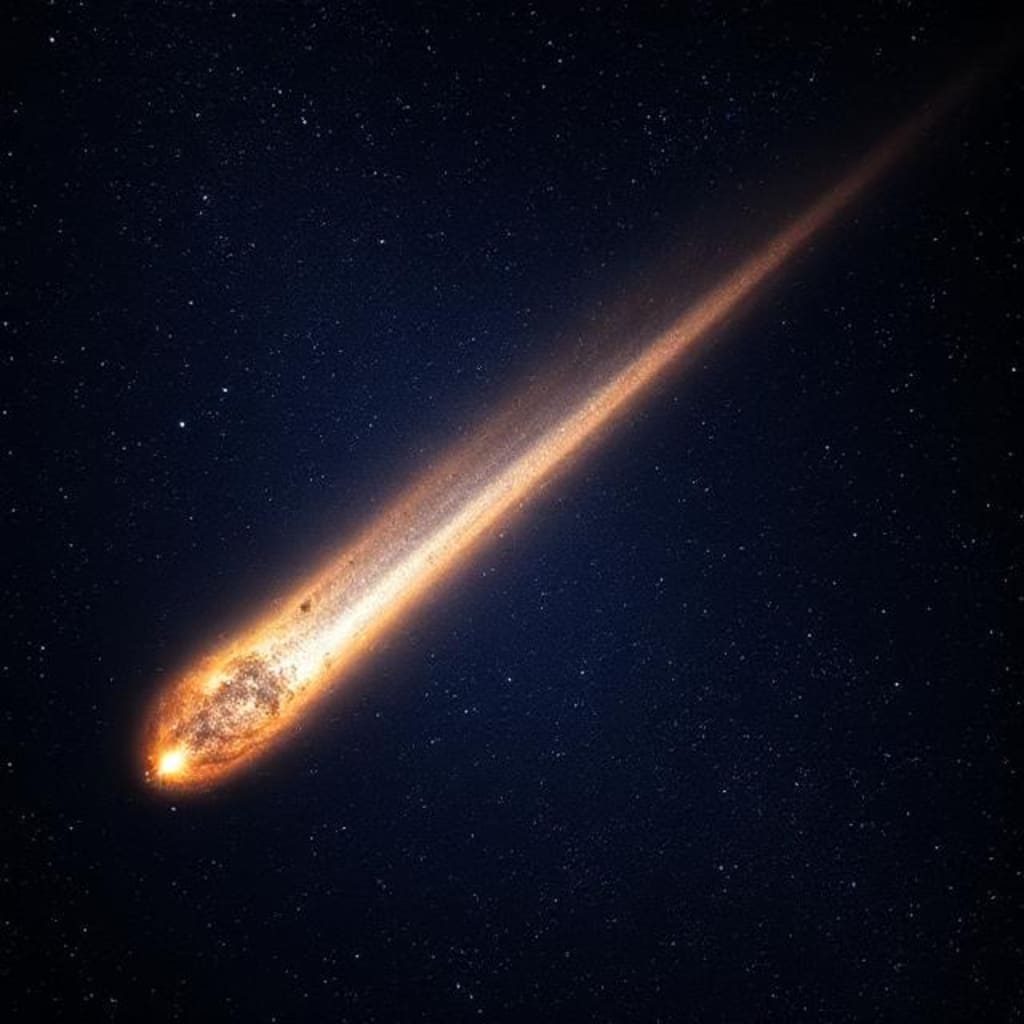
A comet is a strange and mysterious object in space, an integral part of our solar system. It is thought to be a remnant from the early stages of the universe's formation and is essentially a mixture of ice and dust that orbits the Sun. Sometimes, comets come close to Earth and illuminate the sky, offering us a fascinating and enigmatic view. However, their beauty is not the only thing that captures our attention, as scientific studies of comets have provided us with valuable information about our universe.
Composition and Characteristics of Comets
A comet is mainly made up of a mixture of ice, dust, and gases. Its structure has earned it the title of a living relic of the early universe. At the center of a comet is a solid core called the nucleus, made up of frozen ice and rock, which can be as small as 10 kilometers in diameter. Surrounding the nucleus is a cloud of gas and dust particles known as the coma. The coma is what gives the comet its distinctive appearance and brightness.
The heat and energy of a comet's approach to the Sun cause the ice in its nucleus to melt, releasing gas and dust. This process creates a glowing tail, which is called the comet's tail or coma tail. The tail of the comet stretches out in the opposite direction of the Sun, forming an impressive visual phenomenon that can extend for millions of kilometers. The speed at which comets travel can be astounding, reaching up to 100,000 kilometers per hour.
The Travel of a Comet Through Space The path of a comet is very unique and vast. It travels around the Sun in an elliptical pattern, occasionally passing close to Earth and other times traveling far away into deep space. The comet's appearance changes as it moves closer or farther from the Sun as it absorbs heat and energy from the Sun over its long journey. It is essential to keep in mind that comets do not collide with planets like Earth because of the vastly different orbits and positions they take in space. However, when a comet comes into the inner solar system, its bright and beautiful tail often becomes a spectacular sight for people on Earth.
Scientific Research and Importance of Comets
Comets play a crucial role in our understanding of the universe. Even though they are few, their composition provides scientists with useful information. Experts are of the opinion that comets are remnants from the early stages of our solar system and may contain crucial information regarding the process by which planets and other celestial bodies were formed. Chemical elements found in cometary gases and dust give us a better understanding of our solar system's early conditions. Comets may have brought Earth's water and essential chemical components, which are necessary for life, to our planet, according to some scientists. This theory suggests that comets may have played an important role in the development of Earth's climate and the origin of life.
The Impact and Possibilities of Comets
Comets can have a significant impact on the solar system, especially if they come close to Earth. Although comets do not collide with our planet, their gases and dust can occasionally influence Earth’s atmosphere. Some scientists believe that the water and chemical compounds necessary for life were initially delivered to Earth by comets, playing a vital role in the emergence of life.
In addition, some researchers have the expectation that in the not-too-distant future, space exploration will lead to the discovery of brand-new cometary materials or sources of energy. The potential for comets to offer valuable resources makes them a subject of continued scientific interest.
Comets and Human Interest in Them Comets have not only attracted scientific curiosity but have also captivated the imagination of humans for centuries. In various cultures, comets were once seen as omens of bad luck or catastrophe, but in modern scientific terms, they are viewed as spectacular and awe-inspiring celestial events. Universities and space agencies around the world conduct extensive research on comets, and organizations like NASA and other space exploration agencies constantly monitor and study these cosmic wanderers.
Famous comets like Halley's Comet, which passes by Earth once every 76 years, have fueled human curiosity and excitement. The sight of such a comet is a rare and unforgettable experience, one that sparks wonder and fascination about the cosmos.
Conclusion
Comets are mysterious and captivating celestial objects that offer valuable insight into the early history of the universe. We now know more about our solar system and the origins of life on Earth thanks to their structure, motion, and significance to science. While comets are beautiful symbols of cosmic wonder, they also play an important role in scientific research, helping us to unravel the mysteries of the universe. The presence of their bright tails in the sky continues to inspire curiosity, motivating future space exploration that could potentially lead to groundbreaking discoveries for humanity.
About the Creator
MD Ariful Islam
Writer, thinker, and storyteller. I share fresh perspectives on [your niche or interests], sparking new ideas and conversations. Let’s connect!
Keep reading
More stories from MD Ariful Islam and writers in Fiction and other communities.
The Dual Nature of Light
Unraveling the Quantum Mysteries of Illumination: Light and Photons For centuries, people have been interested in light, a fundamental component of our everyday lives. Light has been studied from a variety of angles, from ancient philosophers to modern scientists. Our understanding of light, on the other hand, has only become significantly more mysterious and profound over the past century. The idea of the photon—an elementary particle that is the foundation of light itself—is at the center of this comprehension. To truly appreciate the nature of light, we must explore both the concept of light and the role photons play in shaping the world around us.
By MD Ariful Islam12 months ago in Chapters
The Android Detective: Help Wanted
Vesper Lyra leaned her lanky frame into the door to push through the entrance lacking working electronics. A simple, painted sign in a boring and nondescript font announced that one would find a Clyde Sharpman, P.D. inside. Among the bright lights, vibrantly coloured signs, and announcements everywhere else on Wetwater Street, how she even noticed the place was a mystery. Not to mention the roughly cut-out cardboard sign in the unit’s dirty window advertising that the private detective, Clyde Sharpman, wanted help.
By Jean-François Lamothe2 days ago in Fiction
Why Didn't Anyone Tell Us
Men, move along. This is not for you. This is for the women. I was forty-five when I began menopause. It is pretty young for that to be going on in a woman’s life, but I had undiagnosed PCOS, my entire life. Thank you to all the gynecologists I had seen my entire life. That in itself should encourage women to keep seeking second opinions, especially when you are not getting correct answers or any at all.
By Alexandra Grant4 days ago in Humans


Comments
There are no comments for this story
Be the first to respond and start the conversation.