

You wake somewhere new.
No memory of the night before.
Light arrives from no visible source and refuses to cast shadows. The walls are pale, unmarked, faintly warm. The room has edges but no corners. Sound travels too cleanly. There is a door behind you. You know this without turning.
You turn.
The door is sealed. No handle. No seam. Only a rectangle slightly darker than the wall around it. A clock without hands is mounted at eye level. It ticks anyway.
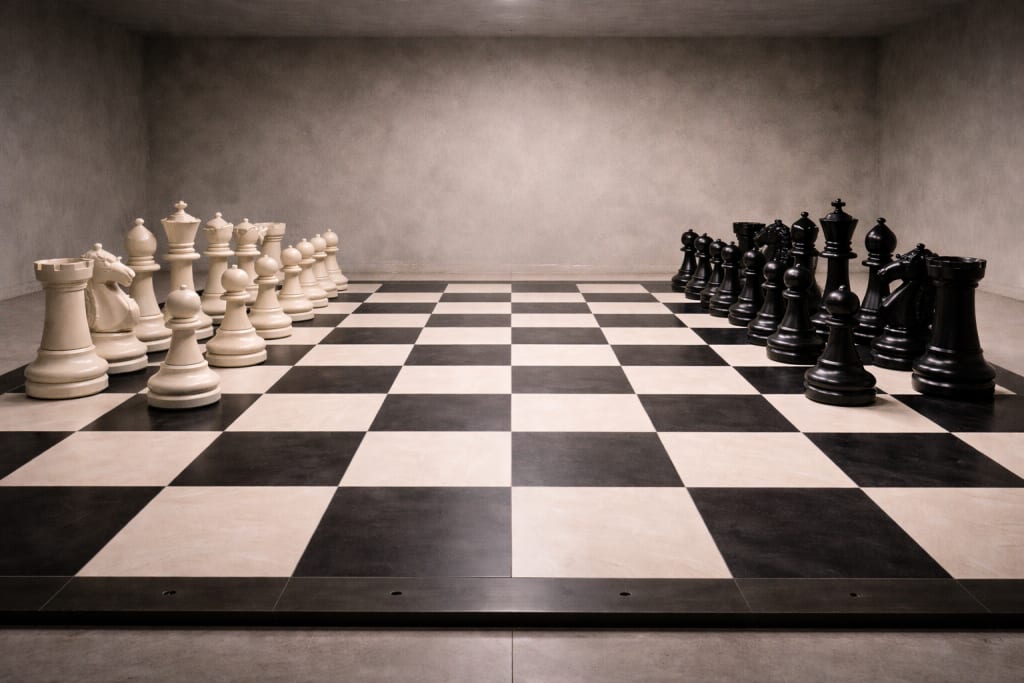
In the center of the room is a board set into the floor. Black and white squares. Perfectly even. A chessboard large enough to stand on.
There is a desk made of glass along the far wall. On it rests a single sheet of paper.
It wants a signature.
You do not touch it.
A tone sounds.
It is calm.
The board hums.
Pieces rise from the floor. They do not slide into place. They emerge as if the room exhales them. Pawns first. Then rooks. Knights. Bishops. The King. The Queen.
They arrange themselves.
The tone sounds again.
You understand without being told: it is your turn.
You hesitate.
The clock ticks louder.
A sign fades into the wall beside the board.
Stand here.
Wait your turn.
You step onto a white square.
The room stills.
A pawn moves on its own.
The tone sounds.
You are expected to respond.
You choose a pawn. It is close. It seems harmless. You move it forward one square.
The tone stops.
The board hums.
Nothing else happens.
You wait.
Another pawn advances.
The tone sounds.
You move again.
The rhythm establishes itself.
Tone.
Move.
Silence.
You begin to anticipate. You think one move ahead. Then two. The board allows this. It does not resist. It simply answers.
A bishop disappears.
Not taken.
Gone.
You do not notice.
Two turns later, a square darkens. The light narrows. The room feels smaller by a margin you cannot measure.
You do not connect this to the bishop.
The clock ticks.
You keep playing.
A knight vanishes.
The hum deepens.
The air grows denser.
You adjust. You protect your King. You sacrifice a pawn. You gain space.
The Queen is gone.
You do not miss it yet.
You will later.
The board continues.
You begin to understand the tones. One is for urgency. One is for error. One is for delay. You learn when to breathe. You learn when to wait.
A rook disappears.
The wall behind you warms.
You turn.
The door remains sealed.
You play faster.
You try to win.
The board does not reward this.
Three moves later, a row of squares becomes inert. You step onto one by habit. Your foot does not lift. The board holds you in place until the tone releases you.
You stop rushing.
You begin to watch.
You notice that when a piece vanishes, the room changes later. Never immediately. Always delayed. Always proportional.
You begin to count.
One piece lost: light shifts.
Two pieces lost: sound tightens.
Three pieces lost: space contracts.
The board is not punishing you.
It is teaching you scale.
You test it.
You sacrifice a pawn.
Nothing happens.
You sacrifice another.
The clock ticks louder.
You sacrifice a third.
The ceiling lowers by a breath.
You recover a piece.
The ceiling halts.
You stop thinking about winning.
You start thinking about cost.
The board does not care about victory. It cares about consequence.
A piece you save now will matter later.
A move you make now will close a door you cannot yet see.
You play more slowly.
You let a knight fall because you understand what it will buy you.
The room warms. The ticking softens.
You learn that every square is a future.
You learn that speed is not control.
You learn that reaction is not choice.
The tone sounds.
You wait.
Not because you are told.
Because you see the board.
You see the path your hand almost took.
You see what it would have cost.
You choose differently.
The room exhales.
The clock grows quiet.
The door does not open.
You are not finished.
You make a move you have already lost.
You see it this time.
You do not take it.
The board waits.
The room waits.
The tone does not sound.
You move anyway.
Not to escape.
Not to win.
To accept that every square you touch
becomes the world that follows.
The door unlocks without a sound.
About the Creator
Tifani Power
Tifani Power is a creative writer who focuses on exploring the darker corners of the human experience—loss, endurance, transformation, and the quiet moments that shape us. She favors depth, atmosphere, emotional precision, and lived truth.
Keep reading
More stories from Tifani Power and writers in Fiction and other communities.
THE PLACE THAT REMEMBERS
They hadn’t seen each other like this in years—not all together, not without weddings or funerals as an excuse. Mid-twenties, edging into their thirties. Old enough to have jobs and habits. Young enough to still talk about high school like it was a country they once lived in and barely escaped.
By Tifani Power 4 days ago in Fiction
The Echo of Water: Washing Away the Scent of Fear
1. A Haunting Nocturnal Ritual For John, his marriage to Mia was supposed to be a sanctuary of peace after years of solitude. Mia was like a figurine of fine crystal; delicate in her movements, soft-spoken, and always trailing a faint scent of hibiscus and vanilla. Yet, beneath this serene surface lay a disturbing nocturnal ritual: twice every night, before retiring to bed, Mia would bathe. It was a rigorous, almost sacred routine that never faltered, regardless of the circumstances. John, a designer with a keen eye for detail, would watch her slip into bed with her back turned to him, whispering a faint "Goodnight" before sinking into a sleep that resembled an escape. He initially dismissed it as a fastidious obsession with cleanliness, never realizing that the water wasn’t for hygiene—it was a desperate attempt to wash away a "memory" that refused to die.
By Mayar Younesa day ago in Fiction


Comments (1)
I really loved how the rules reveal themselves slowly, not through exposition but through consequence. The delayed cause-and-effect between the board and the room made every move feel heavier over time, until the game stopped being about winning and became about understanding cost. That shift felt earned and unsettling in the best way!