
Under the Night Sky: Experiencing Senegalese Wrestling in Joal
A firsthand journey through the sights, sounds, and rituals of Senegalese Njom wrestling.

Hey everyone, how are you all? Today, I’m going to share an interesting story with you, and I hope you enjoy it.
It was that other night—a rather late night, in fact. Deep darkness had fallen over the West African coast for several hours. My friend and I were striding along the lonely road from the town of Joal toward Fadiouth Island, Senegal.
We had spent a very exhilarating evening in Fadiouth, but on the way back to Joal, we couldn’t find any reasonably priced means of transportation to take us onward to Palmarin. On top of that, we couldn’t locate any budget accommodation. After wandering around Joal for a while and asking in vain, we decided to head back to Fadiouth. There was a friendly chap, Alfonce, and his sister, whom we had met earlier and who had invited us to their home for the night. Unfortunately, we had to politely decline, as we were planning to leave. Our new plan was to return to Fadiouth and try to find them again.
Back on the dark, lonely road, we crossed the 500-meter scenic bridge connecting Fadiouth to the mainland. At the beginning of the bridge, we encountered a group of friendly local lads coming the opposite way. They stopped to talk with us. When we explained our situation, one of them—Tarou—turned out to be Alfonce’s cousin. As luck would have it, they were on their way to attend a wrestling contest in Joal and invited us to join them. We agreed: Tarou would take us to his cousin’s house first to drop off our belongings, and then we would all head to Joal together.
About an hour later, we were standing outside a large field on the outskirts of town. The crowds were tightly packed around the wire fence, so we couldn’t see what was happening inside. All we could hear was the iterative drum pattern, accompanied by trance-inducing chants that reverberated through the night.
At the gate, we were initially asked to pay an extraordinary sum for entry, which we refused. A brief wrangle followed between Tarou and the gatekeeper. I couldn’t understand the words, but it was clear Tarou was chastising the gatekeeper for trying to overcharge us. In the end, we paid the normal ticket price and were allowed in.
I had expected the event to be nothing spectacular, and I paid the ticket fee somewhat reluctantly, hoping not to cause discord. But upon entering, I immediately changed my mind. What we witnessed was beyond expectations—absolutely astonishing!
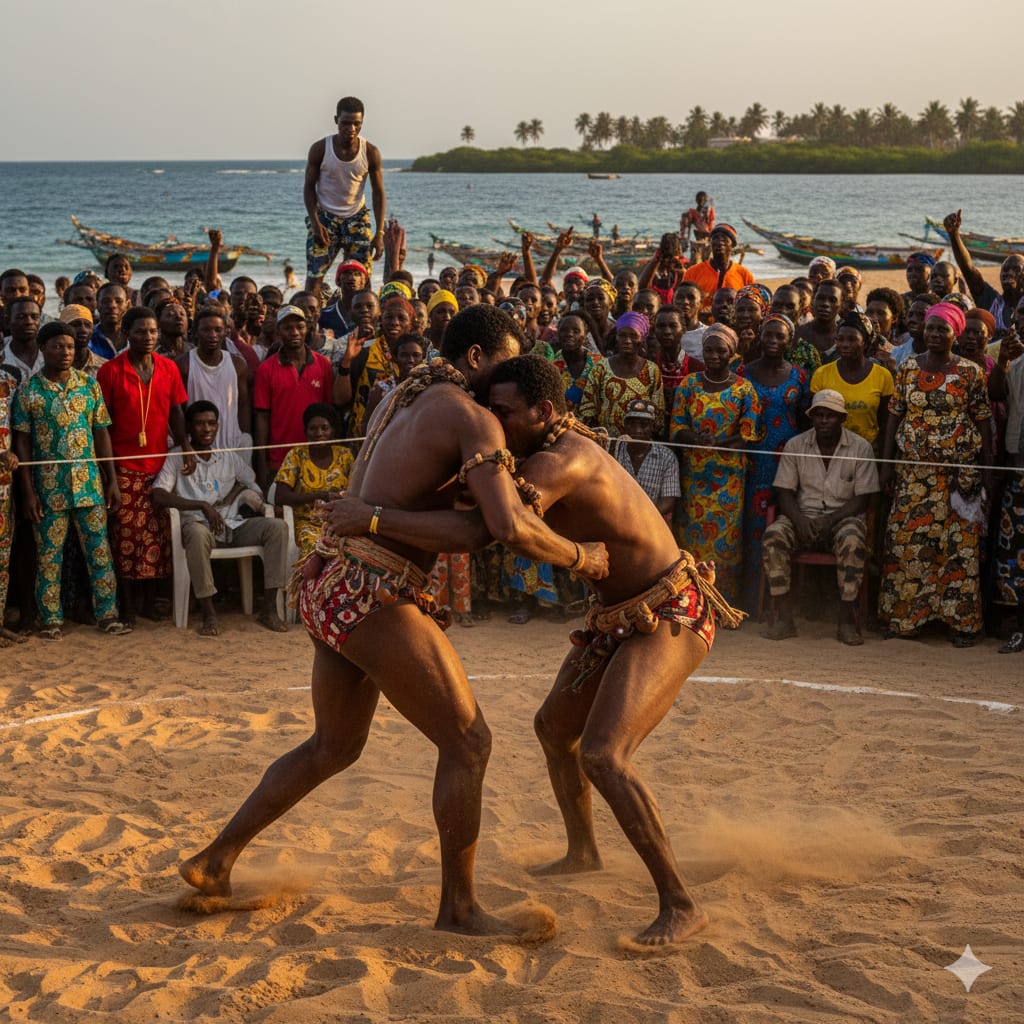
Apart from a platform reserved for some official-looking men, presumably the town’s squirearchy, there were no seats. We found a place to squat among thousands of others surrounding the arena. The arena itself spanned about 100 meters wide, with ten pairs of wrestlers fiercely battling at different spots, each overseen by a referee. These men were colossal, seemingly larger-than-life, with physiques that suggested extreme training or possibly steroid use.
They would stand in a bent position, carefully observing each other, sometimes scooping handfuls of sand and tossing it through the air. At an unexpected moment, one would dash toward the other, and a ferocious battle would ensue until one was laid flat. The winner would then celebrate wildly amidst the delirious cheers of the crowd.
Meanwhile, the wrestlers waiting for their turn circled the arena in a slow, rhythmic pace guided by the percussion—a ceremonial dance believed to increase their chances of winning. Beyond their physical prowess, wrestlers relied on various superstitions. For instance, no serious contestant would fight without a Giri-Giri—a small talisman consisting of a piece of paper inscribed with verses of the Quran, enclosed in a leather strap.
Njom wrestlers enjoy high esteem in Senegalese society and are reputedly wealthy. I wasn’t able to get exact figures, but Tarou tried to give us an idea. At first, he claimed they earn 100,000 CFA per match, but after seeing our lack of reaction, he corrected himself: “No, sorry, 100,000,000 I meant!” When we remained unimpressed, he added, “No, more than that!”—all said with surprising calm.
About the Creator
Keep reading
More stories from Newman Singer and writers in Fiction and other communities.
Today, I found out my girlfriend has a secret Snapchat account — and it changed everything
Hey there, I'm Newman Singer, a solo traveler from California. I usually write about my adventures—like chasing sunsets in Thailand or finding the best tacos in Mexico. But today, I'm sharing something personal and tough: how I figured out my girlfriend was hiding a secret Snapchat account and cheating on me. This isn’t my usual vibe, but maybe my story can help someone else going through the same mess. Here’s what happened, in plain talk, from one regular person to another.
By Newman Singer6 months ago in Fiction
Pandora’s Burden
“My brother warned me to not accept gifts from the one who commissioned you,” said Epimetheus to the woman clad in silvery raiments standing at the entrance to the temple. Her silver tiara and the silver rings on her fingers and toes glinted in the firelight cast by torches set on either side of the doorway. Lingering in the shadows, beyond the reach of the flames as she was, he could not tell what she held in her hands. At first what appeared to be a box was perhaps a funerary urn, or maybe merely an apple.
By J. Otis Haasa day ago in Fiction
Talking Through the Grapevine
Theseus sighed as he picked up a stone and threw it into the ocean. Usually, he would be able to make it skip for at least ten times, even if he was having a bad day. But whether it was because he was sitting on the sand or he just didn’t care, the stone sank with a single plop a half mile away.
By Rebecca Patton2 days ago in Fiction


Comments
There are no comments for this story
Be the first to respond and start the conversation.