
**Title: A Monument of Eternal Love**
**Title: A Monument of Eternal Love**

**Title: A Monument of Eternal Love**
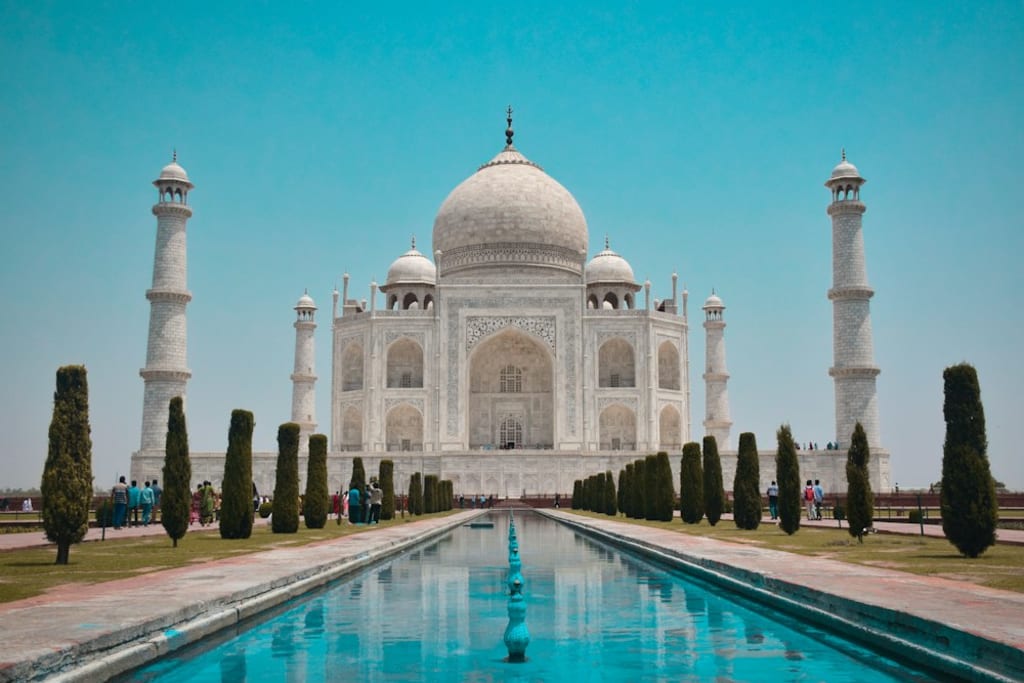
Once upon a time, in the heart of India, there stood a magnificent structure that transcended time itself – the Taj Mahal. It was a symbol of undying love, a testament to the depth of human emotion. Emperor Shah Jahan, grief-stricken by the death of his beloved wife Mumtaz Mahal, commissioned its construction in her honor.
The Taj Mahal's construction began in 1632 and lasted for over two decades, employing thousands of artisans, craftsmen, and laborers. The Emperor spared no expense, using the finest materials from all over the world – marble from Rajasthan, jade from China, turquoise from Tibet, and sapphire from Sri Lanka.
The Taj Mahal's design was the culmination of various architectural styles, blending Persian, Islamic, and Indian influences seamlessly. Its symmetrical layout, intricate carvings, and meticulous detailing mesmerized all who beheld it. Each element was imbued with meaning, from the calligraphy of Quranic verses adorning the walls to the delicate inlay work depicting floral motifs.
As the sun rose over the horizon, casting a golden hue upon the marble facade, the Taj Mahal seemed to glow with an ethereal radiance. Its pristine white domes and minarets reached towards the heavens, reflecting the purity of Shah Jahan's love for Mumtaz.
Legend had it that the Emperor's grief was so profound that he wished to immortalize his beloved wife's memory for eternity. Thus, the Taj Mahal became more than just a mausoleum – it became a monument to everlasting love, a beacon of hope in a world filled with sorrow.
Visitors from far and wide flocked to witness the beauty of the Taj Mahal, each one awestruck by its grandeur and majesty. For some, it was a pilgrimage to pay homage to the enduring bond between Shah Jahan and Mumtaz. For others, it was an architectural marvel, a masterpiece of human creativity and ingenuity.
As the years passed, the Taj Mahal stood as a silent witness to the ebb and flow of history. It weathered wars, revolutions, and the passage of time, yet its beauty remained unscathed, a testament to the resilience of love in the face of adversity.
Poets penned verses extolling its magnificence, artists captured its likeness on canvas, and travelers immortalized it in photographs. The Taj Mahal became synonymous with romance and passion, its name whispered in hushed tones by lovers professing their devotion to one another.
But amidst the admiration and adulation, whispers of tragedy lingered in the air. For behind the facade of splendor lay a tale of heartbreak and loss – the story of Shah Jahan and Mumtaz, two souls bound together in life and death.
Mumtaz Mahal, the Emperor's beloved wife, was more than just a consort – she was his confidante, his companion, his soulmate. Her untimely death shattered Shah Jahan's world, leaving him bereft of purpose and consumed by grief.
In his anguish, the Emperor vowed to immortalize Mumtaz's memory in the grandest way possible – by building a monument that would stand the test of time. Thus, the Taj Mahal was born, a labor of love that would endure for centuries to come.
As the sun set behind the domes of the Taj Mahal, casting a crimson glow upon its marble walls, the Emperor would often visit Mumtaz's final resting place. With tears in his eyes and a heavy heart, he would kneel beside her sarcophagus, whispering words of love and longing into the stillness of the night.
But even as Shah Jahan gazed upon the beauty of the Taj Mahal, he knew that his time on earth was drawing to a close. As he grew older and frail, his thoughts turned to the legacy he would leave behind – a legacy of love, devotion, and eternal beauty.
In his final days, surrounded by his children and grandchildren, Shah Jahan reflected on the fleeting nature of life and the enduring power of love. He knew that he would soon be reunited with Mumtaz in the afterlife, where their souls would soar together, unbound by the constraints of mortality.
And so, as the Emperor breathed his last and his spirit ascended to the heavens, the Taj Mahal stood as a silent sentinel, bearing witness to the eternal bond between Shah Jahan and Mumtaz. Their love had transcended the boundaries of time and space, leaving an indelible mark on the world for all eternity.
And though centuries have passed since the days of Shah Jahan and Mumtaz, their legacy lives on in the timeless beauty of the Taj Mahal. It remains a symbol of enduring love, a monument to the power of the human heart to overcome even the greatest of tragedies.
As visitors from around the world continue to flock to its gates, drawn by the allure of its storied past and unparalleled beauty, the Taj Mahal stands as a testament to the enduring power of love – a love that knows no bounds, no limits, no end.
About the Creator
The Mediation, Friday, November 9th, 2012
Anton sat at the large oak table in the mediation services office. He had already been there for twenty minutes. He was fifteen minutes early and eager to get this over with. He already knew that she wasn’t going to agree to anything. If Karin thought he killed it at the first court date, wait until she sees what’s about happen here.
By Anton Mathias Heft 3 days ago in Fiction




Comments
There are no comments for this story
Be the first to respond and start the conversation.