
"Till the dawn."
A young man is challenged by his best friend to spend the night in the ruin of a local lighthouse.

I will write down everything just as it happened. My hands still shake at the memory, but I will try.
It seemed like such a straightforward proposition at the time: a simple wager between two young men who were brothers in all but name and blood. I thought that my friend had been looking for a way around accusations of charity: that the bet was the best that he could come up with to help me with the cost of my impending wedding.
My name is Niall Turner. My friend was Jude Wilberforce. My beginnings were humble, but comfortable: my father was the gamekeeper to Squire Wilberforce, Jude’s father. In my thirteenth year, scarlet fever took my parents from me. Jude’s father took pity on me. He allowed me to remain in the cottage I had grown up in and he insisted that I continue in my father’s position. The condition of my remaining in his service, and in my father’s role, was that I should begin to attend lessons with his own son. I was delighted. I recognised the squire’s generosity as a gesture of kindness and love; I accepted it immediately.
Jude and I spent our formative years together, wrangling over matters of literature, science, philosophy and ethics. I was the naive optimist, Jude the morose cynic. He always seemed so bitterly amused by me and my rustic ways. Where others felt that he was being cruel, I saw it as the exasperation that is born of brotherly love.
One fateful night we attended a summer dance. My friend was distracted and agitated in the carriage. I attempted to draw the reason for his excitement from him, but he waved away my solicitous ministrations with a terse glance and a perfunctory flick of his hand. Upon our arrival he offered me a curt nod and left. I watched him stride into the civil menagerie of bright young things. For the first time in my life, I found myself alone at a society party. I wandered through the throng, bathing in the rich scents, delicious sounds and radiant people. I felt that I was dreaming, and like Rip Van Winkle, I lost myself and lost track of time. I smiled at many and nodded at many more. My clothes were smart but functional. My lower social standing was clear to them. They nodded politely but did not speak to me. Their faces were like those one sees behind the glass of a mirror: silent and watchful.
I was deep in my reveries when I happened to glance up and see my friend. He was in animated conversation with a beautiful young woman. She was dressed in white and had angelic blonde hair. Her eyes were sapphires. Where Jude seemed vexed, she seemed gently amused. Her gestures towards him were soothing. She saw me across his shoulder and murmured something. Jude looked around and nodded towards me; the exasperation of whatever problem had irked him that night was written upon his face. I remember how she leant in and whispered something in his ear. His response was electric; he was delighted and eagerly beckoned me over. He introduced me to the girl: Emily. She was the daughter of our host. She greeted me with a demure glance and a mischievous smile. I spoke to her and she spoke to me, and Jude laughed all the while. In the months that followed I often asked him what she had whispered to him. Jude would simply look at me and grin.
My romance with Emily was a whirlwind. We were engaged within a month, much to the consternation of society. Had the squire not spoken on my behalf, her father confessed that he would have refused to give me her hand. When Jude had told his father of my intention to ask Emily for her hand in marriage, the squire had been delighted. My patron had sent for me, and, laughing with great gladness, he had spoken of how he would make sure that I should be provided with employment that would keep such a lady in the manner to which she was best accustomed. In a moment of emotion, he told me that my own father would have been proud to have such a true and noble son. The squire’s ready reference had convinced Emily’s father of my worth. After I had spoken with Emily’s father, he had smiled and laughed as though with relief.
“You are better than the alternative,” he told me. I had no idea to whom he was referring. Not then.
One night, with the date of the wedding rapidly approaching, Jude suggested that we celebrate my impending nuptials. There was a tavern on the coast that was some distance from the estate, but which we knew served good food and the best beverages. We took two horses and rode off.
We reached the alehouse early in the evening: Jude drank heavily from the moment we arrived. His father had seen to it that he had received an officer’s commission. He looked resplendent in his uniform. His black boots shone; his white trousers blazed in the light of the fire; his dolman was a deep blood red. The hilt of his sword was a firebrand. The glow of the tavern’s candles and hearth caressed the brass buckles and buttons of his uniform; their burnished sheen reflected like dancing embers in the dark pools of Jude’s eyes. I thought that his drinking was a sign of trepidation at the thought of going to war. It felt like he was building to something. Occasionally his knuckles would whiten as he tightened his grip on the sword’s hilt. His face had taken on a ruddy complexion. His eyes periodically flitted away from me to look about the room. His expression was one of rage and gall.
I was preparing to speak to him, to suggest we return home, when in the shaded corner to the right of the fireplace, someone cleared their throat. The room fell silent; the local bard was preparing to speak. Old Seamus was well known in the county as a teller of tales and a singer of songs. He cast his curmudgeonly countenance about the room until it came to rest upon Jude and me. Jude squirmed like a child caught in a lie. For a moment, I looked on my friend with concern, but inevitably I had to turn to meet Seamus’s steady gaze. I have never been able to resist a story. My face was open: my expression gleeful. My honest enthusiasm caused a smile to flit across Seamus’ dour countenance. Then the stone of his scowl rolled back across his face and he began.
“The world is made up of lovers. Their lives surge in and out and about one another like the broiling clouds of a lightning storm.”
He drew a breath upon his pipe, fanning the embers of the tobacco, highlighting the contours of his face with hellfire.
“And sometimes… sometimes these tales of love are tales of treachery and bloody vengeance.” Seamus paused, tears starting in his eyes. “Her name was Lynda Trelawney.”
The tale was well known, but rarely told. Further down the English coast, close to the toe of old man Britain, lay Trelawney lighthouse. It was a ruin now, but once it had been manned by Michael Trelawney, and his only daughter: Lynda. She was a beauty, with auburn hair and blue grey eyes that took on the shades and moods of the ocean. One moment they shone blue and dazzling, the next they would turn green and vivid. Finally, they might deepen into the darkness of a storm churned sea. She fell in love and was betrothed to a feckless local boy.
It was her habit of an evening to climb the steps of the lighthouse tower. From its observation deck she would look out across the sea. No one knew what she thought about, or where her mind would wander, but one evening, as lightning danced upon the darkening horizon, she cast her eyes down to the beach. There she saw him, the boy she loved, entwined in the arms of a local girl. She watched them: they rolled together in the sand and the surf, surging into and onto one another, oblivious to Lynda and her broken heart. Below the deck of the lighthouse the maw of the broiling sea churned and chewed upon itself; the rocks gleamed like ebony fangs, masticating satanically.
Her father saw her leap. Old man Trelawney saw her leap and he saw the treacherous lovers wrapped in one another. His sanity cracked like the bow of a frigate cast upon the rocks. He ran from the balcony, ran from the tower, ran along the coastal path, descending upon them like a demon. He caught them by their throats, his calloused hands like corded steel, and with horrible certainty he dragged them into the sea. He walked until all three of them had disappeared and were lost to the sundering depths.
The tavern fell quiet for a long moment. Then a bitter, callous laugh cut through the room. I looked at my friend in astonishment, startled at the look of cruel amusement upon his face.
“And who saw these terrible events, Seamus?” Jude asked. His drunkenness had made him bitter and spiteful. “If all of them were dead, who remained to tell the tale?”
For a moment the silence returned, but now it was a deadly silence: fragile like glass, ready to shatter in an instant. Seamus bent his head and leaned forward in his chair. He took a shuddering breath and looked up at my friend.
“I was there,” he said. “I was standing on the crest of the dunes. A boy. I watched it happen. I watched as that lovely lass fell upon the rocks, and I watched her da’ take each of those children like a farmer takes the scruff of the runt of a litter. I saw every one of them enter the sea. And there wasn’t one of them as ever came out again.” Old Seamus turned his gimlet eye on Jude and said, “I saw what treachery in love can do, young Wilberforce. I saw it and I’ll ne’er forget it.”
Jude could not hold the old man’s eye: he looked away in bitter shame. Seamus watched him a moment longer before he continued. “They’re still there: still in that lighthouse. The da’ and his daughter walk the deck of the tower. They say the girl waits to see and save the betrayed. The da’ waits to see and slay the treacherous.”
“Has anyone ever gone into the tower?” I asked.
Seamus looked at me for a long moment before he spoke: “Some. Some have stayed the night, Master Turner.”
“What happened to them?” I said, breathless and awestruck.
“Those who come out are blessed: their fortunes golden: their lives settled. T’others?” Seamus drew a shuddering breath. “T’others ne’er be seen again.”
I sat back, exhausted by the extraordinary tale. The heady ale had taken its toll. I turned to find Jude, but he had disappeared. I stumbled up, asked the barman to prepare our rooms, and went looking for my friend. I found him outside, speaking to the stableboy. The boy was mounted and as I emerged from the tavern, Jude handed him a slip of paper and slapped the rump of the horse. As the beast sprang away, Jude turned to face me, smiling.
“I have a proposition for you, Niall.”
*
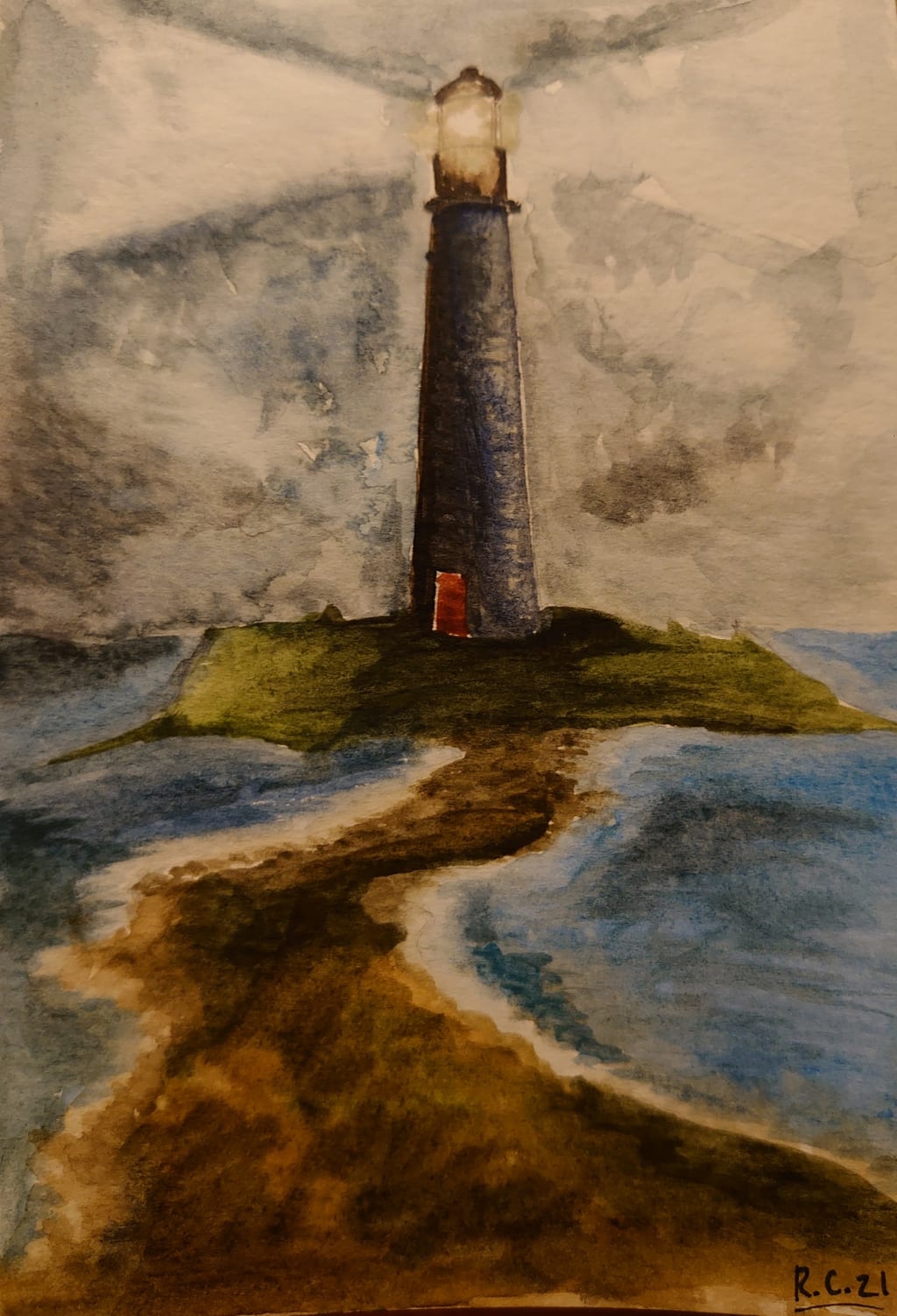
I remember how strangely beautiful the ancient lighthouse looked against the blazing sunset. It stood upon the cliff, looking out across the ocean, proud and desolate. I took my horse up the path and thought of the night before.
“A wager, Niall: spend tomorrow night in Trelawney lighthouse, and I will pay for your wedding.”
Jude had seemed almost gleeful as he had said it.
“And if I don’t?”
“You’ll come to fight Napoleon with me,” Jude had said. “But you will not lose. You’ll take the bet, spend the night and win the wager. You’re many irritating things, Niall, but you’re no coward.” Then he had grinned at me, and for an instant, for the first time in my life, I had seen what everyone else had always seen: in that instant, I had hated my friend.
I tied my horse to a hook in the lighthouse wall. The lighthouse’s rotted door hung from the frame and lightly screamed back and forth in the strong sea breezes. The sound of the surf below fell away as I entered the building. There was a brackish scent. I was cold. Shivering, I gathered my great coat about me and readjusted the bag of provisions upon my shoulder. I approached the stairs and began to climb. I took my time. The happiest day of my life was too close for me to lose it through unnecessary haste. I climbed slowly, listening hard to the tortured groan of each step. I will admit it: occasionally I winced at the scream-like keens of the sea air that sliced their way into the building.
At the top of the spiralled staircase, I stepped out onto the floor of the old lantern room. To my right was the doorway that led out to the observation deck. Outside the last light of the setting sun caressed the clouds. To my left I saw an ancient fireplace. I unfurled my roll of kindling and firewood and set a fire burning in the grate. I set about clearing the floor and arranging my bedding in front of the fire. Slowly the warmth of the flames spread across me. Above me the overcast sky fell into darkness. I lay down and drifted off to sleep.
*
Careful.
I woke with a start. Had someone spoken? Moonlight was bleeding through the tattered beams of the roof. I sat up, discombobulated, but alert. The fire had gone out. I looked around myself, seeking my bearings. For the briefest moment, I thought I saw a young woman on the balcony, watching me intently through the empty doorway. I rubbed my eyes and looked again. Nothing. I stood up and walked slowly towards the empty frame. Beneath me the boards creaked ominously. I stepped out onto the deck.
As I had slept, many of the clouds had disappeared. What few remained now scudded across the sky like schooners in a headwind. The moon was half full, but bright. Cold gusts caught my coat and its tails flapped about me.
I turned and noticed that two more horses were tied in front of the lighthouse. I heard the stairs creaking. I had no weapon save my father’s dirk. I drew it and moved back into the room.
The warm light of a lamp climbed the stairs like faerie fire. Jude stepped through the doorway. He raised the lamp and looked at me with cold eyes. He too was wearing a greatcoat. His sword was unsheathed and in his other hand.
“Is he there?”
I started at the voice. Emily stepped out from behind Jude.
“Emily?” I asked. She smiled at me, before reaching up and pulling Jude into a deep and passionate kiss. When they were finished, they looked at me and smirked at my horror.
“The peasant doesn’t know what is going on,” Emily said, laughing.
“He always was a wretched dullard,” Jude said.
His gaze was cold. “I have always hated you. I hated how my father brought you in and how you always seemed to be everywhere I went. When Emily suggested we set you up to be her husband, to open the way for me to take her as a bereaved widow, even Emily’s father accepted you as her suitor.” He looked at me and then screamed, “He accepted you when he had so quickly rejected me. You!”
He spat the word at me. I saw it all then. Saw his hatred. Saw her amused detachment for what it was: gleeful malice.
I tightened my grip on my dagger and he raised his sword.
It was a dull thump, the first sullen tramp of a boot upon the stairs. We started at the sound. It came again, closer and louder. The smell of seawater became overwhelming. More footsteps: faster, louder, closer, charging up the stairs. One moment Jude and Emily were there and then they were yanked away before my eyes, shrieking in terror.
The horses were screaming. I hesitated before I ran onto the balcony. I was too late. I saw a shade between them, a man, I felt, dragging them to the sea. I saw them for a moment, the water churned, and then they were gone.
I stood there till the dawn, watching the breathing sea, the gentle hand of Lynda Trelawney resting on my shoulder.
About the Creator
Raymond Cummings
I am a teacher and Medievalist from Northern Ireland who has only recently begun to write again.
I hope you enjoy reading my work.
Keep reading
More stories from Raymond Cummings and writers in Fiction and other communities.
You're sure of a big surprise.
The Archibalds stole my daughter’s teddy bear. That’s all there was to it. That is all I need to say. I do not take the fifth, your honour. My barrister has offered me no advice, my lord. They took her teddy, and I decided I would take it back and make them pay for their impudence.
By Raymond Cummings4 years ago in Fiction
The Echo of Water: Washing Away the Scent of Fear
1. A Haunting Nocturnal Ritual For John, his marriage to Mia was supposed to be a sanctuary of peace after years of solitude. Mia was like a figurine of fine crystal; delicate in her movements, soft-spoken, and always trailing a faint scent of hibiscus and vanilla. Yet, beneath this serene surface lay a disturbing nocturnal ritual: twice every night, before retiring to bed, Mia would bathe. It was a rigorous, almost sacred routine that never faltered, regardless of the circumstances. John, a designer with a keen eye for detail, would watch her slip into bed with her back turned to him, whispering a faint "Goodnight" before sinking into a sleep that resembled an escape. He initially dismissed it as a fastidious obsession with cleanliness, never realizing that the water wasn’t for hygiene—it was a desperate attempt to wash away a "memory" that refused to die.
By Mayar Younesabout 12 hours ago in Fiction
Ludacris and Nelly draw backlash over bookings at MAGA-coded music festival
Ludacris and Nelly headlining a mostly right-wing event is good for them. It’s also great for the genre of hip hop. The two rap veterans have showcased their talents on other stages. Why can’t they perform for mostly MAGA folks and grab that bag?
By Skyler Saunders4 days ago in Beat



Comments
There are no comments for this story
Be the first to respond and start the conversation.