
Through the Keyhole of Memory
Some doors are built to open inward.


Part One – The Commission
Elias Maren had learned to listen to silence—
not the heavy kind that falls after loss, but the patient hush that lingers before precision. The pause between the tick and the next tick.
His workshop held that sort of quiet. Tools in neat rows, wood darkened by years of touch, the faint metallic perfume of brass and oil.
He hadn’t repaired a watch in years, not since his hands stiffened, but people still brought him small things: clocks that sighed, hinges that stuck, trinkets that had forgotten their purpose. They said Elias had a way of giving things back their patience.
That was why, one cool morning in late October, a young woman from the historical society brought him a door.
It wasn’t much to look at—oak panels split with age, a hinge frozen, the lock plate rusted deep to brown. She asked if he could “make it whole again.” They were restoring a farmhouse from the 1800s, she said. No one had a key for this door anymore.
Elias agreed without thinking. The project gave his hands something honest to do.
He cleaned the grain, oiled the hinges, then studied the lock: unusual, elongated, almost like the shape of an eye.
He fetched a lamp, angled it, and bent to peer through.
At first, only darkness. Then, as he shifted the light, something flickered—a reflection, perhaps, though there was no glass beyond.
He leaned closer.
Beyond the keyhole lay a room suffused with afternoon light. A tall window half open, lace curtains stirring in the breeze, lilies drooping in a vase.
And there—sitting by the window—was Clara.
She was reading. The same book she’d held the afternoon before she died.
He drew back sharply, heart stumbling. Then, unable to resist, leaned in again.
Only darkness. Wood grain. Brass edges.
He locked the door in a cabinet, told himself not to think about it.
But later, as he washed his brush, he caught the faint scent of lilies—sweet and out of place.
That night, moonlight fell across his ceiling like a row of doorframes, each slightly ajar. Somewhere, a hinge creaked.
He told himself it was only the house settling. But even as he closed his eyes, the image returned: Clara’s calm face turned toward the light, her lips moving as though she were speaking to him.
By morning, he’d convinced himself it was exhaustion. Yet when he reached his workshop, he found his hand already on the cabinet key.
The door waited, patient as time itself.
________________________________________
Part Two – The Return
By the second evening, Elias stopped pretending curiosity wasn’t driving him.
He told himself he was checking craftsmanship—but when he bent to the keyhole, the world shifted again.
The same room, but different details. The lilies were gone; Clara was drawing, her hair catching the glow from the window.
He remembered that sketchbook—her first anniversary gift. She’d drawn like someone searching for truth.
“Clara,” he whispered.
She looked up.
It was impossible, yet she paused as though she’d heard him. Her gaze turned directly to the keyhole.
Elias jerked back, pulse racing.
When he looked again, the room was empty, curtains swaying like breath.
That night he dreamt of her laughter—brighter than memory.
Each night the keyhole showed something new: Clara stirring soup, reading aloud, once weeping silently. The more he saw, the more the present thinned.
He began keeping notes, cataloging each vision like a watchmaker logging time.
Sometimes Clara was younger. Other nights, older. Her world shifted fluidly, as if memory obeyed emotion, not chronology.
He grew addicted to the ritual. The workshop became his chapel; the door, its altar.
Then came the night she spoke.
She stood close to the door, her voice clear through metal and air:
“You can’t fix what you won’t open.”
Elias froze. Her words hummed through his bones.
When he looked again, only his workshop remained.
He sat heavily, whispering, “I’ve finally gone mad,” though part of him almost welcomed it.
________________________________________
Part Three – The Reckoning
Days began to slip around Elias like water.
He no longer marked them by sunrise or meal, but by the moment when the keyhole began to glow faintly, as if drawing breath.
Sometimes the scenes were joyous—Clara dancing through morning light. Other times they cut deep—her writing a letter, then tearing it apart.
He began to see himself within those moments: a younger Elias bent over his bench while she tried to speak.
He’d always remembered that day as ordinary. Now he saw it wasn’t. She’d been afraid; he hadn’t looked up.
“Look at her,” he whispered to his past self, absurdly. But the younger man stayed still.
When the image faded, Elias bowed his head against the wood.
The next evening she appeared older, her face calm, candlelit.
“You can’t fix what you won’t open,” she repeated, not as warning but invitation.
He reached out, touched the door. It was warm.
“Tell me what to do,” he said.
No answer—just the rhythm of breath through time.
The following morning, he unscrewed the lock plate. Inside was an impossible mechanism of tiny gears—his own etching on the smallest one: E.M.
He’d never built it, yet it bore his hand.
The lock was not a barrier; it was a clock.
He turned the faceplate gently, and the ticking grew louder—heartlike.
“You always measured life,” Clara’s voice whispered. “You never lived it. This isn’t about repair. It’s about release.”
He picked up the old iron key, turned it once.
The click echoed deeper than sound.
The workshop dissolved.
He stood in the room beyond. The air smelled of lilies, the floor creaked like memory.
Clara turned from the window, smiling. “You took your time.”
He couldn’t speak.
She placed a hand on his cheek—warm, ordinary. “You were the one locked away.”
Her gaze softened. “You built the keyhole, Elias. You just forgot what it was for.”
“I wanted to fix everything.”
“Love was never broken,” she said. “Only paused.”
Light filled the room, gentle and growing. He closed his eyes. When he opened them, he was back in his workshop.
The door stood slightly ajar. Morning light spread across the floor. His watch had stopped. He didn’t wind it.
________________________________________
Part Four – The Unlocking
The next few days unfolded like softened time.
Elias moved through his house as though it had exhaled with him.
He left the door upright in his workshop. The brass lock no longer glowed, yet it seemed quietly alive.
When he pressed his ear close, he heard only his own steady breath.
A few afternoons later, the woman from the historical society returned.
“My goodness,” she said, running a hand over the wood. “You made it look new.”
“Old things only look new when they’ve remembered themselves,” he said.
She laughed, thinking it a joke.
He helped her carry it out to her van. When she drove away, the room felt lighter—perhaps because the door had gone home.
That evening, he sat in his garden watching dusk gather. The wind chime next door clinked softly, out of rhythm but true.
He thought of Clara, not as ghost but presence—the lavender by the gate, the light’s warmth on his hands.
“You were right,” he said. “It wasn’t about fixing anything.”
The breeze lifted and passed.
Later, he found a single gear on his bench—the one marked E.M. He placed it inside an old pocket watch. The hands moved once, then rested. Perfect.
That night, he paused at the workshop door. “You can’t fix what you won’t open,” he murmured, smiling as he turned off the lamp.
Morning came, bright and unhurried.
He poured coffee, sat by the window, and through the steam thought he saw movement outside—a woman turning her face toward the sun. For an instant, the gesture was Clara’s.
He didn’t look away.
When he stepped into the day, the air smelled faintly of lilies, and somewhere behind him, a clock began to tick again.
About the Creator
Rick Allen
Rick Allen reinvented himself not once, but twice. His work explores stillness, transformation, and the quiet beauty found in paying close attention.
Keep reading
More stories from Rick Allen and writers in Fiction and other communities.
The Visitor Who Never Left
Rain has a way of making the house feel occupied again. It softened the edges of silence, filled the gaps between the floorboards, and carried faint echoes of how the place used to sound—Julian moving between rooms, the low hum of his record player, the kettle beginning to whisper before it boiled.
By Rick Allen3 months ago in Fiction
Let's Don't Do This
"I just can't do this anymore..." "Do what?" What can't you do? Put gas in your own car? I swear to God you make me take care of everything, don't you? You know I'm on my way to work right now but that never stops you from bothering me, does it?"
By Shirley Belk7 days ago in Fiction
Fallout Season 2 Episode 1 Explained (Review & Breakdown)
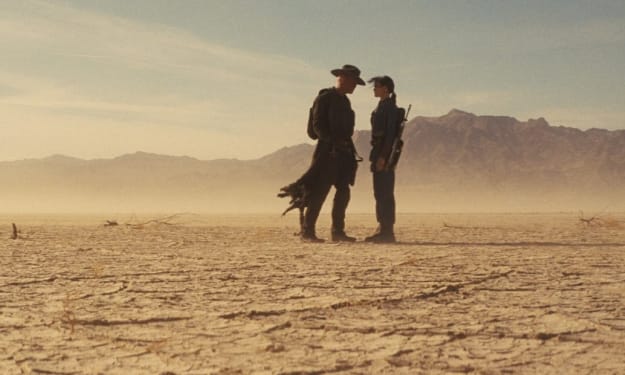
Let me dive straight into Fallout Season 2 Episode 1, and yes—this premiere is packed with so many easter eggs, lore drops, timeline twists, and pure what did I just watch? moments that we absolutely have to walk through it beat by beat.
By Bella Andersona day ago in Fiction



Comments
There are no comments for this story
Be the first to respond and start the conversation.