
The Visitor Who Never Left
Sometimes the ones we've lost find quieter ways to return.

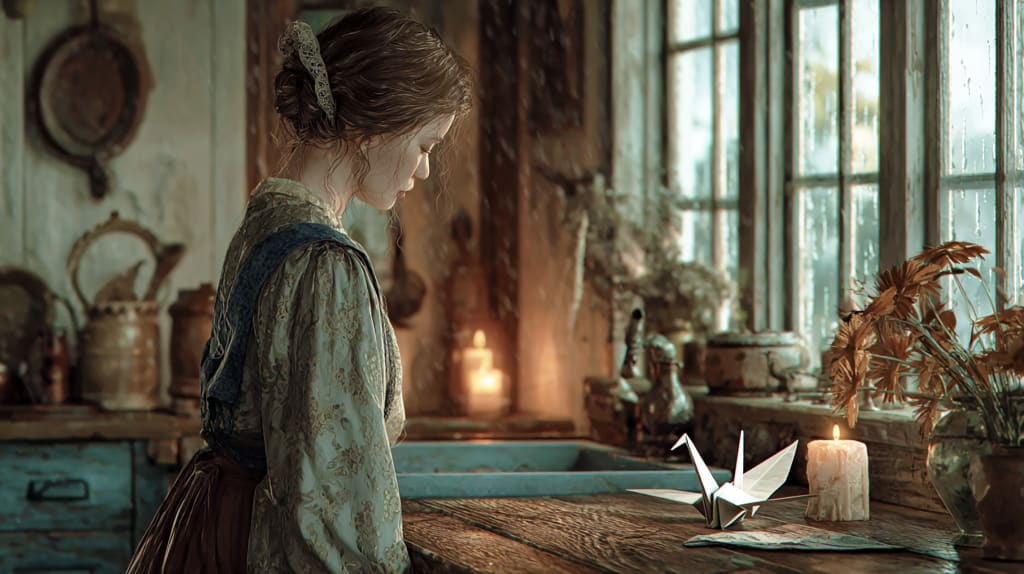
Rain has a way of making the house feel occupied again.
It softened the edges of silence, filled the gaps between the floorboards, and carried faint echoes of how the place used to sound—Julian moving between rooms, the low hum of his record player, the kettle beginning to whisper before it boiled.
Mara sat at the kitchen table, red pen poised above a stack of papers. She still edited his work sometimes, old essays and short stories he’d never finished. It was something between a ritual and a refusal. The habit of a teacher with no class, a wife with no husband, pretending that her mark-ups might still matter.
Outside, the rain ticked against the windowpanes. Inside, the clock on the far wall gave a small, apologetic click—five o’clock. Time to stop pretending.
She set her pen down, took off her glasses, and let her gaze drift to the door. Evening light pooled beneath it, dim and coppery. Somewhere in the walls, the old heater sighed. She thought about dinner, about how many days she could stretch the leftover soup, when—
A knock.
Not the wind brushing the siding or the loose branch at the corner of the porch. A knock.
Three deliberate taps.
Her first thought was wrong address. Then prank. Then—ridiculous, unspoken hope.
She hesitated, hand on the table, pulse marking time with the rain.
The second knock came softer, like an afterthought.
She rose, crossed the small room, and opened the door.
No one stood there. The porch glistened, its boards slick and dark. The rain had eased to a mist. On the top step, just below the light’s reach, rested a small paper crane.
It was folded neatly, the kind of precision Julian used when shaping arguments or trimming drafts. The paper was off-white, faintly yellowed, and the edges had begun to curl. She crouched, picked it up carefully, and carried it inside.
On the kitchen counter, she set it under the lamp. Its creases glimmered faintly with moisture. She could see writing—tiny lines of blue ink, almost illegible. She fetched her glasses, unfolded the crane slowly, careful not to tear the fragile seams.
Words revealed themselves in fragments, stitched across the paper like breath held too long:
It was the night before I left, and I didn’t tell her everything.
Some truths belong to the living, not the leaving.
Her breath caught. The handwriting—thin, slanted—was unmistakable.
Julian’s.
The words seemed to hum beneath the lamplight. Impossible, she thought. She’d boxed every manuscript, every note, every stray page months ago. She knew each one. But this—this wasn’t from any draft she remembered.
She read the short passage again, tracing the ink with a trembling finger, as though touch might explain it. The rain deepened outside, pressing softly against the glass.
A prank, she told herself. Someone finding an old note, folding it as a joke, leaving it here to stir an old woman’s heart. But who would do such a thing? No one even knew she still lived here.
She folded the paper flat and set it aside. Told herself not to make it more than it was.
Still, when she returned to the table, she found she couldn’t focus on the pages before her. Her eyes kept drifting toward the door, toward the place where the rainlight bent and pooled, as if waiting for something—or someone—to return.
That night, she dreamt of sound. Not music, but the quiet percussion of paper—folding, unfolding, folding again.
________________________________________
The Unfolding
The next evening arrived with a reluctant dusk.
Mara had told herself she wouldn’t wait for anything. She’d even gone as far as to stack the mail on the porch, just to prove she wasn’t watching the door. But she’d caught herself checking the clock too often, caught herself pausing when the refrigerator sighed or when the wind brushed the siding.
The mind, she thought, learns hope faster than it forgets loss.
When the knock came again—soft, deliberate, three taps—it didn’t startle her this time. She simply stood, wiped her hands on a towel, and went to the door as though answering an old friend.
No one. Only the sound of rain retreating into the distance. But there, resting against the threshold, was another paper crane.
This one was folded from lined notebook paper. The ink bled faintly where it had gotten wet. Her name curved across one wing in familiar script—“Mara”—as if someone had signed a letter and then folded it into flight.
She brought it inside, placed it under the lamp, and hesitated a moment before unfolding it.
I used to watch you read by the window, your lips moving with the lines. You never noticed how often I borrowed your expressions, how your silences gave me courage. Maybe that’s what marriage is—a long borrowing of light.
The words felt like breath on glass: temporary, tender, true.
She read them again. Once more, she could not account for how they had arrived—or who could have written them—but the warmth in her chest didn’t ask for proof.
By the third night, the knock had become part of her breathing. She tried to busy herself, chopping vegetables she wouldn’t eat, turning on music she didn’t listen to. When the knock finally came, a small smile betrayed her.
Another crane. This one folded from a page of old sheet music—the same Chopin piece Julian used to practice, though he never played it publicly.
You said the house was too quiet without music. I thought silence was enough. I was wrong. You were right—it isn’t the notes that haunt us, but the rests between them.
The words loosened something inside her. For the first time since he died, she spoke aloud—not to the air, but to him.
“I know,” she said quietly. “I know.”
That night she left a candle burning near the door. In the morning, she found a small scorch mark on the brass handle, as if someone had touched it gently from the other side.
________________________________________
Over the next week, the ritual deepened. Every evening around the same hour—between rain and twilight—the knock came. Each crane was unique: torn journal pages, fragments of drafts, once even a napkin from the café where they used to meet.
Each carried a fragment of confession, regret, or gratitude. Together, they began to form a kind of story—not of death, but of unfinished conversation.
I loved your certainty more than my own ambition.
The hardest part of leaving wasn’t dying—it was realizing how much of me remained in the things you touched.
You kept my words alive, and in doing so, kept me honest.
She began keeping them in a shallow wooden box on the table. Each crane unfolded, pressed flat, labeled with the date and time of arrival. The old habit of cataloguing soothed her. It made the impossible feel like something she could study rather than lose herself to.
But one evening, no knock came. The hours lengthened; the silence thickened. She went to bed uneasy, the window cracked, listening for something that didn’t arrive.
The following morning, a sound woke her—a dull thump at the door. She found not one, but two cranes.
The first was blank except for one short line:
You’re learning to listen.
The second carried his name alone—no message. Just Julian, written with the same fluid hand that used to sign her birthday cards.
She set both cranes beside the box and pressed her palm to them, as if to feel the heartbeat of paper. For a moment, she imagined she did.
________________________________________
The days that followed felt strangely full. She found herself humming while she cleaned, taking longer walks, cooking meals instead of reheating soup. The air seemed changed—more companionable.
One evening, she caught herself laughing aloud when she misread one of his lines. “That’s not what you meant,” she said, correcting the phrasing automatically. Then she froze, startled by how natural it had sounded—like old times.
The laugh lingered in the room even after she fell quiet.
That night, the knock came late. She’d almost given up when it sounded—two slow raps, then one final, softer tap. She opened the door expecting another crane.
But the porch was empty. Instead, hanging from the light fixture, she found a single white feather, damp from mist. It wasn’t paper at all—something real, weightless, and ordinary. Yet when she brought it inside, she noticed faint blue ink along the edge of the quill:
Tomorrow.
She placed the feather beside the box, heart steady but bright. Whatever was coming next, she would be ready to open the door.
________________________________________
The Final Crane
Morning opened like a held breath let go.
Mara brewed coffee, set a second spoon beside the cup before realizing what she’d done, and smiled at the habit. The house had grown companionable in its quiet.
She stacked the flattened cranes in order, the white feather resting on top like a bookmark between worlds. Sunlight gathered shyly at the curtains’ edge. She wasn’t waiting, she told herself—just listening.
By dusk she’d lit the candle near the door, the window cracked to the mist. When the knock came, soft but certain, she was already standing.
On the middle step lay a crane unlike the rest. The paper was warm cream, faintly stained with coffee rings and blue ink bleeding through—her journal paper. Her pulse quickened. She’d ripped that page out after the funeral, unable to bear the words she’d written in anger.
She carried the crane to the table and unfolded it carefully.
I’m angry at him for leaving well. He told me the right words and I needed wrong ones. I needed the mess—fear and pleading and the promise to keep trying.
The rest of the page wasn’t hers. The handwriting shifted, steady and slanted.
I wasn’t brave. I was terrified and pretended not to be. I thought sparing you meant strength. I see now it cost us the honesty you trusted more than comfort.
She read once. That was enough. The world tilted, rearranged itself around the ink.
If I could rewrite it, I’d fail better in front of you. I’d let you see me afraid. I’d tell you about the pages I hid—the ones where I begged the dark to slow so I could finish thanking you.
The sentence broke mid-curve, the ink fading like breath. On the back, a single line waited along a fold:
You’ve always known how to finish what I couldn’t.
Mara sat perfectly still. The house listened with her. Then, softly: “Julian.”
The word steadied her hands. She flattened the page, slid it atop the others, and left the box open. The candle flame shivered but held.
________________________________________
She took her seat at the table and opened her laptop. The blank document glowed—a promise, not a void. Her fingers hovered.
For a moment, she thought of everything unwritten between them, then began to type.
Not at the beginning—there are few true beginnings in a lived life—but at a place that felt honest: the morning she’d met him at the café with a book she pretended to read. She wrote the beautiful and the unbeautiful, the light and the noise. She didn’t try to explain him or herself. She wrote what the air had held and what silence had not.
Hours passed unnoticed. When she paused, the candle had burned low, and dawn was already brushing the windowpanes. She stretched, refilled her cup, and returned to the keys.
The words came like breath—sometimes shallow, sometimes sure. She wrote the paragraph she’d never been brave enough to speak: This is not a story about grief. It’s a story about continuation. She let the line stand.
A faint click at the door made her look up. Not a knock—more like the latch testing itself. She rose, opened it, and found a single crane waiting on the step.
It was smaller than the rest, folded from the torn corner of a manuscript page, the kind Julian used to scrawl titles on. One word curved across a wing: Thank.
She held it a moment, then smiled. “You’re welcome,” she said, setting it beside the feather. The house seemed to breathe with her.
The morning light deepened. She opened the window wider, letting the breeze move through. It stirred the cranes on the sill until one lifted and drifted to the floor, sliding toward the door in a path that felt both random and deliberate. Mara didn’t stop it.
The crane slipped through the crack beneath the door and vanished into the new day.
She stood there for a long while, watching sunlight reclaim the porch. The quiet that followed was full—not absence, but presence made gentle.
Turning back, she saw the page on her screen waiting for her to continue. She saved it under one simple name: Ours.
When she closed the laptop, she whispered into the room, “I’m here,” not as a wish but an answer.
The breeze stirred again, lifting the feather in its saucer just enough to prove it had heard.
About the Creator
Rick Allen
Rick Allen reinvented himself not once, but twice. His work explores stillness, transformation, and the quiet beauty found in paying close attention.
Keep reading
More stories from Rick Allen and writers in Fiction and other communities.
Where the House Keeps Secrets
Michael had owned the house for seven months before he went near the attic. It wasn’t fear, exactly. Not then. More like… reverence. The way you walk quietly through an old cathedral even if you don’t believe in God. The attic was part of the house’s spine—old beams, warped boards, a ceiling door with a brass pull-cord that swayed when the windows were open. He passed it every morning on the way to the shower and never looked up. It felt respectful not to.
By Rick Allen4 months ago in Fiction
If You Love Me, You'll Do It
I met Jason when I was five years old. I could say that I loved him from the moment I saw him. He was so handsome to me and I felt in awe by his presence. When they introduced him as the new kid in school, I wanted to be his friend right away. I remember it like it was yesterday. I remember his smile and how he didn't seem shy. He appeared confident and ready to learn. I waved at him and said "hello," before anyone else could even say a word. He sat next to me, and I asked him if he wanted to be friends. He looked so happy as he said, "Yes!"
By Sidney Smith (Sid Smith)7 days ago in Fiction



Comments
There are no comments for this story
Be the first to respond and start the conversation.