
"There weren't always dragons in the Valley." The Wrangler fiddled with the brim of his hat, shifting his weight from one foot to another as if the dirt beneath him compensated for his own discomfort. "Until recently, we were only permitted to breed 'em in the Northern regions. Real remote, like."
"And? How much?"
A twilight grin graced the man's lazy, sun-weathered expression. "Nothin' at all. Consider it a family favor."
It was Fella's turn to smile, now. "I'd embrace the devil as my brother before I did you, Adi. And I'm damn sure he'd be warmer."
"Guaranteed, it's hotter in that direction. Pray the winds don't take you that way."
"I prayed they wouldn't take me here, and yet our paths cross."
"You ain't prayin' to the right gods, then." Adi turned to the pasture, if it could really be called that—it was more a collection of large boulders, occupied by the residents of the Valley—dragons. "But this... this ain't a bad place to start."
"What? Prayin'?"
Adi shook his head. "To find a new set of gods."
~ ~ ~ ~
Nineteen years ago, my sister disappeared. She was chewed up by the ocean's foamy maw and swallowed. They told me she sank away, almost quietly, as if visiting a lover in some other town. But I know that not to be true. Since when has a death at sea ever been complicit in anything except the violence? I know the water. I know the six who returned, would never know all seven who left. What terrorized them more? The gargling sound of wet, filling lungs, or the doomed silence that came after?
I hadn't been alive then, of course. I had known nothing of the world or the peculiarities of its horrors, and while a part of me hoped to remain only intimately aware of its mundanity, the other part of me thrashed violently against these bounds. I longed to know what lay beyond the low-lying stone walls that bordered our little coastal town, with its mossy, decaying one-tiered houses, and its feathery, nettle-lined thickets. I was so drunk on peace, in all its vulgar and comforting quiet, that a singular disturbance in the town would ripple through me like a deep wound, infecting my flesh in a way I could not whittle from my bones. Not really.
My mother had been a singer long before she had met my dad, but a shy one. Her songs were mostly reserved for the home, never above a hum, but by the time I was eight, I would hear her often and joyously. The sun would be sinking into the sea, weighted as a rock, and her voice would rise out of the hazy dusk, languorous and syrupy, the kind of voice I associated with folk tales and smoke-riddled fire. Later, I would hear my father’s, a keening, rough baritone, and they would tangle together easily—two solo singers on opposite sides of the house—weaving a tale that seemed torn by two worlds, one of which I would never understand. Their voices were the soundtrack to my life; I would gut fish and chop wood and lie in the meadow grass that bordered our house, feeling myself split into two people and become one again.
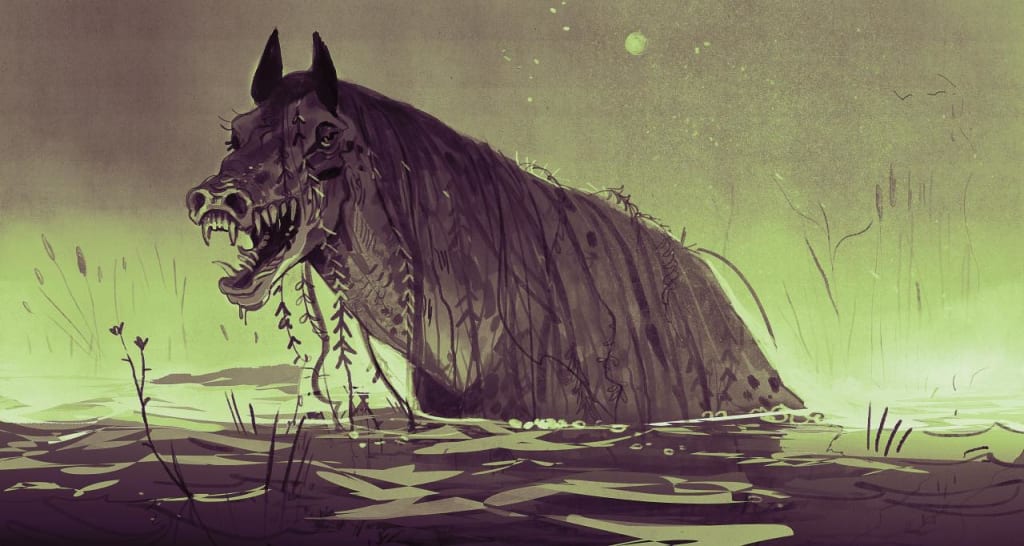
I never saw my father in his kelpie form, though he wasn’t secretive in the least— rather, reserved—and would tell me anecdotes I supposed were from his past life in the form of tiny fictions before bed. I savored these and resented sleep because of it. He told me little of the kelpies themselves, but plenty about the stock of characters who lived in the woods: I recall the little girl who had been raised by bears, who seemed immune to the cold despite her nudity, who emerged from the hollow dredges of hibernation as gaunt as a wraith, whose incisors had sharpened and elongated as if her human form had yielded to the essential bear-ness of her, whose eyes gleaned in the forested dark.
“She ran ahead of the bears,” My father told me. I stared at him, seeing cloudy figures running through the dark glass of his eyes. “She was faster than them, swifter and quieter. As much as they protected her, she protected them. You see, there is no "giving" in the forest: there are only deals and agreements, things to be mutually gained, losses to be gambled. The forest is not the human domain, my little seal. Its tenants expect to be returned what is given, just as the seasons give back the rain, or the sun, just as the forest tucks away its bramble-berries and rabbits and reveals them as a tithe when the snow melts."
I loved my father's explanation for the inner workings of the brush, since the more he made it seem entirely unhuman, the more it appeared to me that humans were simply emulating the rhythms of the forest. We had the same systems of debts and receipts and were at the mercy of the same brutality of the seasons. The only difference I had garnered was that humans could lie about what was owed—or what was paid. Humans could steal. But I still wondered if anyone could truly avoid the consequences of the things they'd done. I still hadn't found out.
My father continued, "In the nearby town, the villagers spoke of her but only in caution: if you see the wispy shape of a lass beyond the tree line, avert your eyes and move on, with haste. She was a prelude to their presence.”
"You don’t think she wondered about how she might’ve lived? As a human?” This was the kind of question I asked a lot, a demonstration of my naivety, my wish for inclusion. Other children explored the bounds of their physical prowess, their social skill, I prodded at the bounds of my humanity and the creature that had yet to begin strangling me from the inside out.
My father had only smiled, a little sadly, I had noticed. “There is no language in the woods for how humans live. All of us come from the wild, from the sea and the soil, but some of us are claimed by it. No matter how she studied them, I'm sure some part of her knew she would never understand it.”
“And Marcy? Was she reclaimed by the woods?” I asked quietly, childishly, feeling like I was begging for a scrap of the sister we never spoke of. Again, inserting my life into these stories.
I could see my father hesitate, as if struck, but he merely glanced down at me with his warm, river-black eyes.
“No,” He said hoarsely, “your sister was claimed by the sea.”
When my father died, my mother and I moved back to the village where she had grown up. His death had been anticlimactic in comparison to the way I had seen him (as an ancient, god-like being, as my father, as my mother’s heart). In the end, he had simply withered away, some unknown illness that had eaten at him until he died. He had never shown signs of any particular ailment except for his physical wasting: his appetite hardly dimmed, he ate heartily and well, he read to me, he sang and walked with my mother. But the circles beneath his eyes grew darker, his wrinkles more pronounced. He grew hollow and weary. I could hear my parents having conversations late at night, and my mother’s tone was pleading, if not outright begging—but I never heard what was being discussed. I simply saw the shadow of my father shaking his head—no—and his arms embracing her as she cried: damn you, damn you.
Now that I am older, I no longer believe that a kelpie can simply renounce their immortal form: not for love, not for children, not for a shot at placid domesticity. I believe that a wild creature divorced from the wild simply decays and dies. I know now that the bear girl may have wondered from the treeline about the curious, daunting lives of the humans that so looked like her, but there is no reality in which she is neat and clothed or sipping fragrant tea by a well-tended fireplace. She is either out there, incisors tearing flesh from bloody bone as the cold wind perfumes her with balsam and sings to her of spring, or she is dead. And Marcy? Marcy must be alive, having been returned to the essential truth of our father—the water, the frigid, dark water.
My father was returned there too. We bundled his body in cloth, a quilt my mother had made, and anchored his body with books and trinkets he had adored. When we moved his body to the wooden dingy, it had jangled with the weight of all he had accumulated, all the love for our little human lives he had distilled into objects. We rowed into the choppy waves, the permanently angry ocean, and together, we hauled his body over the side. Ceremoniously, he fell away into the deep, the bundle of my father sinking out of grasp, out of sight, and the trail of white bubbles that came streaking up to the surface made me believe all of his stories. In his own voice, my father dissolved into sea foam, leaving the quilt to drift easily through the ocean, his possessions burying themselves in the calm and silent sandbed. And though we knew he was from the sharp, crystalline waters of the mountain rivers, with their glassy pebbles and sweet taste, this, too, was where all water returned: the sea.
That was all years ago, now. But unlike my sister, my father never sank into obscurity from my mind. I wondered constantly about the kelpies. I raged for a piece of my ancestry the way some must desire blood, or water. I had never met another like him or like me, half-breed that I was. My mother was no use to me now, cruel as it is to say, my childish curiosity distilling to teenage frustration, to rage: she was no kelpie. She had no secrets to reveal to me. But it took a while for me to realize my father was not like his kind. It took meeting Tilli.
Beside me, Tilli suddenly sat up straight, his eyes searching the impenetrable dark around us.
“What is it?” I demanded, annoyed by his consistent secrecy, his ability to talk my ear off about entirely trivial matters and simultaneously withhold the important. I would’ve been unnerved by his gaze had I not been my father’s daughter: his eyes caught no light, none at all, not even the sliver of moon that wrestled its way down from the thick canopy above. Even just below the surface of the water his eyes seemed to absorb everything, two vacuous spaces where nothing else lived, two perfectly black stones on a pastel riverbed.
“Quiet,” He snapped in response, and I could almost see his ear twitch in searching, though I know that was mostly my own perception, unable to separate him from his equine self.
I narrowed my eyes in the dark, too, though my vision was not as adept. Being with Tilli had awoken some piece of my father’s curse in my blood, as though all of his repressed hunger, decades worth, had been passed down to me. I had begun to feel it shortly before I left my mother’s village, (I thought of it that way though I had lived there for five years post my father's death—those years were enough to tell me I was not one of them, however pleasant that time had been). I had been a well-behaved child, for the most part, but I began seeing visions of dark, deep water, festering with blackened, tentacle-like kelp. Slippery, flaccid livers the color of blood clots nestled between coastal rocks. Dune grass that became horsehair that became clumpy human hair, floating on the water like seabird nests. First, the images invaded my dreams, then my waking life. They were often accompanied by a sound I still have trouble describing, but rouses in me a starved and frothy violence: like a thousand screeching gannets, funneled at me from afar. This sound was so overwhelming that, in my desperation, I had once thrown myself into the ocean bordering the village, hoping the frigid shock of it would quell the assault on my mind.
To my surprise, it had. Despite the water’s apparent rage from the surface, below it was nothing but calm, blessed silence. The water wrapped around me, and at once I felt the urge to remain there indefinitely, even as the warmth seeped from my bones. I opened my eyes underwater for the first time, blinking tears, and found I could see well, that the salt did not sting. Below me, soft, tuberous anemones swayed as if cradled, little fish followed me with practiced synchronicity, and crustaceans regarded me with narrowed eyes, as if I had rudely intruded on some private engagement. I began to laugh, little bubbles emerging from me like hiccups, and felt pulled by the current to swim deeper, to see what was on the other side of the void-like drop-off. I felt like a seal, flexible and swift, spinning in little circles for the joy of it all. I felt like my father was just there, at the edge of the drop-off, just beyond the busy reef. I knew if I could just peek over the edge, like a child considering the height of a cliff, I would see him, his sea-marbled face and new-moon eyes, scrunched by his smile. I knew a kelpie could never be drowned. I knew they were immortal. My father could never die. My father could not have died. I knew—
I was suddenly wrenched from the water by my legs, kicking and screaming and clamoring like a snagged fish. The air awakened all my senses; I was shivering violently, heaving seawater that spilled down my chin in rivulets. I was bawling like a baby, wailing, horrible animal sounds I’d never heard from myself. To be ripped from that quiet place was to be cruelly born again, and when the saltwater drained from my eyes, I saw that half the village men were standing in the tide, shock encrusted on their wind-beaten faces. My mother stood on the hill, crying. One of the other kids had seen me run off and throw myself in the ocean like a man possessed. Apart from the fishermen, they had never touched seawater, having known of the eddies, the foul currents, the lore of water-horses, the stories of disappearing folk and washed-up livers with no bodies.
My father would have told me that I was being compelled to the water by the ocean’s song. I had come to the conclusion that I was being compelled to insanity. Either way, he was gone; I had no one to assure me.
And in a way, I was right. My visions are less abstract now. Now, I lay awake and listen for it, the ghostly gannets, and in my head I see my body becoming an extension of the water itself: my long hair become tangled, sand-riddled mane, my jaw unhinging into a wolf’s maw, flesh and sinew rearranging until I stood anew on bony hooves, gazing at the night with my kelpie’s black, black eyes.
“They’re here,” Tilli said, and for a second I met my gaze in his own. “Get up,” He hissed, and my limbs came alive, scrambling out of my sleep-sack. I gripped Marcy’s scythe in my right hand.
Footsteps approached in the forest, clumsy ones which could only be logged as human. Twigs broke underfoot and I heard a faint swearing beyond the shadows. I lit a candle, standing atop the matted fur of my makeshift bedding. A young boy emerged from the shadowy foliage, the light making his face look more angular than it was. He was hardly older than I was, a teenager, naive on the cusp of adulthood.
“The payment?” The boy asked, glancing around the small semi-circle of a clearing, just wide enough for me to lay down. The trees seemed to lean towards us, listening. Tilli had disappeared.
“You’ll get it,” I answered gruffly, unflinching. I had lowered my voice an octave, tucked my hair beneath a woolen cap I had stolen.
The boy paused, sparing another look over his shoulder, and when he was satisfied the arrangement was observed by only me and the forest gods, produced a wrinkled piece of paper.
“The directions. To the entrance of the Valley.” He steeled himself. “You don’t know what this cost me. People have been beaten for merely speaking of it. It’s been privately owned since the Northerners started their whole operation down there.”
“Let me see it,” I demanded, and the boy yielded easily, handing the paper to me as he cast his eyes upon the ground. It had been crumpled in his pocket and torn, and a crude line had been drawn from the closest town to the southwest edge of the Valley’s cavernous length. My gaze flicked between the paper, hungry for answers, and the boy’s stupidly hopeful expression, which was only thinly masked behind his poor attempt at a scowl.
“It’s fake.” Tilli stepped out of the dark forest into the candle’s reach, looking even more foreboding with his spindly, unnatural figure, his inhuman grace. The boy startled with a soft yelp. I hadn’t even heard him approach. “True old maps don’t smell like coffee. They’re stained with sweat and grime. Dirt and blood.” Tilli loomed over him and the boy erupted into a fit of shakes, the sound of his teeth clacking absorbed by the foliage. Tilli’s long, black hair delicately brushed the boy’s face as he reached over and snatched the map from my hands, glossing over it with murmurs of false approval. “And real maps don’t lead their navigators straight to the cliffs. Isn’t that right, boy?” The last part came out as a purr—a gravelly, undulating purr. I imagined the cat-poachers of the East heard the same sound before they were swallowed whole. The sound of prey overstepping in a predator’s arena. “So what was it, then, that caused you to waste our time? The promise of a quick payoff? A chance to rip off some moronic travelers? Did you think your sloppy ruse was so good you might return home with a full heart and fuller pockets?”
“No, sir.” The boy was weeping in a controlled way, as if attuned to being beaten, as if he could sag his shoulders, make himself smaller, and slip away like a rodent. Snot tangled with tears and ran onto his lips. “Please. Please.” I don’t know what he was begging for. The nightmare had not even begun, for him. I had seen this countless times by this point, no longer the child who had thrown myself into the ocean to escape the perceived psychic violence of my heritage. Now, I simply watched.
“Mac. Ask for Mac. He’s one of the only ones who know where to enter the Valley. It’s famously guarded. Those cliffs are impenetrable from all sides. Of course we wouldn’t know how to access it! You’d be run through for merely peering over the edge!”
“Family name?” I interjected, and the boy flinched at the sound of my voice before he seemed to pull himself together.
“I don’t know. I don’t know. He just goes by Mac. He stops in town sometimes but he never stays. He doesn’t talk to nobody. Low-brim hat, clean-shaved, leather riding chaps. He goes straight to the butcher-boy and leaves. Someone else picks up the order.” The boy was calming as he spoke, as if subduing our anger with the currency of his words. But it wasn’t enough. We’d been promised a direct route, not some convoluted chase over a man who could be entirely falsified. Tilli and I agreed we’d rather avoid a confrontation, but it seemed our journey here had been littered with them, again and again and again. And here we were presented with two more: “Mac” and the boy, whose name was unimportant, forgettable.
“How old are you, boy?” Tilli’s tone was undecipherable. But I knew he had no reason to toy with threats. I knew his nature because it was in me, too. The hunger of the kelpie was immutable.
“S-Sixteen, sir.”
So the boy was my age. His voice wobbled.
Tilli made a murmur of acknowledgement. I knew it was impatience. The boy seemed momentarily relieved. “You humans live such short lives. And yet— they can be shorter.”
I looked away. I didn’t want to see Tilli’s face split into jagged teeth, which reminded me of death laying in the splintered rocks below a prophetic, uncaring lighthouse. I didn’t want to see the knowledge of the end ripple through this gangly teenage boy. I didn’t want to see the blood that would fertilize this clearing, or think of the trees that would grow from it and scrub this place away entirely.
The boy began to scream, keening and helpless, over and over. The boy’s screams dissolved into the sound of crying, hungry gannets, all calling, all telling me to drag the body to the water and devour. I started walking away from the clearing, towards the nearby brook. The babbling would soothe me and drown out the sounds of struggle, what little there would be. I needn’t be gone long. Tilli was efficient in that way. I did not see Tilli as evil for this, either—he simply had not made the promises my father had held so dearly. He had to eat, after all—does the deer think the bear evil for surviving? What am I, then?
The forest was quiet again. I thought of my mother on the hill that day, watching them reel me in from the ocean, newly feral and half-frozen. She had seen it then: seen what I was born to become. Her tears were weighted by the inevitable. I turned my attention back to walking. Tillie would find me when it was over, and we’d keep moving.
I knew by morning, the forest would be peaceful and sun-speckled again, the brilliant dawn light shining upon a wet liver, too small to yet be an adult’s, left nestled in the fallen leaves by the water’s edge.
~ ~ ~
Mac tilted his hat down further over his eyes, his mouth pursed shut in a thin, grim line. It had taken a while to get used to the heat, the sweltering sun that did not exist in this capacity in the place where he had grown, the utter lack of sea or loch or water beside the shallow creek at the base of the Valley’s canyons. The dragon beneath him grunted and rasped, flicking its tongue out impatiently, its long nails clawing at the dusty red dirt. He shifted in the saddle. Patrols were nearly always uneventful: while the Valley itself generated much curiosity, especially to the activities that were concealed within it, the townsfolk did not venture close to the edge. The rumors that circulated were not rumors—occasionally, someone would “fall” over the side of the cliff and was lost to the dragons’ indiscriminate appetite. They would eat anything that fell or landed down there—birds, sheep, cattle, people, but were otherwise lazy beasts who preferred to bask and melt in the god-awful heat. They were wingless creatures and decent climbers, but not so proficient that they could scale the length of these cliffs. Every so often one would sneak out of the Lower Basin, but it was quickly rounded up by the concentrated patrols there, prodded by the butts of their spears back into its long, narrow habitat.
This dragon was assigned as his personal steed for the sole purpose of patrol; the rest, below, were bred to be bought and sold. The saddle was worn-in well, molded directly to his legs after long hours in the sun, the horn of it decorated with a single object: a thin leather cord adorned by a small white riverstone. On the back of it had once been an inscription, chiseled painstakingly by hand, but the words had since worn away and become illegible. By habit, Mac picked it up, cradling it in his palm as his thumb brushed the faint grain of the words. He assumed (hoped, burdened by the despair of the alternative) that the pair who had gifted it to him were long dead, but he still remembered what it said: To Marcy, with all my love.
About the Creator
Nines Hearst
Writer. A coyote in human clothing. Collector of red lighters. Profile art by Brian Luong.
Reader insights
Outstanding
Excellent work. Looking forward to reading more!
Top insights
Compelling and original writing
Creative use of language & vocab
Excellent storytelling
Original narrative & well developed characters
Eye opening
Niche topic & fresh perspectives
Heartfelt and relatable
The story invoked strong personal emotions
Masterful proofreading
Zero grammar & spelling mistakes
Keep reading
More stories from Nines Hearst and writers in Fiction and other communities.
Long Night
I haven’t seen the foreign sun in months. It wasn’t mine, but it was better than nothing. And now there is nothing. From the comfort of the climate-controlled embassy, I watch the shadowy figures pass my window, their edges blurred by the late winter squall. It’s easy to tell us from them. We hurry home in the winter—wearing anything less than a pressure suit means hypothermia in minutes and death in under an hour. They stroll, meander, stop to throw snowballs at each other. All Alwa’an seem to have snowball fights in common, at least. Or maybe what we actually have in common is senseless violence.
By Rosie Ford a day ago in Fiction



Comments (3)
Your writing is beautiful. Its like you wrote a story out of song lyrics. The subject is unique and well thought out and I wish there was more. I have a lot of questions about the story and where it’s going.
You have such a gift for imagery and atmosphere. Eerie, unique, gorgeous storytelling. I would gladly read a few hundred more pages of this story. All the best to you!
What a wonderful story! Beautifully polished prose and a set-up that definitely makes me want to read on and find out what has truly become of Marcy.