
It's Not What I Want
But it's the choice I've made.
It is raining.
My grandfather is meeting with a potential client, which means I've been exiled for the time being from our little one-room hut on the temple grounds.
Which is fine with me. I'm quite content to sit outside the door, swinging my legs over the side of the front deck, watching the world come alive at dusk. The rain hammers down, knocking at the earth's door, and its answer comes slithering from the mud--creatures writhing in the wet grass like tiny serpents, mouths agape for a drop of cold water.
I glance over my shoulder, looking through the half-fogged window. Candles flicker in the room, enough light that I can see the shadow of their lips moving, my grandfather's reverent nods. It is likely that they will be some time yet. The decisions they are discussing are not ones to be made lightly, and are often a last resort. This client had barely made it through the door, and I wondered how she had made it up the hill, even with assistance. They come alone, always, as is my grandfather's policy--he insists that this choice belongs to no one but them.
If the dying are robbed of one thing, he says, it's their autonomy.
And kids too, sometimes? I asked, still feeling robbed, though I cringe now at the reaching comparison.
And kids too, sometimes, he nods.
With the knowledge that this meeting wasn't ending anytime soon, I grab one of the twenty umbrellas parked by our door (none of them are ours, clients keep leaving them, forgetful in their grief) and slip off into the night. My boots squelch as I tromp through the mud towards the building to the right of the temple, affectionately named “The Barn” due to its traditional thatched roof and wooden-slat walls. It is one of four, all built for the same purpose. Despite my dubious feelings aroung the straw roofs, they are the warmest and driest buildings in the winter.
Leaving my boots at the wooden steps, I walk barefoot through the covered walkway into The Barn. There are candles lit in here, too. The room smells of fragrant tea (jasmine, I place it as jasmine) and bitter greens. Closer to the shrine, it is cloudy with incense. It used to sting my eyes and trigger my cough, the incessant wisps of smoke, but I’m used to it now.
You would think that coming from the city smog, I’d be fine with the smoke, but anyone can get used to cigarettes and exhaust pipes, factories belching fat plumes of desecrated clouds. Somehow, it is harder to accept that you care about the fresh air and the calm, because that implies the other things do bother you, and in the city, they don't stop.
Desensitized, that's what my school counselor said before I left. That I was desensitized. She said lots of kids are, here. That it’s noisy and grey but somehow we bloom anyway, like stubborn dandelions in the cracks of the sidewalk. That we make do. But if she wanted to plant metaphors, I had one for her, too: we're all landmines, and you either learn to temper your fuse, which no one teaches you, or you blow up. She didn't like that one.
And she used that word: stubborn. Like it was a good thing. Yet I'm sure I've seen them spray weed-killer on the small patch of dandelions in the schoolyard before they turned white, lest any wishful kids try to blow those festering dreams across the tiny plastic playground. As if they'd have anywhere to land.
She told me to think of childhood as a metamorphosis, then, a winding of my cocoon that would later present me to the world as a fully-grown adult. Who would that adult be? Where would you fly to with those new wings?
I barely know how to be a caterpillar, I said.
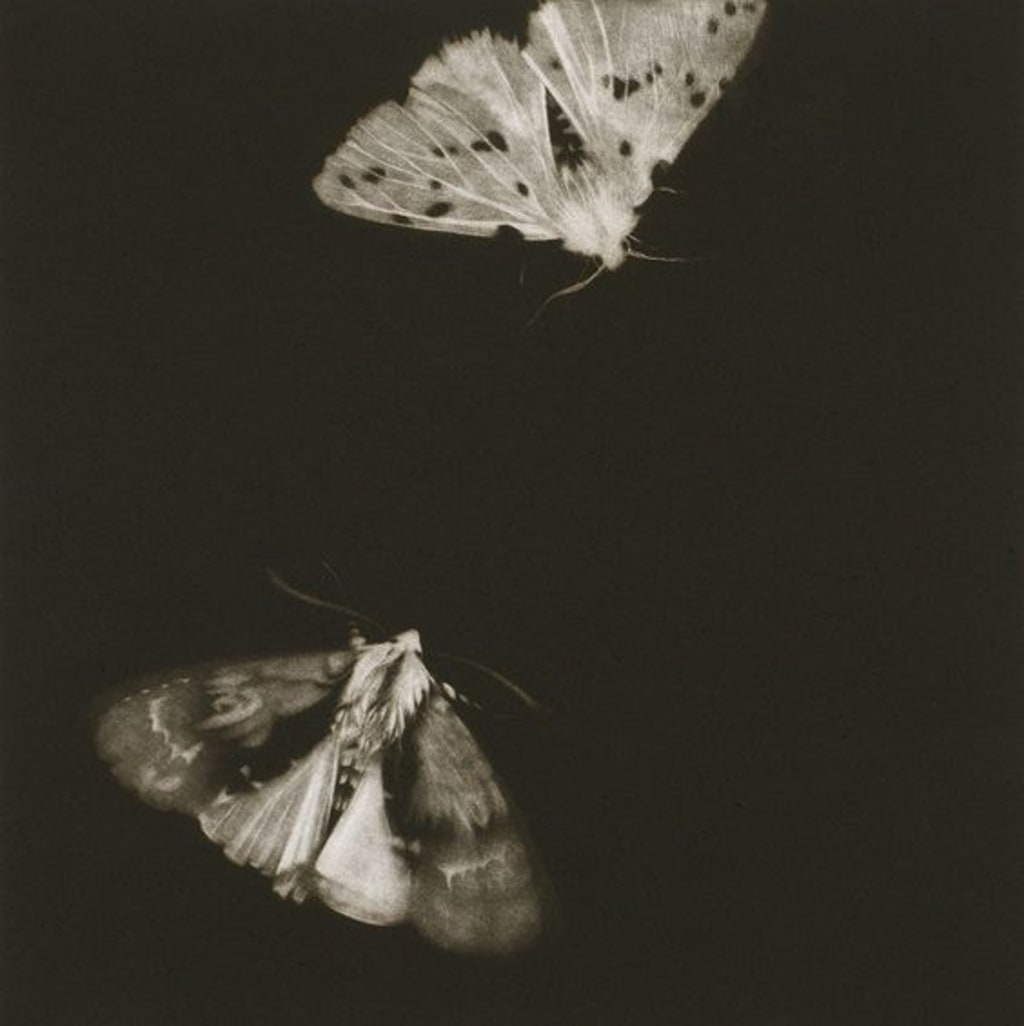
The shadows of stewards move back and forth along the casket-like tables, their long robes sweeping behind them like long, butterfly's wings, tailored in a simple beige silk. A creamy-white lining peeks out from beneath the robes' otherwise plain exterior. Despite the length of their robes, the stewards move as if they are floating. There is so much fabric gathered around their hoods that I rarely see their faces, just the occasional flash of pale skin and muffled features. They gave me the creeps at first, but I soon became far more grateful to have company in this silent, reverent room, dotted with rows of table-mounted caskets. Speaking is forbidden inside these buildings as my grandfather says it disturbs both the 'worms and the resting. I've come to savor this excuse not to talk, and the stewards have now become as much a part of this room as the incense and the heat.
I peer over the closest table. I know what I will find, but it fascinates me all the same. A vague, body-like outline rests upon the linen cushions that line the raised box-tables. They really are like caskets. The shape inside is coated in mulberry leaves, plastered on with a starchy rice glue. And upon the fresh, mossy-green leaves, crawling across the body like maggots, are the silkworms: white caterpillar-like creatures velvet and soft to the touch. They are awake and restless, chewing urgently upon the leaves. The quiet chirps of the nocturne and the humidity have energized them. I feel the same, awake in a way I never am during the day, my skin dewy in the fine mist of all this water in the air.
"Please," I had begged them, my mom and the school counselor and the dean, my only 'supporters' now allied against me in a menacing trio, "It's not what I want." My skin crawled. My legs felt restless. The silence of the office roared in my ears. Distantly, very far away, I could hear someone tapping on a keyboard, like a dripping faucet.
Tap. Tap tap. Tap.
"It's not what any of us want," The dean had answered, watching me calmly, but I couldn't meet her eyes because I could see my puffy, ugly red face reflected back at me in her glasses. "But it's the choice you've made."
Tears stung my eyes, embarassment at this reaction stung me further. I tried to breathe and be a butterfly. I tried to breathe and be a caterpillar. But if ever there was a metamorphosis inside me, it was now.
My frustration boiled over and I let out a raging cry, grabbing a handful of the neat little papers on her desk and throwing them at her, handful after handful, the pages flapping wildly in the air like a cloud of feral pigeons. I couldn't even see the three of them anymore, surrounded in my own little snowstorm, a blizzard I had summoned into this grey, hopeless purgatory I couldn't bear to leave. I reached again for the desk, blinded by the paper moths and the lawless injustice of it all, my fingers wrapping around something metal and cold.
Someone grabbed me from behind, their hands coming up under my armpits to secure me by my shoulders, and the rage became panic and then rage again, and I brought my metal fist down upon their thigh, and their hip, and the soft flesh of their abdomen. I felt the sharp heel of the metal connect with something dense and unyielding, the reverberation of it traveling up my arm and through my attacker's bones alike, ringing in us both like the clash of a silent gong. A dissonant chorus of screams rose up around me, although I do not know how much of it erupted from my throat or theirs. It was only when the arms released me and the papers began settling peacefully upon the furniture that I slumped forward, the heavy stapler unfolding from my grasp and clattering to the floor. The counselor kneeled behind me, but I didn't really see her, just the vague shape of a body doubled over in the periphery of my vision, low moans spilling from her mouth.
After all this time, I'm still unsure of what choice that was, exactly.
You can tell when a client won't make it, because the silkworms start to cocoon the body, a last-ditch effort to make the weak strong. A full-body transformation, like the one I couldn't find inside myself. I had no idea you could outsource the task quite so literally.
The stewards are carrying one of the boxes down the aisle towards the door to the backrooms, a small outer attachment to The Barn. I do not know what they do back there, only that the people who do not make it are donated to the temple.
I catch a glimpse of the body nestled inside as the box tilts backwards onto the stewards' shoulders, the person no longer visible. They are shrouded in a white cloud, a thin layer of many strands of silk, mummified. They rest upon a blanket of shriveled mulberry leaves. A couple dried-out husks of silkworms roll out onto the floor before the box is righted and the person carried away. The nametag reads "Oyamada, Tatsuo". I remember him from last week. He had little round spectacles and a goatee that accentuated his kind smile. I watch the cloaked stewards sweep him away.
"Your mother called," My grandfather says through mouthfuls of rice porridge, pausing to swallow. "She said she misses you, and was wondering if you wanted to return home soon. You've been here nearly a year now."
A year? I think to myself, listening quietly as I pick at my own breakfast. Have I been so distracted that I lost track of time? It feels as if it's only been a few months.
"Open enrollment for the other school in your district begins next month," my grandfather continues, his eyes flicking between me, the bowl in front of him, and a partially-unfolded newspaper to his right. It looks like an old copy. "If you're interested in going back, you should let her know soon. I can always come visit you in town, little bird."
I shook my head vehemently, my own reaction surprising me. Hadn't some part of me yearned to return this whole time? And yet, the thought of leaving the warm rooms of cedar smoke, the perpetual rain, and my grandfather's trusting, laissez-faire attitude wrenched at some deeply-woven panic in me. Besides, returning to the city only to go to another school may as well be its own form of exile. "This is my home now. She can come visit me here."
My grandfather smiled, setting his spoon down. The expression did not quite meet his eyes. "You're welcome to stay here with me, if that's what you want. If you decide to stay, you can be my steward-in-training, how about that? But think about it a little more. Your mother--she really misses you. I know you're probably still angry about what happened. But... don't punish her for it."
It wasn't true. Any anger I had about the situation had unraveled, little by little, until all that was left was what had always resided beneath it: a tender wound. If betrayal was infection then I had been recovering from sepsis for the past year. And if iron skin was forged from broken promises, I'd rather be left to fend for my sensitivities.
I interjected as my grandfather opened his mouth to speak again. "She can visit me here," I said firmly, my lips pursed in a grim, set line.
"Think about it a little longer," he replied, looking amused at my reaction. What was so amusing about this? "And if that's your final decision, I'll show you the backrooms tonight. A steward-in-training should know exactly how the temple functions."
This offer alone wakened a bright and fervent curiosity in me. I had never been allowed even close to the backroom doors--every building on the grounds had one--though I sometimes heard clattering and rustling from behind the doors at dusk and dawn. "The stewards at work," my grandfather had always answered, and nothing more.
My grandfather and I set out across the grounds together as the sun quivered and then sighed beyond the horizon, exhaling stars into the dark void of its absence. Mud submitted to our boots, a little chorus of spongey noises beneath our synced steps. I held on to the excitement that fluttered in my stomach so I could forget the other reason I was jittery: the tearful conversation with my mother about my extended stay. It had ended prematurely when I hung up the phone and stormed out. In my haste to leave, I had almost set the house on fire, my elbow catching one of the many ever-burning candles, pouring hot wax and delicate flames onto one of my mother's unopened letters. Whatever promises she had made inside that envelope now smoldered in the mud outside. It was for the best, since my skin was far from iron. I felt as if I was made of silk now.
We walk past the covered walkway that I had always used to access The Barn, skirting around the periphery of the building to the much smaller "service" entrance to the backrooms. My grandfather withdraws a copper-colored key from his pocket and thrusts it into the padlock upon the door, giving it a practiced jiggle. As I watch him do this, a realization suddenly dawns upon me: why was the door locked from the outside? I had never paid much attention to it considering I was barred access anyway, and the other door was closer to our little one-room hut. Nor had I ever seen any stewards walking around the grounds, only the occasional gardener (all of whom I had befriended, and knew by name) or rarer still, a client.
Now that I was thinking this through, where did the clients park, in these mud-slicked, roadless hills? Why did I never see visitors? Did they not miss their family, left to our stewardship? The silkworms had always been so integral to my focus here, so captivating, that I paid hardly any attention to the people at all. In fact, I had been all too eager to forget other people existed. The freedom of being left to my own devices had been more than enough to sate any lingering curiosity about this place, and I had never been entirely religious. The only reverence I had really experienced was to the 'worms.
Light pours out from under the frame of the little door, and in that smattering of brightness, moths flutter and crawl along the wooden slats. Their wings tickle my legs as they brush by, and something slow and unsure inches its way up my spine. Some moths are upturned, their wings stuck to the tiny deck by the rain-slicked wood, their legs thrashing desperately for purchase of something to right them. The ground is covered in these upturned moths, but my grandfather simply removes his boots and steps over them, across the threshhold. I do the same.
"Moths like the rain, but it doesn't like them. Sometimes you've got to protect them from themselves," he says, smoothing his hair back.
I am hit with a blast of warm, near-tropical air. But as I get my first good look around, my face drops. It is small, akin to some sort of coat room. Rows of stewards' robes hang neatly along the walls on pegs. I reach out to touch one of the robes, only to find that it is rougher than I thought, and unlined. I rub my legs, feeling sweat begin to gather behind my knees and drip onto the tatami mats.
My grandfather is fiddling with some sort of strap in the floor, and just as I reach to help him, he pulls it open, releasing a latch in the tatami mats I would not have noticed otherwise. A blast of steamy air rises up from below, so much so that I would not have been surprised if there was a bathhouse hidden below the floorings. My grandfather had, after all, once said this place was old, and held many secrets of its own. But I hadn't taken that statement this literally.
My grandfather descends into the barely-lit, open hatch, where I can hear an orchestra of sounds that remind me of the kitchens where my mom used to work--distant metal clanging, water bubbling, movement. Alarmed, I peer through the hatch after him, but I can only see the crown of his balding head retreating into the fragrant steam. He does not even turn back to see if I follow.
I quickly shed my outerwear, sticky with heat, and descend the steep wooden ladder after him. The wood railings are smooth beneath my hands, worn with age, and I feel the springy deck of a floor after five steps. It is immeasurably dark in this tiny landing area, so I feel along the condensation-soaked wall, following the watery light around the corner.
My grandfather is nowhere to be found. A long hallway of warmly-lit shoji screens stretches in front of me, veering off sharply to the left. Both sides of the hallway are flanked by movement--the tell-tale dance of flickering candles, or the longer, more ominous shadows of people. I could hear a hushed whispering over the ambient clatter, though I wasn't sure if it was merely the steam. In fact, I wasn't entirely sure how the shoji had survived the onslaught of heavy steam--if the delicate paper crinkled from the water, or where it vented to, if anywhere.
To my right side, one of the screen doors is cracked open already--the source of the cloud. I push it open a little further, as quietly as I can. A part of me wants to call out to my grandfather, but another part, more primal, knows to keep my lips shut. Beyond the screens is a large room, this one lit by dim lanterns mounted to the wooden ceiling beams overhead, light cast over a row of four huge vats of boiling water. The water smells of jasmine. Inside, a clumpy, yellowish-white material floats upon the surface, bubbling away. Silk. It's otherwise empty.
I slide the screen shut, and the steams seals itself away in the room, clearing the hallway. To the direct left of me, I can see bodies moving behind the shoji, large, cloaked figures, so I quickly push onwards as fast as my tip-toeing feet would allow. Where had my grandfather gone? Was he waiting for me in one of these rooms?
The central hallway continues past seemingly endless shoji, some of which appear empty, others which were certainly full of people, likely stewards. What disturbs me is the lack of talking despite the clear occupancy of people--I only ever hear that hissing, stuttering whisper, which seems to come from all places at once. I tell myself that I'm not afraid, but in truth, I am deeply, deeply unsettled.
I'm allowed to be down here, I remind myself.
The hallway veers to the right this time, the hall quieter around the corner. My feet seem louder by contrast on the tatami floor. I could imagine that the layout of this intricate maze could be changed very easily, considering its construction of almost solely sliding doors.
One of the doors is already ajar beside me, so I slowly look inside. It looks like a regular office, modest and cozy, lit by a single table lamp. A bookshelf looms in the corner, its shelves arching under the weight of its payload, spilling stray papers onto the floor. From what I can see, they're birth certificates for people I have never met. I freeze as I glance at the desk. It's empty save for two pens and a lone, black stapler, ominous and poised beneath the light like an omen.
My skin itches.
I can feel its weight in my hand like a loaded gun. I can hear low moans seeping through the walls in agony.
It's not what I want.
I slam the screen door shut and begin to run in earnest now, scrambling down the endless, snaking hallway of light and sound and shadows, hearing countless screen doors sliding open behind me. I pass other ladders leading up into the dark--is this room, this maze, attached to every building? I don't stop to inquire, knowing now that the door out would be locked.
What is this place? What is this place?
I run to the very end of the hallway, where I'm boxed in by more warmly-lit shoji. I pick the brightest one and practically fling myself through its doors, closing them behind me as I hear the movement from down the hall catching up with me.
I turn around to find my grandfather, resting on a floor cushion beside another vaguely-familiar figure. Between them is a low table, upon which sits three cups of hot tea. The room is small but not cramped, its walls lined with budding mulberry trees too young to be placed at the mercy of the elements.
"There you are," my grandfather says, frowning at my disheveled state. "What took you so long? It's all one hallway."
I stare at both of them, speechless.
The other man turns around, and I see why he looks familiar: it's Mr. Oyamada. But he looks like he's shed twenty years, and downy white fuzz sprouts randomly from his skin. The whites of his eyes are gone, all black now, and they are unnaturally big. I see myself in them, but now I can't look away. His features are sharp and insect-like, and I swear I can see mandibles beyond the cover of his lips. His kind smile remains.
As I watch, he slurps a flacid, dark mulberry leaf from his cup, chewing throughtfully and swallowing. I am horrified but I cannot stop looking.
My grandfather nods as I sit, mostly to relieve my trembling legs.
"M-Mr. Oyamada," I stutter out, "d-did you choose this?"
"Yesssss," Mr. Oyamada replies, the air coming out as a hiss from between the sharp claws of his mouth. "I ffffeeeeeel muuuuuch bettterrr nnoooowwww. Peeeerhhhhhapsssss ooooone daaaayyyy, yyyyouuuu wiiilllll geeeetttt tttto chooooossssse, tooooo."
I shook my head, seeing, in my mind, a box carved to my side. Leaves plastered to my skin. The silkworms, in new intimacy. I am so sick I dare not even touch the mulberry tea.
"Butttt ittt willl alllwaaayyyss beeee youuuurrr chhhhhoiccccceeee."
About the Creator
Nines Hearst
Writer. A coyote in human clothing. Collector of red lighters. Profile art by Brian Luong.
Keep reading
More stories from Nines Hearst and writers in Fiction and other communities.
Wrenditions of Desire
I kneel by the base of a frozen pond, my mic hovering over the ice. Well, we’ve debated quite viciously as to whether or not it’s a pond—it’s sort of on that ambiguous scale where it could be called a pond or a lake. Which may seem pedantic, but trust me, when you run out of things to do out here, the small stuff starts to matter. I’ve never seen it in the summer, which might help settle the dispute. It’s only ever been a frozen expanse of cracked white-blue plates.
By Nines Hearst 4 years ago in Fiction
~ Dear Cousin Shee!~
07/07/0000 Dear Cousin Shee, Thank-you for sending us our first ever tree house letter. It was such a wonderful surprise to see an envelope in our tree-house mail box! It was indeed great to learn our hope was true that there is a post officer here at after all.
By Jennifer Cooleyabout 23 hours ago in Fiction
Wild Card Weekend Recap: What Happens Now?
I think I figured out why I love Wild Card Weekend so much. It's because it's the first playoff anything of the calendar year. The NFL season starts in the fall, and once upon a time, the champion was crowned either on or slightly before New Year's. The evolution of the NFL schedule has resulted in the playoffs starting just into the New Year, and currently, the final week of the season falls on the first weekend of the New Year, with Wild Card Weekend coming a week after that. So yes, chronologically, the NFL's Wild Card Weekend serves as the first playoff anything of the calendar year.
By Clyde E. Dawkins3 days ago in Unbalanced



Comments
There are no comments for this story
Be the first to respond and start the conversation.