

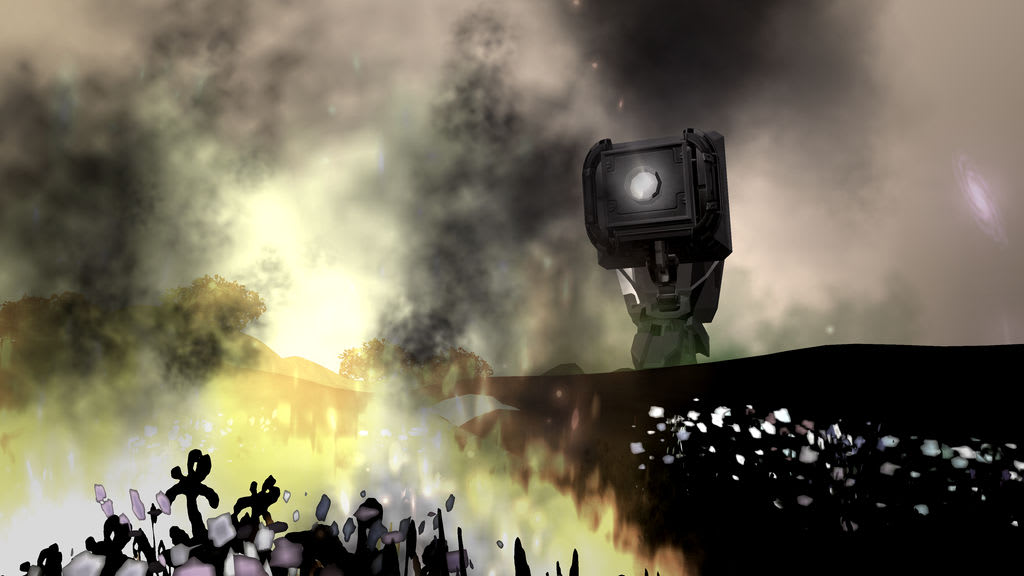
For my own part, I remember nothing of my flight except the stress of
blundering against trees and stumbling through the heather. All about me
gathered the invisible terrors of the Martians; that pitiless sword of heat seemed
whirling to and fro, flourishing overhead before it descended and smote me out
of life. I came into the road between the crossroads and Horsell, and ran along
this to the crossroads.
At last I could go no further; I was exhausted with the violence of my emotion
and of my flight, and I staggered and fell by the wayside. That was near the
bridge that crosses the canal by the gasworks. I fell and lay still.
I must have remained there some time.
I sat up, strangely perplexed. For a moment, perhaps, I could not clearly
understand how I came there. My terror had fallen from me like a garment. My
hat had gone, and my collar had burst away from its fastener. A few minutes
before, there had only been three real things before me—the immensity of the
night and space and nature, my own feebleness and anguish, and the near
approach of death. Now it was as if something turned over, and the point of view
altered abruptly. There was no sensible transition from one state of mind to the
other. I was immediately the self of every day again—a decent, ordinary citizen.
The silent common, the impulse of my flight, the starting flames, were as if they
had been in a dream. I asked myself had these latter things indeed happened? I
could not credit it.
I rose and walked unsteadily up the steep incline of the bridge. My mind was
blank wonder. My muscles and nerves seemed drained of their strength. I dare
say I staggered drunkenly. A head rose over the arch, and the figure of a
workman carrying a basket appeared. Beside him ran a little boy. He passed me,
wishing me good night. I was minded to speak to him, but did not. I answered
his greeting with a meaningless mumble and went on over the bridge.
Over the Maybury arch a train, a billowing tumult of white, firelit smoke, and
a long caterpillar of lighted windows, went flying south—clatter, clatter, clap,
rap, and it had gone. A dim group of people talked in the gate of one of the houses in the pretty little row of gables that was called Oriental Terrace. It was
all so real and so familiar. And that behind me! It was frantic, fantastic! Such
things, I told myself, could not be.
Perhaps I am a man of exceptional moods. I do not know how far my
experience is common. At times I suffer from the strangest sense of detachment
from myself and the world about me; I seem to watch it all from the outside,
from somewhere inconceivably remote, out of time, out of space, out of the
stress and tragedy of it all. This feeling was very strong upon me that night. Here
was another side to my dream.
But the trouble was the blank incongruity of this serenity and the swift death
flying yonder, not two miles away. There was a noise of business from the
gasworks, and the electric lamps were all alight. I stopped at the group of people.
“What news from the common?” said I.
There were two men and a woman at the gate.
“Eh?” said one of the men, turning.
“What news from the common?” I said.
“Ain’t yer just been there?” asked the men.
“People seem fair silly about the common,” said the woman over the gate.
“What’s it all abart?”
“Haven’t you heard of the men from Mars?” said I; “the creatures from
Mars?”
“Quite enough,” said the woman over the gate. “Thenks”; and all three of
them laughed.
I felt foolish and angry. I tried and found I could not tell them what I had seen.
They laughed again at my broken sentences.
“You’ll hear more yet,” I said, and went on to my home.
I startled my wife at the doorway, so haggard was I. I went into the dining
room, sat down, drank some wine, and so soon as I could collect myself
sufficiently I told her the things I had seen. The dinner, which was a cold one,
had already been served, and remained neglected on the table while I told my
story.
“There is one thing,” I said, to allay the fears I had aroused; “they are the most
sluggish things I ever saw crawl. They may keep the pit and kill people who
come near them, but they cannot get out of it. . . . But the horror of them!”
“Don’t, dear!” said my wife, knitting her brows and putting her hand on mine.
“Poor Ogilvy!” I said. “To think he may be lying dead there!”
My wife at least did not find my experience incredible. When I saw how
deadly white her face was, I ceased abruptly.
“They may come here,” she said again and again.
I pressed her to take wine, and tried to reassure her.
“They can scarcely move,” I said.
I began to comfort her and myself by repeating all that Ogilvy had told me of
the impossibility of the Martians establishing themselves on the earth. In
particular I laid stress on the gravitational difficulty. On the surface of the earth
the force of gravity is three times what it is on the surface of Mars. A Martian,
therefore, would weigh three times more than on Mars, albeit his muscular
strength would be the same. His own body would be a cope of lead to him,
therefore. That, indeed, was the general opinion. Both The Times and the Daily
Telegraph, for instance, insisted on it the next morning, and both overlooked,
just as I did, two obvious modifying influences.
The atmosphere of the earth, we now know, contains far more oxygen or far
less argon (whichever way one likes to put it) than does Mars’. The invigorating
influences of this excess of oxygen upon the Martians indisputably did much to
counterbalance the increased weight of their bodies. And, in the second place,
we all overlooked the fact that such mechanical intelligence as the Martian
possessed was quite able to dispense with muscular exertion at a pinch.
But I did not consider these points at the time, and so my reasoning was dead
against the chances of the invaders. With wine and food, the confidence of my
own table, and the necessity of reassuring my wife, I grew by insensible degrees
courageous and secure.
“They have done a foolish thing,” said I, fingering my wineglass. “They are
dangerous because, no doubt, they are mad with terror. Perhaps they expected to
find no living things—certainly no intelligent living things.”
“A shell in the pit,” said I, “if the worst comes to the worst, will kill them all.”
The intense excitement of the events had no doubt left my perceptive powers
in a state of erethism. I remember that dinner table with extraordinary vividness
even now. My dear wife’s sweet anxious face peering at me from under the pink
lamp shade, the white cloth with its silver and glass table furniture—for in those
days even philosophical writers had many little luxuries—the crimson-purple
wine in my glass, are photographically distinct. At the end of it I sat, tempering
nuts with a cigarette, regretting Ogilvy’s rashness, and denouncing the short sighted timidity of the Martians.
So some respectable dodo in the Mauritius might have lorded it in his nest,
and discussed the arrival of that shipful of pitiless sailors in want of animal food.
“We will peck them to death tomorrow, my dear.”
I did not know it, but that was the last civilised dinner I was to eat for very
many strange and terrible days.
About the Creator
Daily RunTwo
ws | Entertainment |Meme | Bsiness | Make Money | Health & Fitness
Keep reading
More stories from Daily RunTwo and writers in Fiction and other communities.
"Hear Me Out"
"Hear me out, what if we ran away together?" "Where do you want to go?" "Anywhere but here. We could move to a new city or to Canada, or we could disappear from society to live in the middle of the woods. Maybe a combination of two of those things would be good. What do you say?"
By Kay Husnick6 days ago in Fiction



Comments
There are no comments for this story
Be the first to respond and start the conversation.