
The World 100 Million Years Ago
When Giants Ruled the Earth

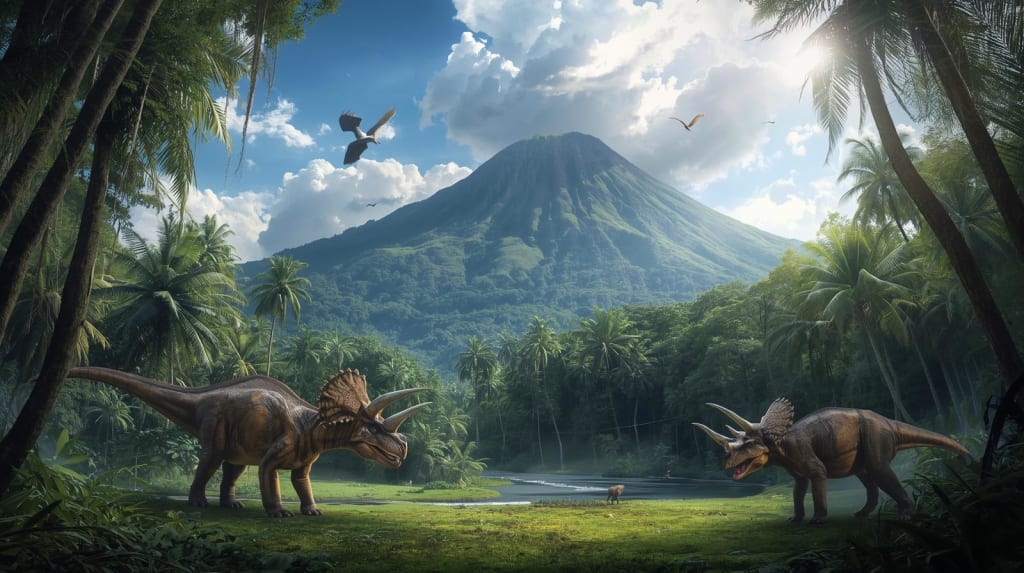
Imagine standing on Earth 100 million years ago. The world was almost unrecognizable. There were no humans, no cities, no continents shaped the way we see them now. The air was thicker, the temperature much warmer, and the planet was alive with creatures so large and strange that today they feel almost mythical.
During this time — known as the Cretaceous Period — dinosaurs ruled every corner of the planet. Towering trees covered vast jungles, and giant ferns grew beside volcanic plains. The continents were still slowly drifting apart, forming the shapes of North America, Africa, and Asia as we know them today.
The oceans were teeming with life. Massive reptiles like Mosasaurus and Plesiosaurus hunted beneath the waves, while strange fish and ammonites drifted near the surface. The sea level was so high that much of the land we know now was underwater. If you stood where Kansas is today, you might have been swimming with ancient sea monsters.
On land, Tyrannosaurus rex was not yet the king — but other massive predators, like Giganotosaurus and Spinosaurus, stalked the forests. Herds of duck-billed dinosaurs wandered the plains, while flying reptiles — Pteranodons with wingspans wider than a car — soared above.
Plants were evolving too. This was the era when flowers first appeared. Before that, the world was green but not colorful. Once flowers emerged, the planet began to bloom — literally. This change would forever alter the course of life on Earth, giving rise to new species of insects and animals that depended on nectar and pollen.
The climate was warm and humid, even near the poles. Antarctica was covered not in ice, but in forests filled with ferns and conifer trees. Dinosaurs roamed there too, adapted to months of light and darkness.
Then, about 66 million years ago, everything changed. A massive asteroid — over six miles wide — struck Earth near what is now the Yucatán Peninsula in Mexico. The explosion was millions of times more powerful than any human-made bomb. It caused massive wildfires, earthquakes, and a global winter that blocked sunlight for years.
Most dinosaurs didn’t survive this catastrophe. But not everything died. Small mammals — tiny, shrew-like creatures — managed to survive underground. From them, millions of years later, came primates… and eventually, us.
So, the next time you look up at the stars or walk through a forest, remember — this world has seen ages of change, giants walking, and entire species rising and vanishing. The Earth you stand on today is the result of a billion years of creation, destruction, and rebirth.
About the Creator
Shohel Rana
As a professional article writer for Vocal Media, I craft engaging, high-quality content tailored to diverse audiences. My expertise ensures well-researched, compelling articles that inform, inspire, and captivate readers effectively.
Keep reading
More stories from Shohel Rana and writers in Fiction and other communities.
The Lost Colony of Roanoke: America’s Oldest Unsolved Mystery
“When they returned, the colony was gone. No bodies. No survivors. Only one word carved into a wooden post: CROATOAN.” In the summer of 1587, a group of 117 English men, women, and children set sail across the Atlantic, dreaming of a new life in the New World. Led by John White, they arrived on Roanoke Island, off the coast of present-day North Carolina. It was England’s first attempt at establishing a permanent settlement in America—a bold step toward expanding its empire across the ocean. But what began as a hopeful venture would soon become one of the greatest mysteries in history.
By Shohel Rana5 months ago in Fiction
Becca
"Everything is so... flat." Denille said stupidly as she looked around her new neighborhood. She looked around at the muted desert where even the smallest sign of life seemed to have given up. The plant life was shrubs that were half cooked by the heat and where there should have been a lawn, a mess of white rocks laid glistening in the sun. Even the sky looked stretched thin, like the sun had ironed it smooth. She’d moved from Riverside, where at least there were hills, but here in Barstow, everything felt baked and brittle.
By Sara Wilson4 days ago in Fiction
Guard Your Battery, Lose Your Humanity
I used to think my phone was my lifeline. In Amsterdam, where rain slicks the cobblestones and bikes fly by like they're late for something important, my screen was the one constant: notifications buzzing through tram rides, endless scrolls while waiting for koffie at a brown café, quick checks at red lights on the Keizersgracht. It felt safe. Controlled. Connected. Until it didn't. By early 2026, I was exhausted in a way sleep couldn't fix. My anxiety had crept up quietly — heart racing in crowds, that low hum of dread when the battery dipped below 20%. I blamed the city, the weather, work. But deep down, I knew the truth: I'd outsourced my presence to a rectangle in my pocket. I was here, but never really here. So on a drizzly February morning, I made a rule that felt ridiculous: no phone in public for 30 days. Pocket, bag, or leave it at home — but never in hand when outside my apartment. If I needed directions or music, tough. The goal wasn't total detox; it was forcing myself to look up, be bored, and — if the moment felt right — talk to someone. One stranger conversation a day if it happened naturally. No forcing, just availability. What broke first was the fidgeting. Days 1–10: The Withdrawal Hits Hard The first week was brutal. At the Albert Cuyp Market, my hand kept reaching for my pocket like a phantom limb. Without the screen to hide behind, every line felt exposed. I noticed things I'd ignored for years: the way an old man feeds pigeons near the Nieuwmarkt, the precise rhythm of bike bells, the smell of fresh stroopwafels mixing with canal water. I also noticed people. Everyone else was doing what I'd been doing — heads down, thumbs moving. On the 2 tram toward Centraal, a carriage full of silent faces lit by blue light. No one spoke. No one looked up. It hit me: we're all in our own little bubbles, floating through the same beautiful city. By day 5, boredom turned into restlessness. Waiting for coffee at a spot on the Prinsengracht, I had nothing to do but watch. A woman in a red coat struggled with her umbrella in the wind. Our eyes met. She laughed first. "This weather," she said. I replied, "It builds character, right?" We chatted for two minutes about nothing — the rain, the best waterproof jackets. It felt awkward, electric, alive. That tiny exchange cracked something open. My anxiety didn't vanish, but it lost its grip for a moment. Days 11–20: The City Starts Talking Back Halfway through, the experiment shifted from punishment to curiosity.
By Shoaib Afridi4 days ago in Fiction


Comments
There are no comments for this story
Be the first to respond and start the conversation.