
The Lost Colony of Roanoke: America’s Oldest Unsolved Mystery
The Lost Colony of Roanoke

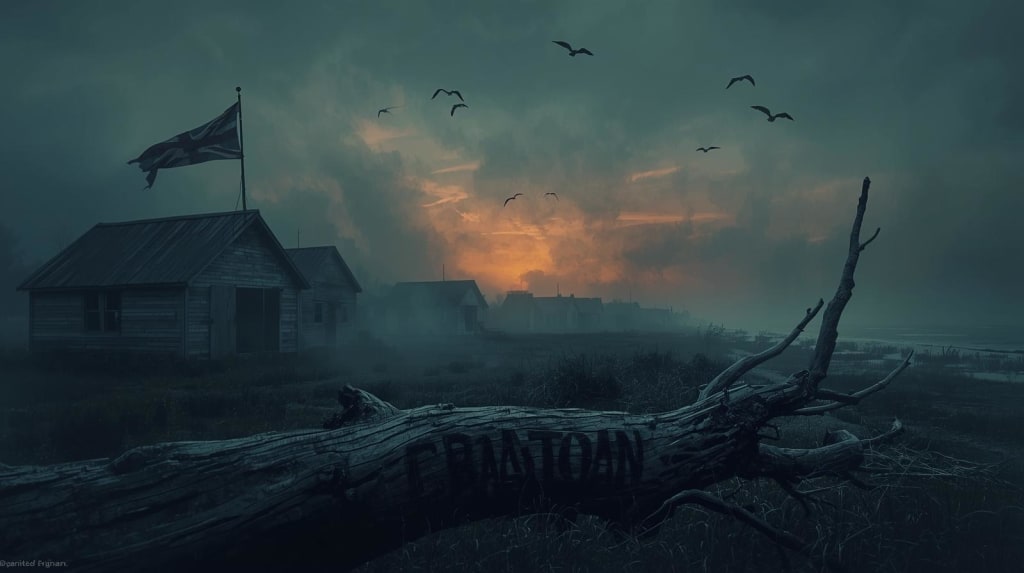
“When they returned, the colony was gone. No bodies. No survivors. Only one word carved into a wooden post: CROATOAN.”
In the summer of 1587, a group of 117 English men, women, and children set sail across the Atlantic, dreaming of a new life in the New World. Led by John White, they arrived on Roanoke Island, off the coast of present-day North Carolina. It was England’s first attempt at establishing a permanent settlement in America—a bold step toward expanding its empire across the ocean. But what began as a hopeful venture would soon become one of the greatest mysteries in history.
At first, the settlers were filled with excitement. The island was green and fertile, the sea brimming with fish, and the forests alive with birds. They built homes, planted crops, and prepared for their new lives. But beneath the beauty of Roanoke lay danger—hostile weather, limited supplies, and tension with local Native American tribes. The settlers had no idea just how fragile their dream truly was.
John White, the colony’s governor, realized they would need more provisions if they were to survive. In August 1587, he decided to return to England to gather food, tools, and reinforcements. Leaving behind his family—including his daughter Eleanor Dare and his newborn granddaughter, Virginia Dare, the first English child born in America—he promised to come back within months. But fate had other plans.
When White reached England, his country was in chaos. Spain had launched its mighty Armada against England, and every available ship was seized for war. For three long years, John White pleaded for permission to return, but the seas were controlled by battle and storms. Only in 1590 was he finally able to make the voyage back to Roanoke.
He arrived on a foggy August morning, his heart pounding with both hope and dread. As his ship neared the shore, the colony looked eerily still. No one came to greet him. The fort stood silent, its walls weathered and half-broken. The sound of gulls echoed over the empty beach. White and his men stepped ashore, searching for any sign of life.
What they found was chilling.
There were no graves, no bones, no sign of struggle. Houses had been carefully dismantled—as if the settlers had packed up and left willingly. But one clue stood out: carved into a wooden post was the word “CROATOAN.” On another tree, the letters “CRO” were etched deep into the bark. It was the only message left behind.
White immediately thought of Croatoan Island, home to a friendly Native American tribe located about fifty miles away. He believed the colonists had moved there for safety. But before he could investigate, a fierce storm forced his ship back out to sea. He never returned. And no one ever saw the lost colonists again.
Over the centuries, countless theories have tried to explain what happened. Some believe the settlers were attacked and killed by hostile tribes. Others suggest they starved, moved inland, or tried to sail back to England on their own and perished at sea. A few historians think they were absorbed into Native American communities, their descendants blending into local tribes over generations.
Archaeologists have found tantalizing clues but no definitive answers. Broken pottery from the Elizabethan era has been discovered on nearby islands, suggesting the colonists may have relocated. Oral traditions among some Native American groups mention pale-skinned ancestors with strange customs and English-style tools. Yet, despite decades of digging and research, the mystery remains unsolved.
One haunting possibility is that the settlers split up—some going inland, others to Croatoan Island. Without strong leadership and constant threats from hunger and conflict, they may have been scattered or assimilated, leaving behind no trace of their original colony. What makes the mystery so compelling is not just the disappearance itself, but the silence that followed. No survivor accounts. No wreckage. Just that single carved word.
Even today, “CROATOAN” echoes through American folklore like a ghostly whisper. It has appeared in horror stories, television shows, and even carved mysteriously into objects linked to strange deaths—fueling the legend that the word itself carries a curse. The idea of an entire community vanishing without a trace, leaving only a cryptic message, captures the imagination in a way few other mysteries can.
John White died in England, heartbroken, never knowing the fate of his daughter and granddaughter. Virginia Dare’s name became a symbol of innocence lost—a reminder of how fragile the dream of the New World truly was. Some poets later romanticized her as a spirit of America’s beginnings, wandering the woods of Roanoke, searching for her family.
Modern technology has renewed efforts to solve the puzzle. DNA analysis, satellite mapping, and new archaeological digs continue to shed light on fragments of evidence. In 2020, researchers uncovered signs of English artifacts far inland from Roanoke, near sites once inhabited by Native Americans. These findings suggest the settlers may indeed have merged with local tribes, creating one of the earliest cultural exchanges in North America.
Yet, the mystery endures because no single explanation fits all the facts. The settlers’ disappearance remains a haunting symbol of both ambition and uncertainty—of humanity’s desire to explore, and the peril that comes when dreams outpace preparation.
Roanoke was the first English attempt at colonization, but it failed utterly. And in that failure lies a deeper lesson: that survival in a new world requires more than courage—it demands cooperation, respect, and understanding between cultures. Later colonies, like Jamestown and Plymouth, would learn from Roanoke’s mistakes, paving the way for the birth of a new nation.
Four centuries later, Roanoke still holds its secrets beneath the Carolina sands. Perhaps someday, technology will uncover the final truth. Or perhaps, like so many legends, it will remain forever lost—echoing through time as the story of the Lost Colony, where the first whispers of America began.
About the Creator
Shohel Rana
As a professional article writer for Vocal Media, I craft engaging, high-quality content tailored to diverse audiences. My expertise ensures well-researched, compelling articles that inform, inspire, and captivate readers effectively.
Keep reading
More stories from Shohel Rana and writers in Fiction and other communities.
The Forgotten Empire: The Rise and Fall of Mesopotamia
When we think about human history, we often picture grand empires like Rome, Persia, or Egypt. But long before them, a land between two rivers—the Tigris and Euphrates—birthed something far more profound: the first organized civilization known to mankind—Mesopotamia.
By Shohel Rana3 months ago in Fiction
Miss Persephone's Manual to a Seemingly Ordinary Life
Miss Persephone was found at the dining table, her blue eyes swollen, her tears arriving and retreating like the tides of the ocean. Earlier that day, her family had visited her in the retirement home where she had lived for eight years. It was her eightieth birthday.
By Imola Tóth3 days ago in Fiction
The Sparkle of Fate on the Mountain Slope
Lina was a young girl who lived in a small village near the mountains. Her village was quiet and peaceful, surrounded by green fields and tall trees. The mountains stood behind the village like silent guardians. Lina loved those mountains more than anything else. She often dreamed that one day they would change her life.
By Bilal Mohammadi7 days ago in Fiction


Comments
There are no comments for this story
Be the first to respond and start the conversation.