
The Whispering Violin
A melody of peace in the heart of war

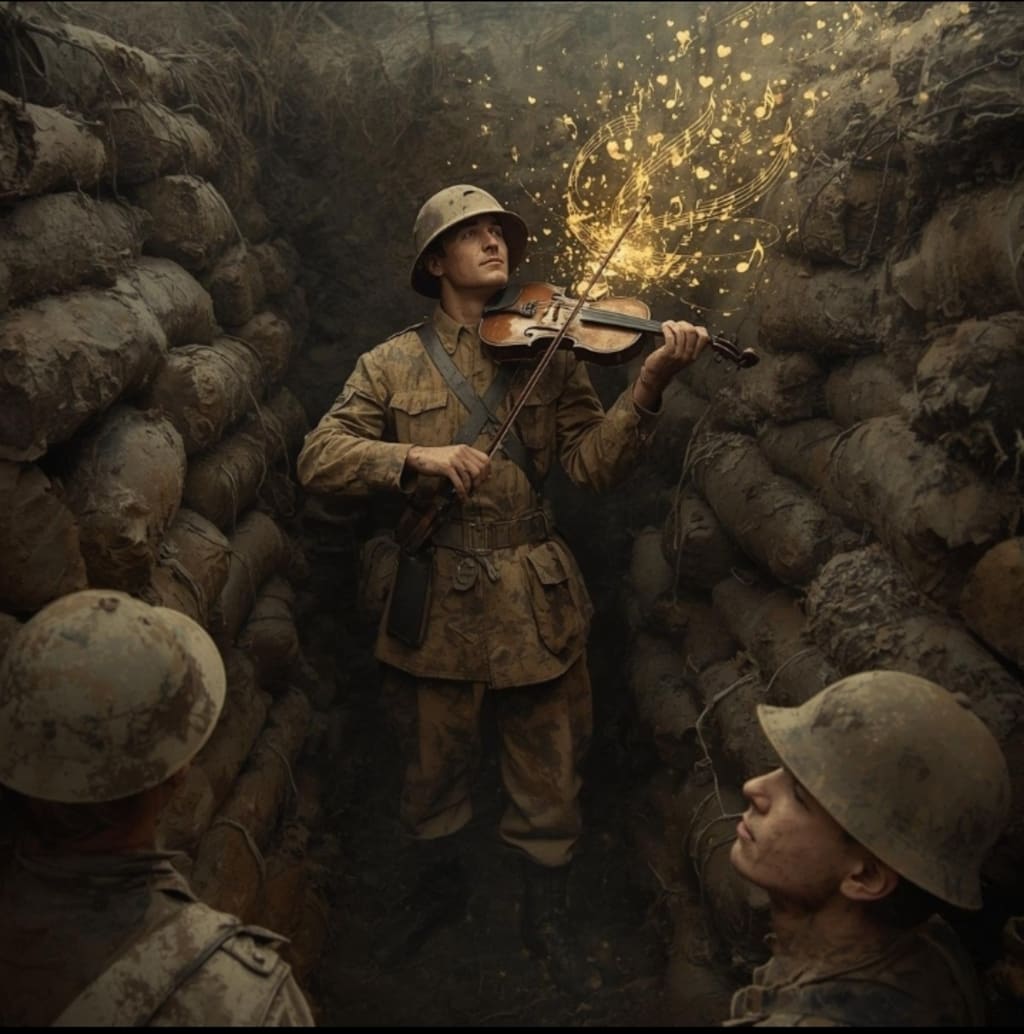
The mud was endless. It clung to boots, swallowed rifles, and painted every soldier the same shade of gray-brown. The Somme front had become a wasteland where men vanished into the earth as quickly as they appeared, consumed by smoke and shellfire.
Private Elias Moreau crouched low in the trench, his back against the cold sandbags. His unit, the 78th Infantry, had lost more men than he cared to count that week. But despite the roar of artillery above, Elias carried something precious, something fragile, wrapped carefully in oilcloth: a violin.
Before the war, Elias had been a concert musician in Paris. He had played in great halls with chandeliers glittering overhead, his bow gliding across strings while the audience held its breath. He remembered those nights with an ache that went deeper than hunger. Now, his violin was scratched, battered from travel, but still alive.
One evening, when the guns fell silent for the first time in days, the men of his unit slumped into a kind of exhausted quiet. Some lit cigarettes with trembling hands; others stared blankly into the dark. Elias felt the weight of his violin under his coat. His fingers itched.
“Go on, Moreau,” muttered Sergeant Lavigne, a scarred man who had once scoffed at Elias’s “toy.” “Play us something. Remind us we’re still human.”
Elias hesitated. Music here, in this graveyard of mud? But then he pulled out the violin, tuned it quickly, and lifted the bow. The first notes were soft, almost uncertain, like a bird testing its wings. Slowly, the melody gre something gentle, not triumphant, not martial, but tender. A lullaby for men who hadn’t slept peacefully in weeks.
The trench changed. Heads lifted. Cigarettes burned down, forgotten. For a moment, the war receded, replaced by sound that seemed to come from another world.
And then something remarkable.
From across the barbed wire, faint and wavering, came an answering sound: a harmonica. The Germans were playing back.
Elias froze, bow hovering mid-air. Every French soldier tensed. Was it a trick? But the harmonica’s tune was simple, plaintive, unmistakably human. Slowly, Elias raised his violin again, and the two instruments began to weave together.
A hush fell over the battlefield. Enemies who had been killing each other hours earlier now listened as music threaded across no man’s land. It was not French or German it was something older, deeper. A language without borders.
The soldiers on both sides leaned against their sandbags, heads tilted to the night sky, listening. Some closed their eyes. Others wept quietly, ashamed and unashamed all at once.
When the last note faded, the silence that followed was profound. No shot was fired. No order was shouted. Just the heavy, stunned breathing of men who had remembered they were not machines, but human beings.
Elias lowered his violin, hands trembling. Sergeant Lavigne gave a rough laugh and wiped his eyes with the back of his sleeve. “Well, Moreau,” he said hoarsely, “you’ve done what the generals never could you made the Germans stop shooting.”
Word of the night spread quickly. Men called Elias “The Whispering Violinist.” Some said his music was luck, that it saved their lives. Others swore the violin carried a kind of magic. Elias never claimed such things. He only knew that for one fragile evening, the sound of strings and breath had silenced the thunder of war.
The next day, the guns roared again. The dead returned to the mud. But something lingered in the hearts of those who had heard. Even years later, men from both sides remembered the night when music built a bridge over the chasm of hate.
And Elias? He survived the war. When he returned to Paris, he played his violin once more in golden halls. But the piece audiences begged for, the one that moved them most, was not from Mozart or Debussy. It was the melody he had played in the trenches the whisper of peace born in the heart of destruction.
About the Creator
Keep reading
More stories from MUHAMMAD UMAIR KHAN and writers in Fiction and other communities.
The Village of Kind Hearts
The Village of Kind Hearts A Small Village Long ago, there was a small village between green hills. The houses were made of wood and stone. The people were not rich, but they lived close to each other like one family. Everyone knew each other by name. If one person had a problem, all the others tried to help.
By MUHAMMAD UMAIR KHAN4 months ago in Humans




Comments
There are no comments for this story
Be the first to respond and start the conversation.